Every year, workers are injured or killed by gas hazards they never saw coming because the most dangerous gases in industry are invisible, and many are odorless too.
Gas detection exists to give people what their senses can’t: an early warning before an atmosphere becomes explosive, toxic, or oxygen-deficient.
If you’re new to industrial safety, responsible for a facility, or just trying to understand what that beeping monitor on a technician’s chest actually does, this guide covers the gas detection basics you need to know.
We’ll walk through the three major gas-hazard categories, how the main sensor technologies work, what terms like LEL and PPM mean, the difference between fixed and portable systems, and the maintenance practices that keep detectors reliable.
Why Gas Detection Matters
Human senses are unreliable gas detectors. Carbon monoxide is completely odorless. Hydrogen sulfide has a strong rotten-egg smell at low concentrations.
Still, at dangerous levels it paralyzes your sense of smell within minutes, a phenomenon called olfactory fatigue that has killed workers who assumed the gas had dissipated.
Methane is odorless in its natural state. And an oxygen-deficient atmosphere gives almost no warning at all before you lose consciousness.
Gas detection instruments measure the actual concentration of gases in the air and alarm before those concentrations reach dangerous levels.
They protect against three fundamentally different types of hazard, and understanding these three categories is the foundation of everything else in gas detection.
The Three Types of Gas Hazards
Combustible (Flammable) Gas Hazards
Flammable gases like methane, propane, hydrogen, and gasoline vapors become explosive when they mix with air in the right proportions.
Every flammable gas has a Lower Explosive Limit (LEL), the minimum concentration in air at which it can ignite, and an Upper Explosive Limit (UEL), above which the mixture is too rich to burn.
For methane, the LEL is about 5% by volume in air. Gas detectors don’t wait until you reach that point.
Combustible gas monitors typically alarm at 10% of the LEL for methane, which is just 0.5% gas by volume, giving workers a wide safety margin before the atmosphere becomes genuinely explosive.
How to Choose the Right LEL Gas Detector
Toxic Gas Hazards
Toxic gases harm the body at concentrations far below any explosive threshold, which is why they’re measured in parts per million (ppm) rather than percent. Common industrial toxic gases include the following:
Carbon monoxide (CO)
Produced by combustion engines, furnaces, and incomplete burning. Binds to hemoglobin and starves the body of oxygen.
Hydrogen sulfide (H₂S)
Common in oil and gas, wastewater, and agriculture. Deadly at 100+ ppm; deadens your sense of smell well before that.
Ammonia (NH₃)
Used in industrial refrigeration and fertilizer production.
Chlorine (Cl₂)
Water treatment and chemical processing.
Sulfur dioxide (SO₂)
Smelting, combustion of sulfur-containing fuels.
Exposure limits for toxic gases are defined by regulatory and advisory bodies. You’ll see terms like TWA (time-weighted average over an 8-hour shift), STEL (short-term exposure limit, usually 15 minutes), and IDLH (immediately dangerous to life or health). Toxic gas monitors alarm when concentrations approach these limits.
Oxygen Hazards
Normal air contains 20.9% oxygen. Anything below 19.5% is considered oxygen-deficient by OSHA, and levels below 16% begin to impair judgment and coordination, often before the victim realizes anything is wrong.
Oxygen deficiency is usually caused by displacement: nitrogen purging, argon welding gas, CO₂ from fermentation, or decomposition in confined spaces all push breathable air out.
Oxygen enrichment (above 23.5%) is also dangerous, because enriched atmospheres make materials ignite more easily and burn far more violently.
This is why the standard confined space monitor always includes an oxygen sensor alongside combustible and toxic gas sensors.
How Gas Detection Sensors Work
Different gases require different sensing technologies. These four cover the vast majority of industrial applications.
Catalytic Bead (Pellistor) Sensors: Combustible Gases
The workhorse of combustible gas detection. A catalytic bead sensor contains a small heated ceramic bead coated with a catalyst.
When flammable gas contacts the bead, it oxidizes (burns) on the surface, raising the bead’s temperature and changing its electrical resistance. That resistance change is proportional to gas concentration.
Strengths
Broad response to most flammable gases, proven technology, and relatively inexpensive.
Limitations
Requires oxygen to function, can be poisoned by silicones and sulfur compounds, and sensors degrade over time, which is why bump testing matters (more on that below).
Electrochemical Sensors: Toxic Gases and Oxygen
Electrochemical cells work like tiny fuel cells. The target gas diffuses into the sensor and undergoes a chemical reaction at an electrode, generating a small electrical current proportional to the gas concentration. Most CO, H₂S, O₂, Cl₂, SO₂, and NH₃ sensors in portable monitors are electrochemical.
Strengths
Excellent sensitivity at ppm levels, low power consumption, gas-specific.
Limitations
Finite lifespan (typically 2–3 years) as the cell chemistry depletes, sensitivity to temperature and humidity extremes, and potential cross-sensitivity (some sensors respond partially to gases other than their target).
Infrared (IR) Sensors: Combustible Gases and CO₂
Infrared sensors measure how much IR light a gas absorbs at specific wavelengths. Hydrocarbons and CO₂ absorb infrared energy in predictable patterns, so the amount of absorption reveals the concentration.
Strengths
No oxygen required, immune to catalytic poisoning, long service life, fail-safe design (a blocked optical path triggers a fault).
Limitations
Higher cost, and IR sensors cannot detect hydrogen, which doesn’t absorb infrared light.
Photoionization Detectors (PID): Volatile Organic Compounds
PIDs use ultraviolet light to ionize gas molecules, producing a measurable current. They excel at detecting volatile organic compounds (VOCs), solvents, fuels, and industrial chemicals at very low ppm or even ppb levels that other sensors would miss entirely.
Strengths
Extremely sensitive to a wide range of VOCs.
Limitations
Non-specific (a PID tells you something is present, not exactly what), and readings must be adjusted with correction factors for specific compounds.
Quick Sensor Comparison
| Sensor Type | Detects | Measurement Range | Typical Lifespan | Key Limitation |
|---|---|---|---|---|
| Catalytic bead | Combustible gases | 0–100% LEL | 3–5 years | Needs O₂; can be poisoned |
| Electrochemical | Toxic gases, O₂ | ppm / % volume | 2–3 years | Cell depletion, cross-sensitivity |
| Infrared | Hydrocarbons, CO₂ | 0–100% LEL / % vol | 5+ years | Can’t detect hydrogen |
| PID | VOCs | ppb–ppm | 1–3 years (lamp) | Non-specific readings |
Fixed vs. Portable Gas Detection: What’s the Difference?
Gas detection systems fall into two broad categories, and most facilities with serious gas hazards need both.
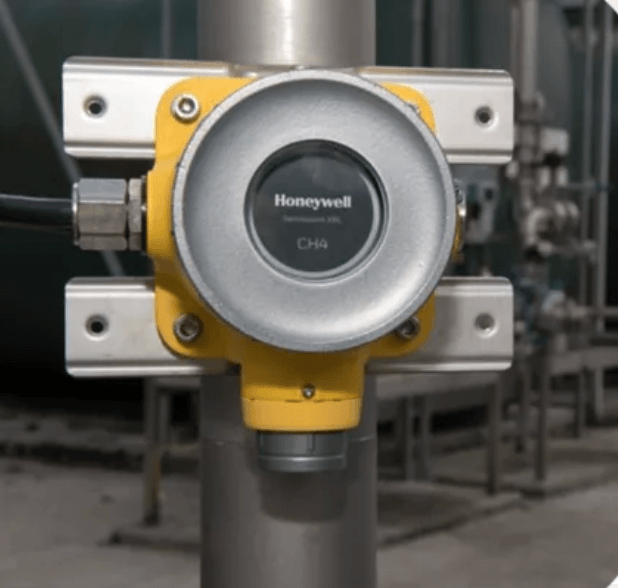
Fixed gas detection systems are permanently installed sensors wired (or wirelessly connected) to a central controller.
They monitor specific locations, such as compressor rooms, chemical storage, and boiler rooms, 24 hours a day, and can automatically trigger alarms, ventilation fans, or process shutdowns. Fixed systems protect places and processes.
Portable gas monitors are worn or carried by workers. The most common configuration is the 4-gas monitor, which measures combustible gases (LEL), oxygen, carbon monoxide, and hydrogen sulfide, the standard package for confined space entry and general industrial work. Portable monitors protect people wherever they go, including areas fixed sensors don’t cover.
A simple way to think about it: fixed systems guard your facility around the clock; portable monitors guard the worker in their immediate breathing zone. They complement each other rather than compete.
Understanding Gas Detector Readings and Alarms
A gas monitor is only useful if you understand what it’s telling you. The essentials:
%LEL
Combustible gas readings displayed as a percentage of the lower explosive limit, not a percentage of gas in air.
A reading of 10% LEL for methane means the atmosphere contains 0.5% methane (10% of methane’s 5% LEL). Typical alarm setpoints: low alarm at 10% LEL, high alarm at 20% LEL.
PPM
Parts per million, used for toxic gases. For reference, 1% by volume equals 10,000 ppm. Typical CO alarms are set around 35 ppm (low) and 200 ppm (high); H₂S around 10 ppm and 15 ppm.
%O₂
Oxygen is displayed as a percentage by volume. Alarms typically at 19.5% (deficiency) and 23.5% (enrichment).
Modern monitors also log TWA and STEL values, tracking cumulative exposure across a shift, critical for demonstrating regulatory compliance and protecting workers from chronic low-level exposure that never triggers an instantaneous alarm.
Calibration and Bump Testing: The Basics of Detector Maintenance
A gas detector that hasn’t been verified is a false sense of security clipped to your shirt. Two maintenance practices keep detectors honest:
Bump testing is a quick functional check: expose the monitor to a known concentration of test gas and confirm the sensors respond and alarms activate.
It doesn’t adjust anything; it simply proves the instrument works. Industry best practice (and ISEA guidance) is to bump test portable monitors before each day’s use.
Calibration goes further: the instrument’s response is adjusted to match a certified concentration of calibration gas, correcting for sensor drift.
Full calibration is typically performed monthly, or per the manufacturer’s schedule, and always after a failed bump test.
Skipping these steps is one of the most common and most dangerous failures in gas detection programs.
Sensors drift, get poisoned, and degrade silently. The instrument will still power on and display comforting zeros right up until the moment it fails to warn you.
Regulatory Framework: Who Requires Gas Detection?
In the United States, several OSHA standards drive gas detection requirements.
29 CFR 1910.146 (Permit-Required Confined Spaces)
It requires atmospheric testing for oxygen, combustible gases, and toxic contaminants before and during confined space entry, in that specific order.
29 CFR 1910.1000
It establishes permissible exposure limits (PELs) for hundreds of air contaminants.
Substance-specific standards
Gases like hydrogen sulfide and formaldehyde have their own detailed requirements.
Beyond OSHA, standards from NFPA, ANSI/ISEA, and international bodies like IEC 60079-29 govern detector performance, placement, and maintenance.
If your facility handles flammable or toxic gases, some combination of these almost certainly applies to you.
Common Beginner Mistakes in Gas Detection
Trusting your nose
Olfactory fatigue, odorless gases, and adaptation make human smell worthless as a safety system.
Skipping bump tests
A monitor that hasn’t been verified today is an assumption, not a safeguard.
Ignoring sensor placement
Heavier-than-air gases (propane, H₂S) accumulate low; lighter gases (methane, hydrogen) rise. Fixed sensors mounted at the wrong height can miss a leak entirely.
Using the wrong sensor for the environment
Catalytic bead sensors in oxygen-deficient inert atmospheres will read zero even in pure methane.
Ignoring cross-sensitivity
An unexpected reading on one sensor may actually be caused by a different gas. Know your monitor’s cross-sensitivity table.
Treating alarms as nuisances
Alarm fatigue, silencing or ignoring alarms is a documented factor in serious incidents.
Frequently Asked Questions
What are the basics of gas detection?
Gas detection uses sensors to measure combustible gases, toxic gases, and oxygen levels in the air, alarming before concentrations reach dangerous thresholds.
The fundamentals include understanding the three hazard types, the sensor technologies that detect them, alarm setpoints like 10% LEL, and regular bump testing and calibration.
What is the difference between LEL and PPM?
%LEL measures combustible gas as a percentage of its lower explosive limit, an explosion-hazard scale.
PPM (parts per million) measures much smaller concentrations and is used for toxic gases, where health effects occur far below explosive levels.
What four gases does a standard multi-gas monitor detect?
The standard 4-gas monitor detects combustible gases (as %LEL), oxygen, carbon monoxide, and hydrogen sulfide, the four most common atmospheric hazards in industrial and confined space work.
How often should a gas detector be calibrated?
Best practice is a bump test before each day’s use and full calibration monthly or per the manufacturer’s recommendation. Any monitor that fails a bump test must be fully calibrated before it returns to service.
Can I rely on my sense of smell to detect gas leaks?
No. Carbon monoxide and methane are odorless, and hydrogen sulfide paralyzes your sense of smell at dangerous concentrations. Only calibrated instruments can reliably confirm whether an atmosphere is safe.
Building on the Basics
Gas detection isn’t complicated at its core: know your hazards, match the right sensor technology to each one, set appropriate alarm levels, and verify your instruments regularly.
But the details of sensor selection, placement, calibration programs, and regulatory compliance are where safety programs succeed or fail.
From here, a good next step is learning about multi-gas monitor sensor selection, the differences between fixed and portable gas detection systems, and proper bump testing and calibration procedures.
At SafeguardSense, we break down industrial gas detection topics with practitioner-level depth so safety managers, technicians, and facility owners can make informed decisions. Explore our guides or contact us with your gas detection questions.
This article is for informational purposes only and does not replace site-specific hazard assessments, manufacturer instructions, or applicable regulations. Always consult qualified safety professionals for your facility’s gas detection program.