Water treatment keeps communities alive, but the same processes that clean our water can quietly generate some of the deadliest gases workers ever encounter.
Hydrogen sulfide, methane, chlorine, and oxygen-deficient atmospheres all lurk in wet wells, digesters, and confined spaces, and most give little or no warning before they incapacitate someone.
Gas detection technology has come a long way, with smarter sensors, better data logging, and rugged portable monitors that clip to a belt.
Yet none of that matters if the wrong system is installed, the sensors drift out of calibration, or a worker trusts their nose instead of a meter.
Gas detection isn’t a nice-to-have in water and wastewater treatment; it’s the layer of protection standing between a routine shift and a fatality.
This guide breaks down which gases threaten water treatment facilities, why hydrogen sulfide deserves special respect, and how to choose and maintain a gas detection system that actually keeps your team safe.
The gases that threaten water treatment facilities
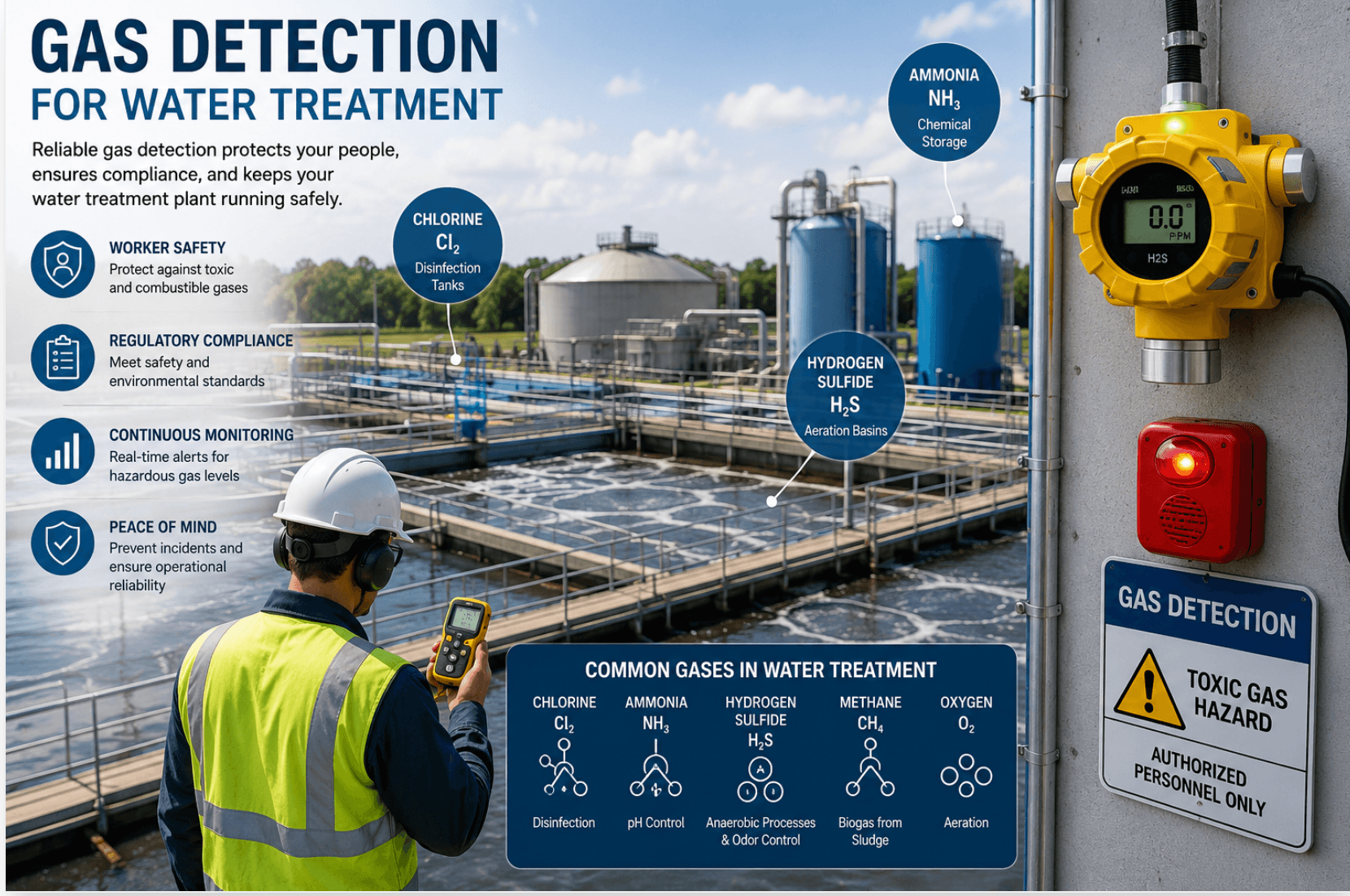
Water treatment doesn’t produce a single hazard; it produces a shifting cocktail of them, depending on the process stage and whether an area is enclosed. The main offenders are the following:
Hydrogen sulfide (H₂S)
The most common and most lethal gas in wastewater environments. Colorless, flammable, and heavier than air, so it pools in low-lying and confined spaces.
Methane (CH₄)
A byproduct of anaerobic digestion. It’s flammable and, in high concentrations, displaces oxygen. Monitored on the %LEL scale.
Chlorine (Cl₂)
Used as a disinfectant. Toxic and corrosive even at low concentrations, with a sharp, irritating odor.
Carbon dioxide (CO₂) and oxygen deficiency
Biological activity and displacement by other gases can drop oxygen below the safe 19.5% threshold, causing asphyxiation with no warning.
Ammonia (NH₃)
Present in some treatment streams and used in certain disinfection processes; toxic and pungent.
A single portable monitor set up only for one gas can leave a worker blind to the others. That’s why multi-gas detection, typically H₂S, LEL (combustibles), oxygen, and carbon monoxide as a four-gas baseline, is the standard for anyone entering a treatment area or confined space.
Why hydrogen sulfide is the silent killer
Hydrogen sulfide earns its reputation. It’s a colorless, flammable gas with the unmistakable “rotten egg” smell at low concentrations, and that smell is exactly what makes it so dangerous, because you cannot trust it.
Where H₂S actually comes from
Contrary to a common misconception, chlorine does not create hydrogen sulfide in water treatment.
It’s the opposite. H₂S is produced biologically: sulfate-reducing bacteria (SRB) break down organic matter under anaerobic (oxygen-free) conditions and convert sulfate compounds into hydrogen sulfide.
This happens wherever wastewater goes stagnant, such as septic lift stations, force mains, wet wells, gravity sewers with low flow, and anaerobic digesters.
Chlorine is an oxidizer that facilities actually use to help control sulfide and odor, not a source of it.
Because H₂S is heavier than air, it accumulates in exactly the places workers are asked to enter: manholes, sumps, tanks, and utility vaults.
That combination, biologically generated, invisible, and concentrated in confined spaces is why H₂S is one of the leading causes of occupational fatalities in the wastewater industry.
Why you can never trust your nose
At low levels, H₂S smells strongly. But within minutes of exposure to higher concentrations, olfactory fatigue sets in; the gas deadens your sense of smell, so it seems to “disappear” even as the concentration climbs.
OSHA is explicit on this point: smell must never be used to gauge the presence or safety of hydrogen sulfide.
A worker who thinks the danger has passed because the odor faded may actually be standing in a lethal atmosphere.
H₂S health effects by concentration
The following figures are drawn from OSHA and NIOSH guidance. They illustrate how quickly the margin for error vanishes.
| Concentration (ppm) | Effect on the body |
|---|---|
| 0.02 | Odor threshold detectable “rotten egg” smell |
| 20 (OSHA PEL ceiling) | Ceiling limit not to be exceeded; irritation to eyes, nose, throat |
| 50 (OSHA peak) | Permitted only up to 10 minutes with no other exposure; increasing irritation |
| ~100 (NIOSH IDLH) | Immediately Dangerous to Life or Health; olfactory fatigue (loss of smell) within minutes |
| 500–700 | Staggering, collapse within minutes; death possible in 30–60 minutes |
| 700+ | “Knockdown”, collapse and loss of consciousness within one or two breaths; rapid death |
Note
OSHA’s construction and shipyard standards apply an even stricter 8-hour limit of 10 ppm. Always confirm the exposure limits that apply to your specific operation and jurisdiction.
What to do if you suspect an H₂S release
If gas alarms sound or you suspect a dangerous atmosphere:
Evacuate immediately
Move upwind and to higher ground, since H₂S settles low. Do not stop to investigate.
Never enter to rescue without protection
A huge share of H₂S deaths are of would-be rescuers who collapse alongside the first victim. Entry requires SCBA or supplied-air respirators and a trained standby team.
Account for everyone and call emergency services
Report a hydrogen sulfide exposure so responders arrive equipped for a toxic atmosphere.
Ventilate before re-entry
Ventilate before re-entry and confirm safe readings with a calibrated monitor before anyone goes back in.
Unlike a natural-gas leak, there’s no external “gas supply” to shut off — H₂S is generated on-site by the process itself.
Control comes from ventilation, atmospheric monitoring, and confined-space procedures, not from closing a valve to a utility.
The role of gas detection in water treatment
Every hazard above shares one solution: continuous, reliable atmospheric monitoring. A gas detection system watches the air around the clock, and when a gas crosses a preset threshold, it triggers audible and visual alarms so workers can act before the atmosphere turns deadly.
There are two fundamental deployment types, and most facilities need both.
Fixed gas detection systems are permanently installed at known risk points: pump rooms, chlorine storage, digester galleries, and headworks and wired into a central panel or SCADA system for remote, continuous monitoring.
They provide always-on coverage of a defined area and can automatically trigger ventilation or plant alarms.
Portable gas detectors are worn or carried by workers, moving the protection with the person. They’re essential for confined-space entry, maintenance rounds, and any task where the hazard travels with the job.
A confined-space entry should never happen without a portable multi-gas monitor and pre-entry atmospheric testing.
| Fixed systems | Portable monitors | |
|---|---|---|
| Coverage | Continuous, fixed high-risk zones | Travels with the worker |
| Best for | Chlorine rooms, digesters, headworks | Confined-space entry, rounds, maintenance |
| Cost | Higher install and integration cost | Lower per-unit cost |
| Integration | Ties into SCADA, ventilation, alarms | Standalone, personal protection |
Neither type is optional in a well-run facility; fixed detection guards the plant, and portable detection guards the individual.
Calibration and bump testing: non-negotiable
A gas detector is only as trustworthy as its last calibration. Sensors drift over time, and exposure to contaminants can degrade them. Two routines keep them honest.
Bump test
A quick check before each use, exposing the sensor to a known gas concentration to confirm the sensor responds and the alarms activate. Do this daily or before every entry.
Full calibration
A more thorough adjustment against certified calibration gas, performed on the manufacturer’s recommended schedule (commonly every few months, sooner in harsh environments).
Skipping these steps is how facilities end up with monitors that read “clear” in a lethal atmosphere. If a detector fails a bump test, it comes out of service until it’s calibrated or repaired — no exceptions.
How to choose the right gas detection system
Selecting a system comes down to matching the equipment to your facility’s real hazards and layout. Weigh these factors.
Which gases you actually face
Map every process stage: H₂S at the headworks and wet wells, methane at the digesters, chlorine at disinfection, and oxygen deficiency in confined spaces.
Your detection must cover all of them, not just the obvious one. A four-gas monitor (H₂S, LEL, O₂, CO) is a sensible baseline for personal protection.
The area you need to monitor
A sprawling plant needs multiple fixed points and remote monitoring; a small station may need a couple of fixed detectors plus portables. Match sensor coverage to the physical space and the way gases pool.
Confined-space demands
If workers enter tanks, vaults, or manholes, prioritize rugged portable monitors with sampling pumps for pre-entry testing, plus datalogging for compliance records.
Sensor technology
Electrochemical sensors for toxic gases like H₂S, catalytic bead or infrared for combustibles, and appropriate sensors for chlorine and ammonia. The right sensor type matters as much as the alarm.
Integration and alerts
Decide whether you need standalone alarms or integration with SCADA, ventilation, and remote notifications. In unmanned or remote stations, remote alerting can be the difference between a controlled response and a delayed one.
Budget over the full lifecycle
Factor in sensor replacement, calibration gas, and servicing, not just the purchase price. The cheapest monitor that goes uncalibrated is the most expensive mistake you can make.
Investing in the right gas detection system is one of the highest-leverage safety decisions a water treatment facility can make.
The gases are invisible, the margins are thin, and the technology to see them clearly already exists. The only real question is whether it’s deployed, calibrated, and trusted before the next confined-space entry, not after an incident.
This article is for general educational purposes and does not replace site-specific risk assessment, manufacturer guidance, or applicable OSHA and local regulations. Always consult a qualified safety professional when designing or operating a gas detection program.