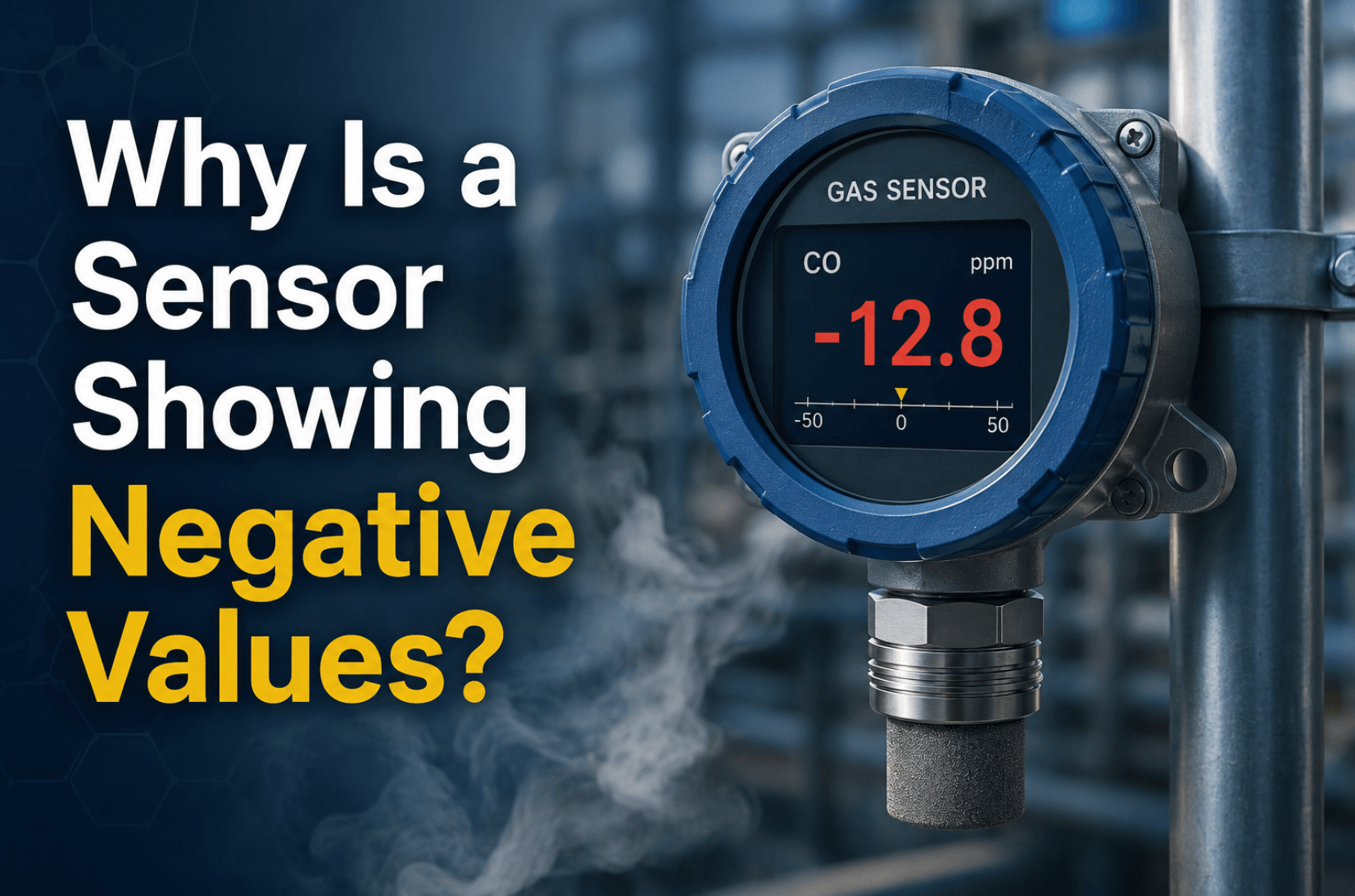
If you’re staring at a gas detector or process sensor that reads below zero, you’re right to be concerned.
A negative value isn’t just a cosmetic glitch. It’s the instrument telling you that something in the measurement chain has shifted.
In most cases, it’s harmless and easily corrected, but in safety-critical environments, it can mask a genuine hazard.
Below, I’ll walk through why this happens, drawing on years of commissioning and troubleshooting gas detection systems in the field.
Why Is a Sensor Showing Negative Values?
A sensor shows negative values when its measured signal falls below the zero (baseline) point it was calibrated against.
This almost always comes down to one of four things: zero drift, calibration in clean air that was actually contaminated, an environmental change (temperature, pressure, or humidity), or an electronic or wiring fault. The fix depends on which one you’re dealing with.
What “Negative” Actually Means on a Sensor
Most gas detectors and analog sensors don’t measure an absolute quantity directly. They establish a zero point, a baseline reading they treat as “nothing present,” and then report deviations from it. A toxic gas sensor zeroed in clean air, for example, calls that condition 0 ppm.
If the sensor’s baseline later drifts upward, the instrument interprets genuinely clean air as being below its stored zero, so it displays a negative number.
The sensor isn’t detecting “negative gas,” which is physically impossible. It’s reporting that current conditions are cleaner or different from the reference it was told to expect.
The Most Common Causes
Zero Drift
Electrochemical and catalytic sensors age. Over weeks and months, the chemistry inside shifts, and the baseline the sensor established at calibration slowly moves.
If the sensor was zeroed in an environment that had a trace background of the target gas, and you later move it to genuinely clean air, the reading dips below zero.
This is the single most common reason a healthy sensor reads negative, and it’s usually a sign that the unit is simply due for re-zeroing or calibration.
Calibration in Contaminated “Clean” Air
A surprising number of negative readings trace back to a flawed calibration. If the zero calibration was performed in an area that wasn’t truly clean, say, near a running vehicle, a solvent station, or residual gas in a confined space, the sensor locked in an artificially high baseline. Every time it later sees real clean air, it reports negatively.
Always zero a sensor in confirmed fresh air or with a certified zero-grade gas cylinder, never just “outside” or “in the corner of the shop.”
Temperature, Pressure, and Humidity Swings
Sensors are sensitive to their environment. A unit calibrated in a warm calibration room and then deployed in a cold outdoor location can read negative purely from the temperature differential.
Rapid pressure changes (moving between altitudes or in and out of pressurized spaces) and large humidity swings affect electrochemical cells the same way.
These readings often self-correct once the sensor equilibrates to its new environment. If yours doesn’t settle within the manufacturer’s stated warm-up and stabilization window, look elsewhere.
Electronic, Wiring, or Bridge Faults
On fixed systems and 4–20 mA loops, a negative or below-zero indication can signal an electrical problem rather than a sensing one.
A failing sensor element, a corroded connection, a loose terminal, or an imbalanced Wheatstone bridge in a catalytic (pellistor) sensor can all push the signal below baseline.
A reading that’s deeply negative or erratic, not just slightly under zero, points strongly toward a hardware fault.
Cross-Sensitivity and Recovery Overshoot
After a sensor is exposed to a high concentration of gas and then returns to clean air, some electrochemical cells temporarily overshoot below zero as they recover. This is normal transient behavior and typically clears within minutes.
How to Diagnose It Step by Step
Confirm the environment is truly clean
Move the sensor to known fresh air and give it the full warm-up period.
Check the magnitude
A small negative value (a few ppm, or a fraction of %LEL) usually means drift. A large or jumpy negative value suggests a fault.
Perform a bump test
Apply a known gas concentration. If the sensor responds correctly and accurately, the cell is healthy, and you simply need to re-zero. If it under-responds or doesn’t respond, the cell may be failing.
Re-zero in confirmed clean air
This corrects the majority of legitimate negative readings.
Calibrate the sensor
Run a full calibration if re-zeroing alone doesn’t hold or if the bump test was marginal.
For a fixed gas detector, check the wiring
Inspect wiring and connections on fixed systems before condemning the sensor itself.
When a Negative Reading Is a Safety Concern
Here’s the part that matters most in safety work: a sensor reading negative cannot be trusted to detect a real hazard.
If the baseline has drifted down by, say, 10 ppm, then a genuine 10 ppm exposure of toxic gas would display as a “safe” 0 reading while you’re actually being exposed. The negative offset eats into your safety margin.
For this reason, you should never simply ignore a persistent negative value or “wait for it to come back up.”
Treat it as a fault condition: remove the instrument from service, re-zero or recalibrate it, and verify with a bump test before trusting it in a hazardous area.
Preventing Negative Readings
The best defense is a disciplined maintenance routine. Bump test before each use or shift; calibrate on the manufacturer’s recommended schedule (typically every 6 months for many electrochemical sensors, but follow your specific equipment’s guidance).
Always zero in on confirmed clean air, and replace sensor cells before they reach the end of life. Logging your readings over time also makes drift visible early, before it becomes a safety gap.
Frequently Asked Questions
Is a negative gas detector reading dangerous?
The negative number itself isn’t dangerous, but it means the instrument’s zero has shifted, which can cause it to under-report real gas. Treat it as a calibration fault and correct it before relying on the detector.
Can I just ignore a small negative value?
No. Even a small negative offset reduces your effective detection margin. Re-zero the sensor in clean air to bring it back to a trustworthy baseline.
Why does my detector read negative after exposure to gas?
This is usually a temporary recovery overshoot as the electrochemical cell returns to baseline. It typically clears within a few minutes. If it persists, re-zero the unit.
How often should I calibrate to prevent this?
Follow your manufacturer’s schedule, commonly every six months for electrochemical sensors, and bump test before each use. Regular calibration is the main way to prevent drift-related negative readings.
This article is for general informational purposes. Always follow your specific equipment manufacturer’s documentation and your site’s safety procedures when calibrating or servicing gas detection equipment.