When a fire breaks out, you may have as little as two minutes to get everyone out safely. That isn’t enough time to think, search for exits, or figure out where to meet.
There’s only enough time to execute a plan you already made. A fire escape plan turns panic into action, and for families with children, elderly relatives, or pets, having one practiced and posted can be the difference between a close call and a tragedy.
This guide gives you a complete fire escape plan checklist for families, walks you through building and practicing your plan, and covers the details most households overlook.
Why Every Family Needs a Fire Escape Plan
House fires spread faster than most people expect. Modern homes, filled with synthetic furnishings and open floor layouts, can become fully involved in flames in a matter of minutes, far quicker than homes built decades ago.
Smoke, not flames, is the leading cause of fire deaths, and it can fill a room and block visibility before you’re even aware of the danger.
A documented, rehearsed escape plan matters because it removes guesswork during a crisis. Children who have practiced know not to hide under beds or in closets.
Everyone knows two ways out of every room. And critically, everyone knows where to regroup so you can confirm in seconds that no one is still inside.
The Complete Fire Escape Plan Checklist for Families
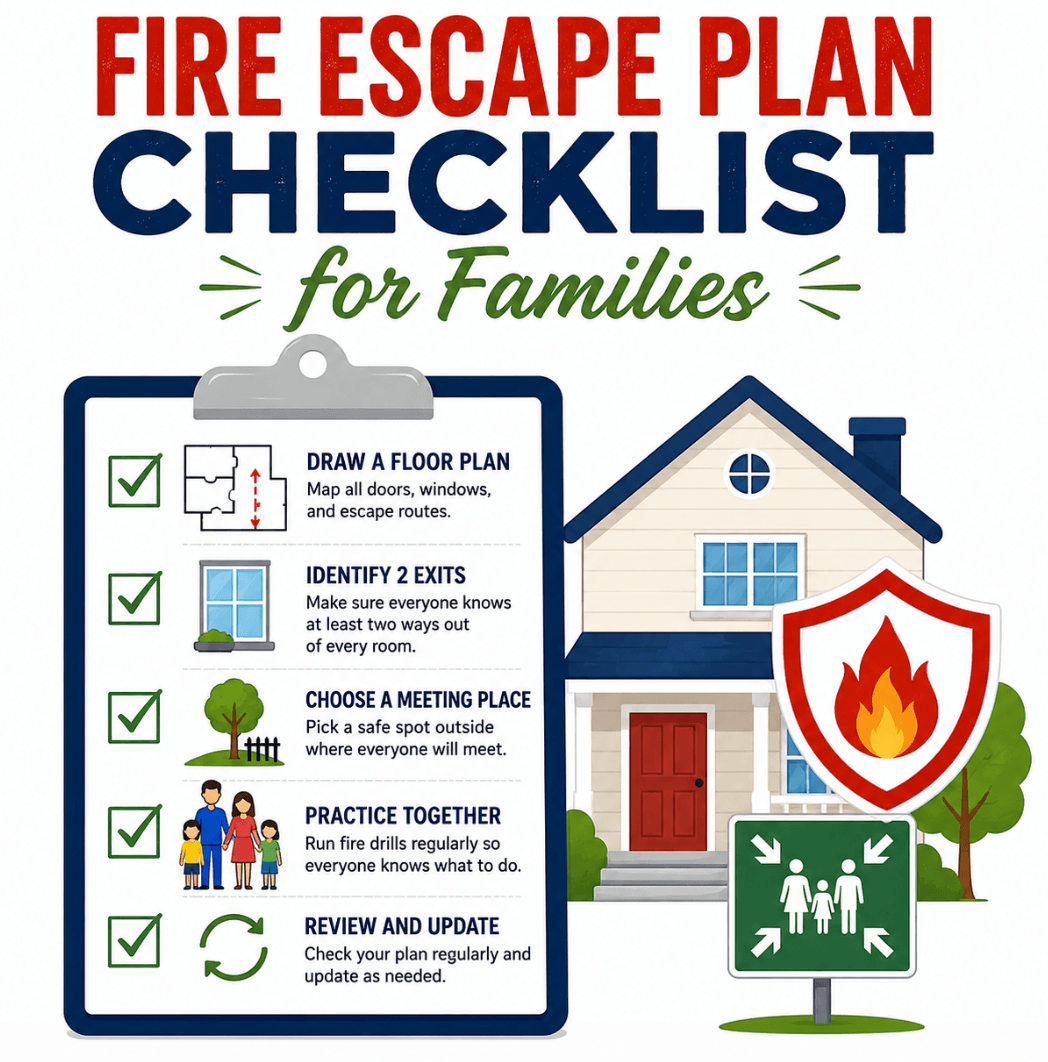
Use this checklist to build your plan. Work through every item, and don’t skip the practice steps at the end; they’re what make the plan actually work.
Map Every Room and Identify Two Exits
Draw a simple floor plan of your home, marking every room. For each room, identify two ways out. The primary exit is usually the door, and the secondary is typically a window.
This “two ways out” rule is the foundation of any reliable escape plan, because the most obvious route may be blocked by fire or smoke.
For upper-floor rooms, the second exit may require an escape ladder. Keep a collapsible, fire-rated escape ladder in each upstairs bedroom and make sure family members know how to deploy and use it.
Test All Doors and Windows
Walk through your home and physically open every window and door on your escape routes. Windows painted shut, stuck in their frames, or blocked by security bars are a common and dangerous problem.
Make sure security bars have quick-release mechanisms that everyone old enough can operate. Check that doors aren’t blocked by furniture and that locks can be opened quickly in the dark.
Install and Maintain Smoke Alarms
Your escape plan depends entirely on early warning. Install smoke alarms inside every bedroom, outside each sleeping area, and on every level of your home, including the basement.
A few maintenance essentials
- Test every smoke alarm monthly using the test button.
- Replace batteries at least once a year, or use ten-year sealed-battery units.
- Replace the entire alarm every ten years.
- Interconnect alarms where possible, so when one sounds, they all sound.
Consider combination smoke and carbon monoxide alarms for added protection, particularly near sleeping areas and fuel-burning appliances.
Choose an Outside Meeting Place
Pick a safe, specific meeting spot a safe distance from the house, something fixed and unmistakable like a mailbox, a neighbor’s driveway, a particular tree, or a streetlight.
Everyone, including young children, should know exactly where it is. This is how you confirm everyone made it out without anyone going back inside to look.
Assign Roles for Those Who Need Help
Decide in advance who is responsible for helping infants, young children, older adults, anyone with mobility limitations, and pets.
Assign a backup person in case the primary helper isn’t home. Don’t leave this to chance in the moment.
Establish Clear Escape Rules
Teach and reinforce these core rules with everyone in the household.
Get out and stay out
Never go back inside for belongings, valuables, or even pets.
Get low under the smoke.
Crawl on hands and knees where the air is cleaner.
Check doors before opening
Use the back of your hand to feel for heat. If a door is hot, use your second exit.
Close doors behind you as you escape to slow the spread of fire and smoke.
Call 911 from outside, never from inside the burning home.
Plan for Children, Seniors, and Pets
Children often react to fire by hiding, so teach them not to. Practice having them respond to the alarm even when sleeping, since many children sleep through smoke alarms; an adult may need to be assigned to wake and guide them.
For seniors or anyone with limited mobility, plan escape routes that avoid stairs where possible, keep mobility aids within reach of the bed, and consider sleeping on the ground floor.
For pets, keep leashes and carriers near an exit, but make clear that human safety always comes first; never delay your own escape for an animal.
Post the Plan and program emergency numbers
Post your floor plan and meeting-place details somewhere visible, such as the refrigerator. Program emergency numbers into every family member’s phone and post them by a landline if you have one.
How to Practice Your Fire Escape Plan
A plan on paper isn’t enough. Practice is what builds the automatic response that takes over when fear sets in.
Run a home fire drill at least twice a year. Practice both daytime and nighttime drills, since escaping in the dark is very different.
Time your drill, aiming to get everyone to the meeting place in under two minutes. Practice using your second exits, not just the front door, and have children practice the drill so the actions feel familiar.
Once your family is confident, occasionally run a drill with simulated obstacles, such as pretending the main staircase is blocked, to test the backup routes.
Common Fire Escape Plan Mistakes to Avoid
Even families who make a plan often undermine it with a few avoidable mistakes. Watch out for these:
- Only planning one exit per room. Always have a backup route.
- Never practicing. An unrehearsed plan rarely works under stress.
- Forgetting upper-floor escapes. Bedrooms above ground level need escape ladders.
- Choosing a vague meeting spot. “The front yard” isn’t specific enough.
- Ignoring smoke alarm maintenance. A dead alarm gives no warning at all.
- Planning to gather belongings. Every second spent collecting items is a second of breathing toxic smoke.
Frequently Asked Questions
How often should we practice our fire escape plan?
At least twice a year, including at least one nighttime drill. Families with young children or anyone needing assistance may benefit from practicing more often.
What should the family do if the planned exit is blocked by fire?
Use the second exit identified for that room. If both routes are blocked, close the door, seal gaps with towels or clothing to keep smoke out, signal from a window, and call 911 to report your exact location.
At what age can children learn a fire escape plan?
Children as young as three or four can begin learning basic concepts like recognizing the smoke alarm and going to the meeting place. Make practice age-appropriate and repeat it often so the response becomes automatic.
Should we go back for pets or valuables?
No. Once you are out, stay out. Tell firefighters if a pet is still inside, and let trained professionals handle it.
Final Thoughts
A fire escape plan is one of the simplest and most effective steps you can take to protect your family.
It costs nothing but a little time, and the payoff is the confidence that everyone in your home knows exactly what to do when seconds count.
Build your plan using the checklist above, post it where everyone can see it, and most importantly, practice it until the response becomes second nature.
Set aside thirty minutes this week to map your home, test your exits, and run your first drill. The plan you build today is the one that protects your family tomorrow.