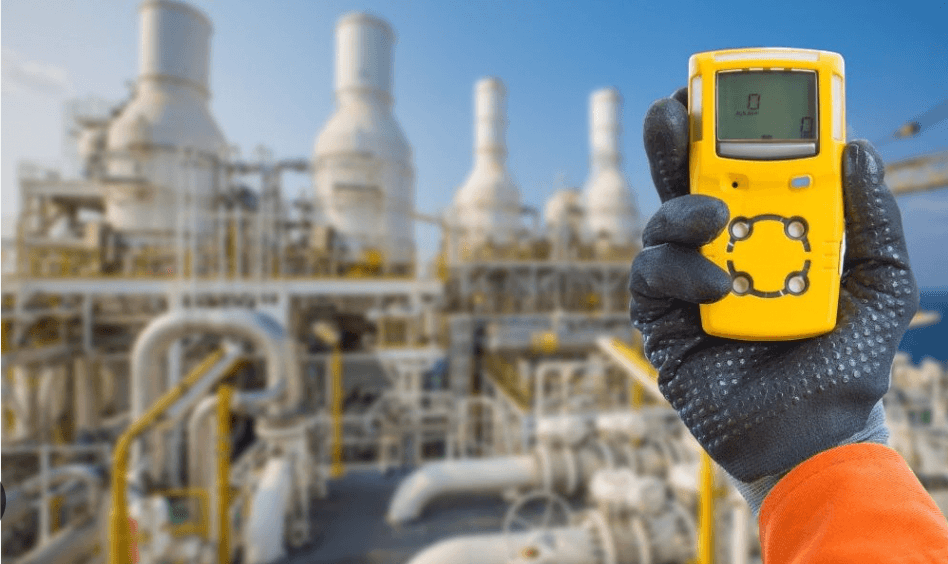
When a gas leak goes undetected, the consequences can be catastrophic explosions, mass poisonings, or fatalities.
The question of which gas detection system to deploy isn’t a minor operational detail. It is a life-safety decision with real legal, financial, and human consequences.
Two primary categories of gas detection technology dominate industrial and commercial facilities worldwide: fixed gas detection systems and portable gas detectors.
Both serve the same overarching goal, identifying hazardous gas concentrations before they reach dangerous levels, but they differ fundamentally in how, where, and when they do the job.
This guide breaks down fixed vs. portable gas detection systems in depth: how each works, what each does well, where each falls short, and most importantly, how to determine which solution is right for your specific application.
What Is a Fixed Gas Detection System?
A fixed gas detection system consists of permanently installed sensors, wired or wirelessly connected to a central control panel, that continuously monitor one or more locations for specific gases or vapor concentrations.
Fixed systems are the backbone of gas detection in refineries, chemical plants, offshore platforms, power generation facilities, wastewater treatment plants, and any site where hazardous gases are routinely present or produced as part of normal operations.
How Fixed Systems Work
Each fixed detector contains a sensing element, a catalytic bead, an electrochemical cell, an infrared optical cell, or a photoionization detector, depending on the target gas housed in an explosion-proof or weather-resistant enclosure mounted at a strategic location.
The detector outputs a continuous 4–20 mA signal (or digital protocol such as HART or Modbus) proportional to gas concentration.
This signal feeds into a gas detection controller or safety PLC, which.
- Displays real-time concentration readings in parts per million (ppm) or percent Lower Explosive Limit (%LEL).
- Triggers audible and visual alarms at pre-set threshold levels (typically alarm 1 at 10–20% LEL and alarm 2 at 40–60% LEL for flammable gases).
- Activates automated responses such as ventilation fans, emergency shutdowns (ESD), or valve closures.
- Logs data for regulatory compliance and post-incident analysis.
Fixed systems can monitor dozens or hundreds of points from a single control room, giving safety personnel and operators a real-time map of atmospheric conditions across the entire facility.
Strengths of Fixed Gas Detection Systems
Continuous, 24/7 monitoring
Fixed systems never sleep, take breaks, or forget to switch on. A gas build-up at 2 a.m. on a Sunday will trigger the same alarm as one during peak operating hours.
Integrated safety responses
Fixed systems can be interlocked with process control and emergency shutdown systems. When a sensor trips an alarm, the system can automatically shut down equipment, open relief valves, or activate ventilation without waiting for a human to react.
No dependence on human compliance
Portable detectors only protect a worker if the worker is wearing one, has charged the battery, and has calibrated it recently. A fixed system removes the human compliance variable from continuous area monitoring.
Regulatory compliance support
Many jurisdictions and industry standards, including OSHA, IEC 60079-29, and API RP 505, require fixed gas detection in classified hazardous areas where flammable or toxic gases are routinely handled.
Data logging and trend analysis
Fixed systems connected to SCADA or DCS platforms provide a historical record of gas concentrations, enabling engineers to identify process drift, recurring leak events, or sensor degradation over time.
Limitations of Fixed Gas Detection Systems
Coverage gaps
Fixed sensors only detect gas at their installed location. A leak that develops in a confined space, a rarely accessed area, or a location not covered by an installed sensor may go undetected.
High installation cost
Wiring, conduit, cable trays, intrinsically safe barriers, junction boxes, and control panel integration make fixed system installation expensive, especially in hazardous-area-classified zones where all electrical components must be certified Ex equipment.
Inflexibility
If a process changes, a new piece of equipment is installed, or operations shift to a different area, the fixed sensors may no longer cover the right locations.
Relocating fixed sensors requires new wiring runs and potentially new hazardous area classifications.
Maintenance access
Fixed sensors require periodic bump testing and calibration, often in locations that are difficult to access at height, inside process enclosures, or in classified areas requiring hot work permits.
What Is a Portable Gas Detector?
A portable gas detector is a handheld or body-worn instrument that measures gas concentrations in real time and alerts the user through audible, visual, and sometimes vibrating alarms when concentrations exceed preset limits.
Portable detectors range from single-gas instruments designed to monitor one specific hazard, such as hydrogen sulfide (H₂S) or carbon monoxide (CO), to multi-gas monitors capable of simultaneously measuring four or more gases, typically oxygen (O₂), combustible gases (%LEL), H₂S, and CO as a standard combination.
How Portable Detectors Work
Most portable detectors use the same sensing technologies as fixed systems: electrochemical sensors for toxic gases, catalytic bead sensors for flammable gases, and photoionization detectors (PIDs) for volatile organic compounds (VOCs).
The difference is packaging: the sensors, power source, alarm components, and display are integrated into a compact, ruggedized housing that a worker can carry or clip to a belt or lapel.
Workers activate the detector at the start of a shift, allow it to complete a warm-up cycle, and then enter a monitored area.
The detector provides continuous readings and alerts if concentrations rise above alarm setpoints.
Confined space entry scenarios often require sampling with a probe before a worker enters the detector is lowered or extended into the space to test the atmosphere before human entry, as required by OSHA 29 CFR 1910.146.
Strengths of Portable Gas Detectors
Mobility and flexibility
A portable detector goes where the worker goes. It monitors the specific breathing zone of the individual rather than a fixed point in space, providing the most relevant exposure information.
Essential for non-routine work
Maintenance, inspection, hot work, confined space entry, and emergency response all take place in locations or conditions not anticipated during facility design. Portable detectors are the only practical solution for these scenarios.
Lower upfront cost
A quality multi-gas portable detector typically costs a fraction of a fixed detection point with all associated wiring and installation.
For small facilities or infrequent hazard exposures, portables may be the most cost-effective solution.
Rapid deployment. Portable detectors can be issued, activated, and in use within minutes. No installation, no wiring, no engineering review.
Personal alarm
Because the detector is on the worker’s body, the alarm is immediate and personal; there is no delay waiting for a control room operator to see an alert and dispatch someone to investigate.
Limitations of Portable Gas Detectors
Dependent on human compliance
A portable detector only works if it is carried, activated, properly calibrated, and the battery is charged.
Compliance programs, bump-test records, and fleet management software are all necessary to ensure portables are actually providing protection.
No automated response capability
A portable detector can alert the wearer. It cannot automatically shut down a compressor, close an isolation valve, or activate emergency ventilation. Human action is always required.
Limited data continuity
Most portable detectors log data internally, but this data is often not integrated into facility safety systems in real time.
Wireless-enabled portables connected to fleet management platforms can partially address this, but require additional infrastructure.
Not suited for continuous area monitoring
Deploying portable detectors to continuously monitor a large area would require stationing workers permanently at each monitoring point not practical or cost-effective.
Sensor drift and battery dependency
Electrochemical sensors degrade over time and require regular calibration. A detector with a depleted battery or out-of-calibration sensor is worse than no detector at all; it may give a false sense of security.
Fixed vs. Portable Gas Detection Systems: Side-by-Side Comparison
| Feature | Fixed System | Portable Detector |
|---|---|---|
| Monitoring continuity | 24/7, continuous | Active during use only |
| Location coverage | Fixed points | Worker’s breathing zone |
| Automated response | Yes (ESD, ventilation) | No |
| Installation cost | High | Low |
| Flexibility | Low | High |
| Regulatory compliance | Required in many classified areas | Required for confined space entry |
| Dependency on compliance | Low | High |
| Data integration | Real-time SCADA/DCS integration | Typically post-shift download |
| Best for | Permanent hazard zones | Non-routine work, mobility |
When to Use Fixed Gas Detection
Fixed gas detection systems are the appropriate primary layer of protection when:
Hazardous gases are routinely present as part of normal operations
Any process that handles, stores, transfers, or produces flammable or toxic gases in significant quantities warrants continuous fixed monitoring.
Refineries, petrochemical plants, LNG terminals, ammonia refrigeration systems, and hydrogen production or storage facilities are examples where fixed detection is essential and usually mandated.
The hazardous area is classified
If your facility has formally classified hazardous areas under NEC Article 500–516 or IEC 60079-10 (Zone 0, 1, or 2; or Division 1 or 2), fixed gas detection is typically part of the area’s safety integrity requirement.
Automated safety responses are needed
When a gas release demands immediate process shutdown without waiting for a human decision, such as in unmanned compressor stations, offshore topside areas, or high-consequence chemical processes, fixed detection integrated with ESD systems is non-negotiable.
Regulatory or insurance requirements mandate it
Jurisdictions, including the European Union (ATEX directive), the UK (DSEAR), and various OSHA and EPA process safety standards, may require fixed detection based on inventory thresholds or process hazard analysis outcomes.
When to Use Portable Gas Detectors
Portable gas detectors are the appropriate tool when.
Workers enter confined spaces
OSHA’s confined space standard explicitly requires atmospheric testing before entry and continuous monitoring during occupancy in permit-required confined spaces. Portable multi-gas detectors are the standard tool for this purpose.
Maintenance and hot work is performed in normally non-hazardous areas
A mechanical seal replacement, a vessel opening, or a welding job in an area not covered by fixed detection requires a portable detector for the duration of the task.
Emergency responders enter an incident scene
Firefighters, hazmat teams, and emergency response personnel use portable detectors, including extended-range instruments and PIDs, for unknown atmosphere characterization as their primary monitoring tool when fixed infrastructure may be compromised or absent.
Survey or leak detection work is performed
Portable detectors, particularly flame ionization detectors (FIDs) and PIDs, are used to survey pipelines, process equipment, and connections for fugitive emissions as part of leak detection and repair (LDAR) programs.
The workforce is mobile, and hazards are location-variable
In construction, utilities, environmental remediation, and similar industries where the hazard location changes day to day, portable detectors are the practical standard.
The Case for Using Both: A Layered Approach
The most effective gas detection strategy in any facility with significant hazard potential is a layered approach that uses fixed and portable systems in complementary roles not one or the other.
Think of fixed detection as your facility’s immune system: always running, covering the known hazard zones, capable of automated response, integrated into your safety architecture.
Think of portable detection as your workers’ personal shield: protecting individuals in the specific locations they occupy, covering scenarios and areas the fixed system was not designed to address.
A practical layered strategy looks like this:
Layer 1
Fixed detection covers all classified hazardous areas, high-consequence process areas, and locations identified in the process hazard analysis (PHA) as requiring continuous monitoring. Fixed detectors are integrated with alarms, ventilation, and ESD systems.
Layer 2
Portable detection is issued to all workers entering hazardous areas, required for all confined space entries, mandatory for any non-routine work (maintenance, inspection, hot work), and used for LDAR survey work.
Layer 3
Wireless-enabled portables with fleet management (for larger organizations) provide real-time visibility into worker location, gas exposure history, and detector status, bridging the gap between portable protection and centralized monitoring.
This layered approach is consistent with guidance from the ISA (International Society of Automation), the Energy Institute’s Model Code of Safe Practice, and site-specific requirements under OSHA PSM (Process Safety Management) for highly hazardous chemicals.
Key Factors in Your Selection Decision
When evaluating which solution or what combination is right for your facility, consider these factors.
Nature of the hazard
What gases are present? At what concentrations? Under what conditions? Flammable gas in a continuously operating compressor station demands fixed detection. Potential oxygen deficiency during vessel entry demands a portable multi-gas detector.
Frequency and type of occupancy
Is the hazardous area continuously occupied, periodically occupied, or entered only for non-routine tasks? Continuous occupancy and critical processes favor fixed systems. Infrequent, task-based entry favors portables.
Regulatory requirements
Review OSHA standards (29 CFR 1910.146 for confined spaces; 29 CFR 1910.119 for PSM), applicable NEC/IEC hazardous area classifications, and any industry-specific standards (API, NFPA, ISA).
Budget and lifecycle cost
Fixed systems have higher upfront costs but lower per-measurement lifecycle costs in high-frequency monitoring applications.
Portables have lower upfront costs but require ongoing calibration, battery management, and eventual sensor and instrument replacement.
Integration requirements
If your safety architecture requires real-time, automated response capability, a fixed system or wireless-networked portable fleet with real-time connectivity is necessary. A standalone portable detector cannot provide this.
Maintenance capability
Fixed sensors in hard-to-reach or classified locations require structured maintenance programs. Portable detectors require daily bump testing, periodic calibration, and battery management. Assess your maintenance team’s capability to support each system type before committing.
Frequently Asked Questions
Can portable detectors replace fixed gas detection systems?
In most industrial applications with classified hazardous areas or continuous process operations, no.
Portable detectors require a person to carry them to be effective and cannot initiate automated safety responses.
Fixed systems are typically required for continuous area monitoring in high-consequence environments and may be mandated by regulation.
Do I need both fixed and portable gas detectors?
In most facilities with significant gas hazards, yes. Fixed detection provides continuous area monitoring and automated response capability.
Portable detection protects individual workers during non-routine tasks, confined space entry, and maintenance activities in areas not covered by fixed sensors.
How often do gas detectors need to be calibrated?
Portable detectors should be bump-tested before each use and formally calibrated according to the manufacturer’s schedule (typically every 3–6 months, or as required by site policy).
Fixed sensors are typically calibrated on a 3–6 month cycle or when a sensor trip or drift is suspected. Calibration intervals should be documented and traceable for regulatory compliance.
What is the difference between a bump test and a calibration?
A bump test exposes the detector to a known concentration of test gas to verify that the sensor responds and that the alarm triggers.
It does not adjust the sensor’s output. A full calibration uses certified test gas at a known concentration to adjust the instrument’s response to a verified reference point. Bump tests are for daily verification; calibration corrects sensor drift.
What gases should a multi-gas portable detector monitor?
The standard four-gas configuration monitors oxygen (O₂), combustible gases (%LEL), hydrogen sulfide (H₂S), and carbon monoxide (CO).
This combination addresses the most common hazards in general industrial settings. Specific applications may require additional sensors for gases such as ammonia, chlorine, SO₂, or VOCs, depending on the process.
Summary
Fixed gas detection systems and portable gas detectors serve distinct, complementary roles in a facility’s overall gas hazard management strategy.
Fixed systems provide the continuous, automated, integrated monitoring that classified hazardous areas and high-consequence processes require. They are the permanent backbone of facility-level gas safety.
Portable detectors protect individual workers where and when fixed coverage does not apply in confined spaces, during maintenance, in emergency response, and anywhere the hazard location is variable or non-routine.
The most robust gas safety programs deploy both, with clear protocols defining when each is required, how each is maintained, and how both layers integrate into the facility’s overall emergency response plan.
If you are evaluating or designing a gas detection strategy for your facility, the starting point is always a thorough hazard assessment identifying which gases are present, at what concentrations, in which locations, and under what operational conditions. From that foundation, the right combination of fixed and portable detection becomes clear.
SafeguardSense covers gas detection, flame detection, and industrial safety technology for engineers and safety professionals.
Browse our articles on detector selection, calibration best practices, and hazardous area classification to build out your safety knowledge base.