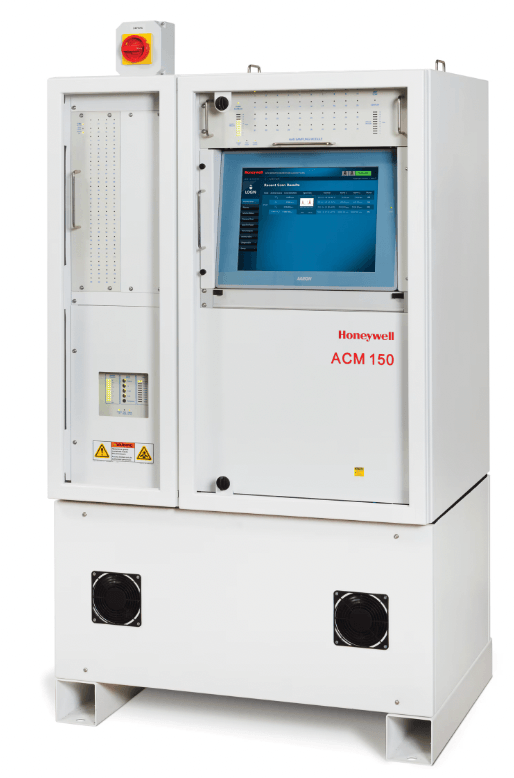
If you’ve ever sat in a design review arguing over whether a process area needs a bank of fixed-point detectors or a single multipoint sampling panel pulling from a dozen locations, you already know this isn’t a trivial choice.
It affects your capital budget, your maintenance workload, and most importantly, how fast your team finds out about a leak.
I’ve specified both architectures across industrial gas detection projects, and the honest answer is that neither one is universally “better.” They solve different problems.
This article breaks down how each system actually works, where each one wins, and how to decide which belongs in your facility or whether you need both.
What Is a Point Gas Detector?
A point gas detector is a standalone sensor installed directly at a specific monitoring location, such as a compressor skid, a tank farm valve manifold, or a confined-space entry point.
The sensor sits in the actual atmosphere it’s monitoring, using catalytic bead, electrochemical, infrared, or photoionization sensing elements depending on the target gas.
Because the sensor is physically present at the hazard, it reads gas concentration in near-real time. There’s no transport lag, no tubing to clog, no sample pump to fail. Each point detector reports independently to the control system or safety controller, typically over 4-20 mA, HART, or a digital fieldbus protocol.
Where point detectors are the obvious choice.
- A small number of well-defined, high-consequence release points.
- Locations where response time is critical (H2S near a wellhead, for example).
- Areas where running sample tubing is impractical or where tubing itself would need to cross classified hazardous zones.
- Facilities that already have SIL-rated fixed detection integrated into their safety instrumented system.
The tradeoff is scalability. Once you’re monitoring 15, 20, or 30 points across a sprawling process unit, the cabling, junction boxes, and per-point maintenance (calibration, bump testing, sensor replacement) start adding up fast both in capital cost and in technician hours.
What Is a Multipoint Sampling System?
A multipoint sampling system, sometimes called a sequential sampling or extractive multiplexed system, uses a central analyzer (often a single, higher-quality NDIR or electrochemical bench) connected to multiple remote sample points through a network of tubing and a solenoid-driven sampling manifold.
The system pulls air sequentially from each point back to the central unit for analysis, cycling through locations at set intervals.
Instead of buying and maintaining 20 individual sensors, you maintain one analyzer and a set of sample lines, filters, and a pump.
That’s the core value proposition: fewer sensing elements to calibrate, one point of analytical truth, and centralized diagnostics.
Where multipoint sampling makes sense
- Large numbers of monitoring points spread across a wide area (tank farms, warehouse HVAC returns, large confined spaces with multiple sample locations).
- Environments where sensor exposure to dust, moisture, or corrosive atmosphere would shorten the life of individual field-mounted sensors.
- Applications where a slightly slower response time is acceptable in exchange for lower long-term maintenance costs.
- Facilities standardizing on one analytical technology for consistency across many locations.
The tradeoff is response time and mechanical complexity. Every additional sample point in the sequence adds to the cycle time before that specific location gets re-checked.
If you have 12 points on a 60-second sample time each, a given location might only be re-sampled every 10-12 minutes.
Tubing runs are also a maintenance liability of their own: they can develop leaks, kinks, condensation blockages, or biological fouling over time, and a single pump or manifold failure takes the whole system down rather than just one point.
Point Detector vs Multipoint Sampling: Side-by-Side Comparison
| Factor | Point (Fixed) Detector | Multipoint Sampling System |
|---|---|---|
| Response time | Seconds, sensor is in the atmosphere | Minutes. Depends on sample cycle time and tubing length |
| Number of sensing elements | One sensor per monitored point | Typically one central analyzer for many points |
| Capital cost (small point count) | Lower for under ~6-8 points | Higher, central analyzer plus tubing infrastructure |
| Capital cost (large point count) | Scales linearly, gets expensive fast | Scales more efficiently past 10-15 points |
| Maintenance | Per-sensor calibration and bump testing | Single analyzer calibration, plus tubing/filter/pump upkeep |
| Failure mode | Independent. One sensor failure doesn’t affect others | Shared risk. Pump, manifold, or analyzer failure affects all points |
| Best for hazardous area routing | Sensor mounted directly, minimal cable-only routing | Requires sample tubing routed through the hazardous area |
| Typical use case | High-consequence, fast-response locations | Wide-area monitoring with many lower-urgency points |
| Integration with SIS | Common, well-established for SIL-rated loops | Less common for SIL applications due to sample lag |
Response Time: The Deciding Factor for Many Applications
This is usually where the decision actually gets made. If you’re protecting a confined space entry, a compressor seal, or any location where a release could reach IDLH concentration within a minute or two, the sample transport lag of a multipoint system is a genuine safety concern, not just an inconvenience.
Sample line length, tubing diameter, and pump flow rate all add delay on top of the sequential cycle time between points.
For slower-developing hazards, a warehouse with a refrigerant leak that would take time to accumulate or a tank farm perimeter where you’re looking for trend data rather than instant alarm, the extra minutes of lag from a multipoint system are usually acceptable, especially given the cost and maintenance savings.
If you’re unsure how detection technology affects response and reliability, it’s worth understanding how NDIR sensors handle response time and battery life and how condensation can distort infrared gas readings before committing to an architecture. The sensing technology inside either system has its own set of failure modes worth knowing about.
Maintenance and Total Cost of Ownership
Point detectors win on simplicity per unit but lose on aggregate labor. Once you’re past a dozen points, each sensor needs its own calibration gas, bump test schedule, and eventual sensor cell replacement (catalytic sensors are particularly prone to poisoning from silicones and sulfur compounds; see our breakdown of why catalytic sensors get poisoned if that’s part of your process environment).
Multipoint systems concentrate that maintenance burden into fewer analytical units but shift it toward mechanical upkeep: sample line integrity checks, filter replacement, pump diaphragm wear, and periodic verification that tubing hasn’t developed a leak or blockage that would silently invalidate readings from an entire point.
A tubing leak in a multipoint system is a particularly sneaky failure. It can pull ambient air instead of sample air and read artificially clean without tripping an obvious fault.
Neither system is “low maintenance.” They just distribute the maintenance burden differently. Per-sensor labor versus centralized-analyzer-plus-tubing-network labor.
Can You Combine Both Architectures?
In practice, most larger industrial sites do exactly this. Point detectors get deployed at the small number of high-consequence, fast-response locations near compressors, at confined space entries, and at flammable gas release points feeding directly into the safety instrumented system.
A multipoint sampling system then handles the wider net of lower-urgency locations where centralized trending and lower per-point cost matter more than seconds of response time.
This hybrid approach is common in tank farms, wastewater treatment facilities, and large manufacturing plants where the risk profile genuinely varies by location.
Treating every point the same, whether with all fixed detectors or an all-sampling system, usually means overspending in one area and undershooting response time in another.
Frequently Asked Questions
Is a point gas detector always faster than a multipoint sampling system?
Generally yes. A point detector’s sensor sits directly in the atmosphere it monitors, so there’s no transport delay.
A multipoint system has to physically pull a sample through tubing back to a central analyzer, and that location has to wait its turn in the sampling sequence. Both factors add lag that a point detector doesn’t have.
How many monitoring points does it take before a multipoint system becomes more cost-effective?
There’s no universal number, but many facilities find the crossover somewhere around 10-15 points, depending on tubing run lengths and site layout.
Below that, the capital cost of a central analyzer and sampling infrastructure often isn’t justified compared to just installing individual point detectors.
Can a multipoint sampling system be used for SIL-rated safety instrumented functions?
It’s uncommon, mainly because of the sample transport lag and shared failure mode (a single pump or manifold fault affects every point).
Most SIL-rated gas detection loops use fixed-point detectors specifically because they respond independently and quickly enough to meet the required safety integrity level.
What causes a multipoint sampling system to give a false clean reading?
The most common cause is a tubing leak upstream of the sample point, which lets the system pull in ambient air instead of the actual sample.
Blocked or crushed tubing, a failing sample pump, or a clogged particulate filter can also starve the analyzer of representative sample air without triggering an obvious system fault.
Do point detectors and multipoint systems use the same sensor technology?
They can both use architectures that are compatible with catalytic bead, electrochemical, infrared (NDIR), and photoionization detection principles.
The difference is architectural, not about the underlying sensing technology. It’s about where the sensing happens (at the point or centrally after sample transport) rather than what kind of sensor does the sensing.
Bottom Line
Choose a point detector when speed and independence matter most, and your point count is manageable.
Choose a multipoint sampling system when you’re covering a large number of locations and centralized analytics and lower per-point maintenance outweigh the cost of a few minutes of sample lag.
And on larger or higher-risk sites, don’t be afraid to run both, matching the architecture to the actual consequence severity at each location, rather than forcing one system to do a job it wasn’t designed for.
This article draws on hands-on field experience specifying, installing, and maintaining fixed and portable industrial gas detection systems across process safety applications.