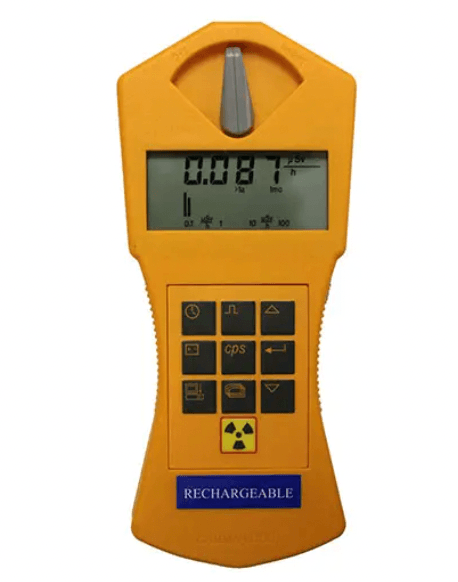
If you work anywhere near radioactive sources, radiography operations, nuclear facilities, or even certain oilfield logging tools, a gamma radiation detector isn’t optional equipment. It’s the instrument standing between a normal shift and an unrecognized overexposure.
Gamma radiation is invisible and silent and passes through most everyday materials, which is precisely why relying on your senses to know it’s there is not a strategy.
This guide walks through what gamma radiation actually is, why detection matters in industrial and safety settings, how gamma sensors work at a physical level, the detection technologies you’ll encounter on the market, and a practical framework for choosing the right detector for your application.
What Is Gamma Radiation?
Gamma radiation is a form of electromagnetic radiation, similar to visible light or X-rays, but with much higher energy and frequency.
It’s emitted from the nucleus of certain unstable (radioactive) atoms as they decay toward a more stable state. Unlike alpha or beta particles, which are actual pieces of matter ejected from an atom, gamma rays carry no mass and no electric charge. They’re pure energy traveling as photons.
That lack of mass and charge is precisely what makes gamma radiation so penetrating. Alpha particles can be stopped by a sheet of paper or the outer layer of skin.
Beta particles need a few millimeters of plastic or aluminum. Gamma rays, on the other hand, require dense shielding, such as thick lead, concrete, or steel, to attenuate them meaningfully.
They can pass through the human body, through walls, and through most industrial equipment casings.
Common sources of gamma radiation include the following:
- Naturally occurring radioactive materials (NORM), found in some oil and gas production scales and certain mineral deposits.
- Industrial radiography sources (such as cobalt-60 and iridium-192) used for non-destructive testing of welds and pipelines.
- Medical isotopes used in diagnostic imaging and cancer treatment.
- Nuclear power generation and spent fuel handling.
- Certain well-logging tools are used in oil and gas exploration.
Because gamma rays can’t be seen, smelled, or felt until biological damage has already occurred, detection instruments are the only reliable way to know gamma radiation is present, at what intensity, and whether it exceeds a safe threshold.
Why Do You Need to Detect Gamma Radiation?
The case for gamma detection rests on three key points: it is invisible, it is cumulative, and the consequences of missing it can be severe.
Human senses can’t detect it
There is no smell, sound, or visual cue associated with gamma exposure. Someone standing next to an unshielded source has no biological warning system telling them to move away.
Exposure is dose-dependent and cumulative
Radiation damage to tissue is a function of both intensity and time. A detector doesn’t just tell you radiation is present.
It quantifies dose rate (µSv/h or mR/h) and, on personal dosimeters, accumulated dose over a shift, month, or career. That data is what keeps workers within regulatory exposure limits.
Regulatory and liability exposure
Facilities working with radioactive sources, radiography operations, and NORM-handling sites are typically governed by national nuclear regulatory bodies (in the U.S., the NRC; in Mexico, the CNSNS; and equivalent agencies elsewhere) as well as international guidance from the IAEA. Documented, calibrated gamma detection is often a licensing and audit requirement, not a nice-to-have.
Beyond compliance, gamma detectors serve several practical field functions: locating lost or damaged radiography sources, verifying that shielding is adequate before workers re-enter an area, screening scrap metal loads for contamination, and confirming that transport packages of radioactive material meet regulatory dose-rate limits at the surface and at one meter.
How a Gamma Radiation Sensor Works
Every gamma detection technology relies on the same underlying principle: gamma photons interact with a detector material and transfer some of their energy to it, producing a measurable signal, either an electrical pulse, a flash of light, or a change in electrical conductivity.
The instrument’s electronics count these interaction events and convert the count rate into a dose rate reading.
The three physical interaction mechanisms that make this possible are
Photoelectric effect
A gamma photon is fully absorbed by an atom in the detector, ejecting an electron. This dominates at lower gamma energies and in high-density materials.
Compton scattering
A gamma photon transfers only part of its energy to an electron and continues at a lower energy, at an altered angle.
This is the dominant interaction across most of the energy range that detectors encounter in the field.
Pair production
At very high photon energies (above 1.022 MeV), a gamma photon can convert into an electron-positron pair.
This interaction is less common in typical industrial detection scenarios but relevant in higher-energy nuclear physics applications.
Whichever interaction occurs, the result is a burst of ionization or excitation inside the detector medium.
The detector’s job is to capture that burst, convert it into an electronic pulse, and pass it to a counting circuit.
The instrument then applies a calibration factor (tied to a specific isotope, usually Cesium-137, unless energy-compensated) to translate counts per second into a dose-rate unit like µSv/h.
Response time, energy dependence, and sensitivity all vary by the underlying detection technology, which is where the choice of sensor type becomes important.
Gamma Radiation Detection Technologies
Gamma detectors on the market today fall into three broad technology families, each with distinct trade-offs in sensitivity, cost, ruggedness, and application fit.
Geiger-Müller (GM) Tubes
The GM tube is the most widely deployed gamma detection technology because it’s simple, rugged, and inexpensive relative to its alternatives.
It consists of a gas-filled tube (typically a halogen-quenched noble gas) with a high-voltage anode wire running through the center.
When a gamma photon ionizes the gas, the resulting avalanche of electrons produces a detectable current pulse.
Strengths
Low cost, mechanically robust, simple electronics, wide availability, good for general area monitoring and survey work
Limitations
Lower sensitivity than scintillation detectors, meaning slower response at low dose rates; limited energy discrimination (can’t distinguish isotopes); “dead time” after each pulse can cause undercounting at very high dose rates
GM-based survey meters and personal dosimeters are the workhorse instruments for radiography crews, emergency responders, and general area surveys where identifying the specific isotope isn’t the goal, just confirming presence and intensity.
Scintillation Detectors
Scintillation detectors use a crystal (commonly sodium iodide doped with thallium, NaI(Tl)) or a plastic scintillator that emits a flash of visible light when struck by gamma radiation.
That light is captured by a photomultiplier tube (PMT) or solid-state photodiode and converted into an electronic pulse proportional to the energy deposited.
Strengths
Significantly higher sensitivity than GM tubes, making them well-suited to detecting low-level or shielded sources; the pulse height is proportional to photon energy, enabling spectroscopic identification of specific isotopes in higher-end units
Limitations
More expensive, more fragile (crystal can be sensitive to shock and temperature swings), higher power consumption, PMTs add bulk
Scintillation-based instruments are the standard for radioisotope identification devices (RIIDs), portal monitors at scrap yards and border crossings, and search operations where a weak or shielded source needs to be located from a distance.
Semiconductor (Solid-State) Detectors
Semiconductor detectors, most notably high-purity germanium (HPGe) and cadmium zinc telluride (CZT), generate an electrical signal directly when gamma photons create electron-hole pairs in the crystal lattice, without an intermediate light-conversion step.
Strengths
Excellent energy resolution (HPGe in particular is the gold standard for laboratory-grade isotope identification), compact form factor for CZT-based handheld identifiers
Limitations
HPGe requires cryogenic cooling for lab-grade performance, making it impractical for rugged field use; CZT units are more affordable and portable but still carry a significant cost premium over GM and standard scintillation instruments
Semiconductor detectors show up most often in laboratory analysis, homeland security screening, and premium handheld isotope identifiers, where precise energy resolution justifies the added cost.
| Technology | Sensitivity | Isotope ID | Ruggedness | Relative Cost | Typical Use |
|---|---|---|---|---|---|
| Geiger-Müller | Moderate | No | High | Low | Area survey, personal dosimetry, radiography checks |
| Scintillation (NaI) | High | Yes (with MCA) | Moderate | Moderate–High | Search & locate, portal monitoring, isotope ID |
| Semiconductor (CZT/HPGe) | High | Excellent | Low–Moderate | High | Lab analysis, high-precision field ID |
How to Select the Right Gamma Radiation Detector
Choosing a gamma detector comes down to matching the instrument’s capability to the actual hazard and workflow, not simply buying the most sensitive unit available. Work through these criteria:
Define the application first
A radiography crew doing daily source-retrieval checks has different needs than a scrapyard screening incoming metal loads for orphan sources, and both differ from a personal dosimetry program tracking cumulative worker dose.
Area survey vs. personal exposure monitoring vs. isotope identification are three distinct instrument categories.
Match sensitivity to the dose-rate range you expect
GM-based instruments are perfectly adequate for confirming the presence of radiation at moderate-to-high dose rates but will respond slowly at very low levels.
If you’re searching for weak or shielded sources, a scintillation-based instrument is worth the added cost.
Decide whether isotope identification matters
If your job is simply to confirm “radiation present, evacuate,” a basic survey meter or dosimeter will suffice.
If you need to know whether you’re looking at a medical isotope, an industrial radiography source, or a security threat, you need a spectroscopic instrument (scintillation with a multichannel analyzer or a semiconductor-based RIID).
Check the energy response range
Gamma-emitting isotopes span a wide energy range from around 60 keV (Americium-241) to over 1,300 keV (Cobalt-60). Confirm the detector’s calibrated energy response covers the isotopes relevant to your site.
Consider environmental ruggedness
Field instruments used in oilfield, construction, or emergency response settings need an IP-rated enclosure, intrinsic safety certification if used in classified areas, and a wide operating temperature range. Lab-grade instruments with cryogenic cooling requirements simply won’t survive field conditions.
Verify calibration and traceability
Any gamma detector used for regulatory compliance or worker safety should have a documented calibration traceable to a national standards body with a defined recalibration interval, typically annual, though check your local regulatory requirements.
Battery life and alarm functionality
For personal dosimeters and survey meters used on long shifts, confirm battery runtime against your actual shift length, and check whether audible/vibration alarms are configurable to your site’s dose-rate action levels.
Data logging and connectivity
For programs tracking cumulative worker dose or feeding into a broader safety monitoring system, look for units offering data logging, Bluetooth or wireless connectivity, and export compatibility with your existing EHS or radiation safety software.
Gamma Detectors vs. Other Radiation Detection Instruments
It’s worth being clear that a gamma radiation detector is not a universal radiation instrument. Alpha and beta contamination require dedicated pancake-probe or thin-window detectors, since gamma-optimized sensors are largely blind to those particle types.
Neutron detection (relevant near reactors or certain industrial neutron sources) requires yet another detector technology entirely, typically based on helium-3 or boron-lined proportional counters.
If your site has mixed radiation hazards, you’ll likely need a combination instrument or separate dedicated detectors rather than expecting one gamma-only unit to cover everything.
FAQ
What’s the difference between a Geiger counter and a gamma radiation detector?
A Geiger counter is one specific type of gamma (and beta) radiation detector, built around a Geiger-Müller tube.
“Gamma radiation detector” is the broader category that also includes scintillation and semiconductor-based instruments, which offer higher sensitivity and, in some cases, isotope identification that a basic Geiger counter can’t provide.
How far can a gamma radiation detector sense a source?
Detection range depends on the source’s activity, the detector’s sensitivity, and shielding between the source and the instrument.
High-sensitivity scintillation detectors can locate stronger sources from several meters away, while weaker or well-shielded sources may only be detectable at close range or not at all without a more sensitive instrument.
Do gamma radiation detectors need regular calibration?
Yes. Gamma detectors drift over time as components age, and most regulatory frameworks require documented calibration against a certified reference source at regular intervals, usually annually, with functional response checks done more often.
Can a gamma radiation detector also detect X-rays?
Many gamma detectors will also respond to X-rays since both are high-energy electromagnetic radiation and the underlying detection physics (photoelectric effect and Compton scattering) is the same.
However, instrument sensitivity and calibration at typical X-ray energies should be confirmed with the manufacturer if X-ray detection is a specific requirement.
What dose rate should trigger an alarm on a gamma detector?
Alarm setpoints depend on your regulatory framework and site-specific radiation safety program, not a universal number.
Most personal dosimeters and area monitors are configurable, and setpoints should be established by a qualified radiation safety officer based on applicable occupational dose limits.
Is a gamma radiation detector the same as a dosimeter?
Not always. A survey meter reads instantaneous dose rate and is typically used for area or source surveys. A dosimeter is worn by an individual and tracks accumulated dose over time.
Some modern instruments combine both functions, but they serve different primary purposes in a radiation safety program.