Choosing the wrong combustible gas sensor can leave your team blind to a hazard or drown them in false alarms.
After years of specifying, commissioning, and troubleshooting gas detection systems in industrial facilities, I can tell you that the NDIR vs catalytic bead sensor decision comes up in almost every portable gas detector selection I’m involved in.
Both technologies are proven, reliable, and widely deployed. But they work on completely different physical principles, and each has blind spots that can compromise safety if you deploy them in the wrong application.
In this guide, I’ll break down how each sensor works, where each one excels, where each one fails, and give you a practical decision framework based on real-world field experience.
NDIR vs. Catalytic Bead Sensor: Which Combustible Gas Detection Technology Is Right for You?
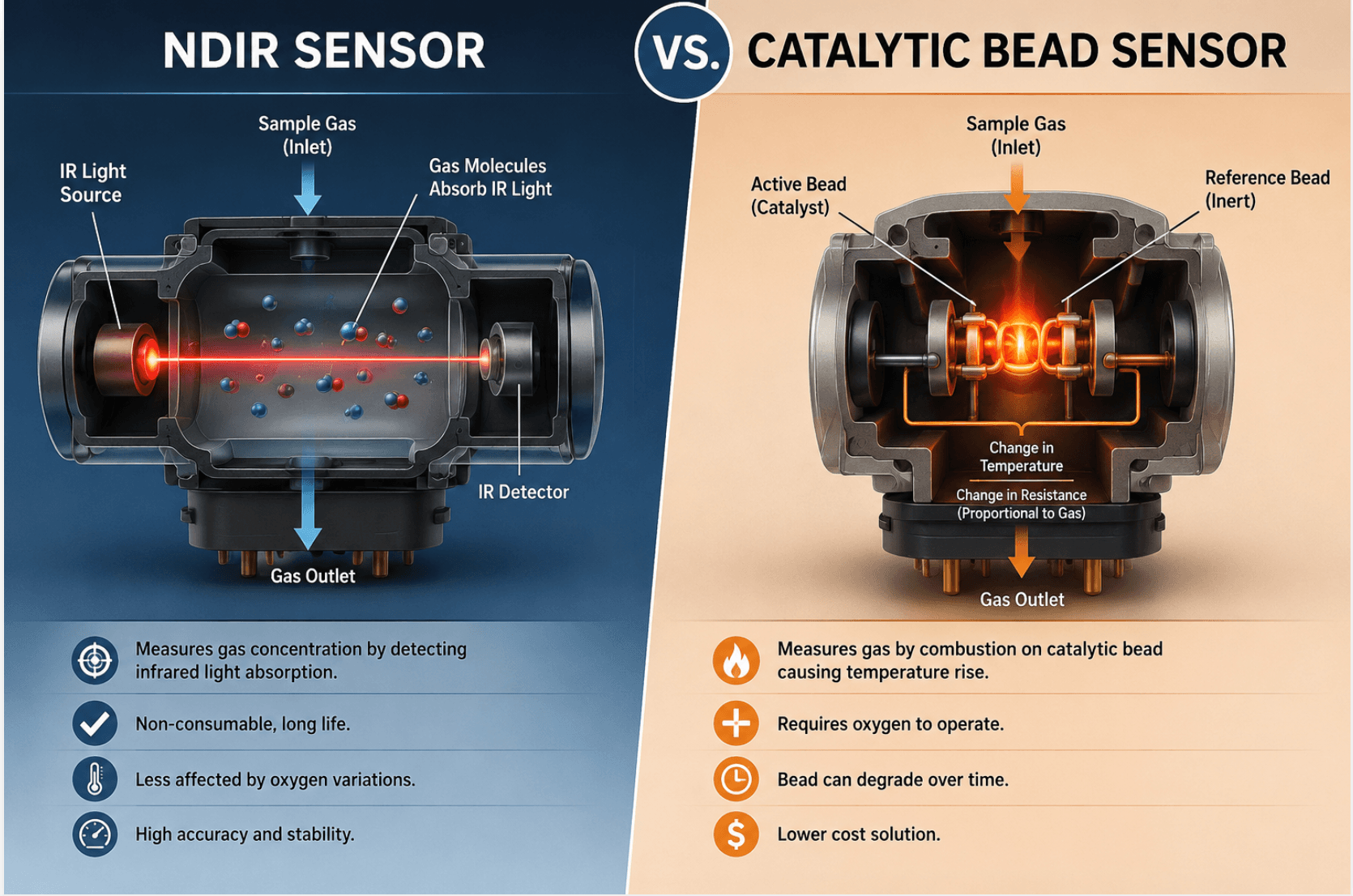
Catalytic bead sensors are the workhorse of portable gas detection: affordable, versatile, and effective for most everyday combustible gas hazards. They burn the target gas on a heated catalyst and measure the resulting temperature change.
NDIR (non-dispersive infrared) sensors measure how gas molecules absorb infrared light. They’re immune to sensor poisoning, work without oxygen, and detect heavy hydrocarbons that catalytic sensors miss, but they cost 3–4 times more and cannot detect hydrogen.
If your hazards vary day to day and include hydrogen, go catalytic. If you work in inert atmospheres, around silicones and sulfur compounds, or with heavy fuel vapors like diesel and jet fuel, NDIR is worth the premium.
Now let’s dig into why.
How Catalytic Bead Sensors Work
A catalytic bead sensor (often called a “pellistor” or catalytic LEL sensor) contains two small beads of ceramic material wound with platinum wire. One bead is coated with a catalyst; the other is inert and serves as a reference.
When combustible gas reaches the active bead, it oxidizes, essentially burning on the catalyst surface.
This combustion raises the bead’s temperature, which changes the electrical resistance of the platinum wire.
The sensor measures the resistance difference between the active and reference beads and converts it into a gas concentration reading, typically expressed as a percentage of the Lower Explosive Limit (%LEL).
Key Characteristics of Catalytic Bead Sensors
Because catalytic sensors rely on combustion, they have two fundamental requirements: the target gas must be flammable, and oxygen must be present for oxidation to occur.
Most catalytic sensors need at least 10–12% oxygen in the atmosphere to read accurately. In oxygen-deficient or inert atmospheres like nitrogen-purged vessels, a catalytic sensor will dangerously under-report gas concentrations.
The catalyst itself is also the sensor’s Achilles heel. Certain compounds permanently degrade or destroy the catalyst, a phenomenon known as sensor poisoning. Common poisons include the following:
- Silicones (found in lubricants, sealants, and hydraulic fluids)
- Sulfur compounds (hydrogen sulfide in high concentrations)
- Lead compounds
- Halogenated hydrocarbons (which act as inhibitors)
- Phosphates and phosphorus-containing substances
A poisoned catalytic sensor may still power on and appear functional while responding poorly or not at all to gas.
This is exactly why regular bump testing is non-negotiable for catalytic-based portable monitors. If you’re not bump testing daily, you’re gambling with a sensor that may already be dead.
How NDIR Sensors Work
Non-dispersive infrared (NDIR) combustible gas sensing is based on a completely different principle: the absorption of infrared energy by the chemical bonds between dissimilar atoms in a gas molecule.
Inside an NDIR sensor, an infrared source emits light through an optical path containing the gas sample.
Hydrocarbon molecules absorb infrared energy at specific, characteristic wavelengths. A detector at the other end of the optical path measures how much infrared light was absorbed at the target wavelength, and that absorption is proportional to the gas concentration.
Because the measurement is optical rather than chemical, nothing is consumed or burned. The gas simply passes through a beam of light.
Key Characteristics of NDIR Sensors
The optical measurement principle gives NDIR sensors three major advantages.
Immunity to poisoning
There’s no catalyst to degrade. Silicones, sulfur compounds, and lead have no effect on the sensor’s ability to detect gas.
No oxygen requirement
Since nothing needs to combust, NDIR sensors read accurately in inert or oxygen-deficient atmospheres critical for nitrogen-blanketed tanks and purged pipelines.
Lower power consumption
Without a continuously heated catalytic bead, NDIR sensors draw less power, extending battery life in portable instruments.
But the physics that makes NDIR work also creates a hard limitation: NDIR sensors cannot detect diatomic molecules made of identical atoms, such as oxygen (O₂), nitrogen (N₂), and, critically, hydrogen (H₂). These symmetric molecules don’t absorb infrared light at the wavelengths NDIR sensors use. If hydrogen is among your potential hazards, an NDIR combustible sensor alone will leave you completely blind to it.
NDIR sensors also come with practical trade-offs
Cost
Expect to pay 3–4 times more than an equivalent catalytic bead sensor.
Warm-up time
A portable gas detector with an NDIR combustible sensor can require up to 5 minutes after power-on before readings stabilize and become accurate. In a rush situation, that delay matters.
Optical path maintenance
Dust shields and optical windows can become blocked or fouled. The sensor must be checked regularly to verify gas can actually reach the optical path.
NDIR vs Catalytic Bead Sensor: Full Comparison Table
| Capability | Catalytic LEL Sensor | NDIR Sensor |
|---|---|---|
| Detects LEL-range C₁–C₅ hydrocarbons (methane, ethane, propane, butane, pentane, natural gas) | ✅ Yes | ✅ Yes |
| Detects LEL-range C6–C9 hydrocarbons (hexane, heptane, octane, nonane) | ✅ Yes | ✅ Yes |
| Detects LEL-range heavy fuel vapors (diesel, jet fuel, kerosene) | ❌ No | ✅ Yes |
| Detects heavy fuel vapors in low ppm range | ❌ No | ✅ Yes |
| Works in low-oxygen / inert atmospheres | ❌ No | ✅ Yes |
| Vulnerable to sensor poisoning | ⚠️ Yes | ✅ No |
| High-range measurement (100% LEL and higher) | ❌ No | ✅ Yes |
| Detects hydrogen (H₂) | ✅ Yes | ❌ No |
| Relative cost | ???? Low | ???????????? 3–4x higher |
| Warm-up time | Fast | Up to 5 minutes |
| Power consumption | Higher | Lower |
When to Choose a Catalytic Bead Sensor
For everyday industrial use where combustible gas hazards vary from job to job, the catalytic bead sensor remains the most commonly used technology in portable gas monitors, and for good reason.
Choose catalytic bead sensors when.
Your hazards are varied and unpredictable
Catalytic sensors respond broadly to most common combustible gases and vapors in the C1–C5 range, making them ideal general-purpose LEL sensors.
Hydrogen is a potential hazard
Battery charging rooms, electrolysis processes, and many chemical plants involve H₂ risk. Catalytic is your only combustible sensor option here (short of dedicated electrochemical H₂ sensors).
You’re working in severe climates
In temperature extremes, high humidity, or around vibrating machinery, catalytic detectors have proved to be the more rugged, dependable choice for occupational safety.
Budget constraints are real
When you’re outfitting a large crew with multi-gas monitors, the 3–4x cost difference per sensor adds up fast.
The trade-off you accept: rigorous bump testing and calibration discipline to catch poisoning before it becomes a safety failure, and awareness that readings are unreliable below roughly 10% oxygen.
When to Choose an NDIR Sensor
NDIR combustible sensors provide the superior solution in specific, well-defined applications where catalytic technology physically cannot do the job.
Choose NDIR sensors when:
You’re measuring heavy hydrocarbons
NDIR responds well to large hydrocarbon molecules, such as diesel, jet fuel, and kerosene vapors that a standard catalytic LEL sensor simply cannot measure, including detection down to low ppm ranges.
You need high-range measurement
For concentrations at 100% LEL and above (such as measuring gas concentration inside pipelines or tanks before hot work), NDIR is the only option.
A catalytic sensor exposed to gas above its LEL range can burn out or give dangerously ambiguous readings.
The atmosphere is inert or oxygen-deficient
Nitrogen-purged vessels, blanketed storage tanks, and confined spaces with displaced oxygen demand a sensor that doesn’t need O₂ to function.
Poisoning agents are present
Refineries, chemical plants, and facilities using silicone-based products will destroy catalytic sensors repeatedly. NDIR’s immunity pays for itself in replacement sensor costs alone.
Fail-to-safe operation matters
In harsh environments like refineries, IR detectors provide reliable fail-to-safe behavior. If the optical path is blocked or the source fails, the instrument flags a fault rather than silently reading zero.
The trade-offs: budget for the higher purchase price, plan around the warm-up time, verify the sensor covers hydrogen risk some other way, and build optical-path inspection into your maintenance routine; dust shields do get blocked in dirty environments.
Field Perspective: What I’ve Seen Go Wrong
In my work with gas detection systems, the most common failure mode isn’t the sensor technology itself. It’s a mismatch between the sensor and the application.
I’ve seen catalytic-equipped monitors carried into nitrogen-purged vessels, reading a comfortable 0% LEL while the actual gas concentration was well above the explosive limit.
The sensor wasn’t broken; it just had no oxygen to burn the gas with. I’ve also seen facilities burn through catalytic sensors every few months because maintenance crews were using silicone lubricants nearby, never connecting the dots to the “faulty” detectors.
On the NDIR side, the classic mistake is assuming infrared covers everything. A team monitoring for combustibles with an NDIR-only instrument in a battery room has zero visibility into hydrogen accumulation, one of the most common and dangerous combustible gases in industrial settings.
Both catalytic and IR-based sensors are reliable, fast, and accurate if you use them correctly
The knowledge of each technology’s capabilities and limitations is what turns a gas detector from a compliance checkbox into a genuine life-safety instrument.
Decision Framework: Which Sensor for Your Application?
Ask these questions in order
- Is hydrogen a possible hazard? → If yes, you need catalytic (or a dedicated H₂ sensor alongside NDIR).
- Will you work in inert or low-oxygen atmospheres? → If yes, NDIR is mandatory.
- Do your hazards include diesel, jet fuel, or kerosene vapors? → If yes, NDIR (or a PID sensor for ppm-level detection).
- Do you need to measure above 100% LEL? → If yes, NDIR.
- Are sensor poisons (silicones, sulfides, leaded compounds) present in your environment? → If yes, strongly favor NDIR.
- None of the above? → A catalytic bead sensor gives you broad, cost-effective protection. Pair it with disciplined daily bump testing.
Many facilities ultimately deploy both: catalytic-equipped multi-gas monitors for general work, plus NDIR instruments for tank entry, inerting operations, and heavy-fuel environments.
Frequently Asked Questions
What is the main difference between NDIR and catalytic bead sensors?
Catalytic bead sensors detect combustible gas by burning it on a heated catalyst and measuring the temperature change, which requires oxygen.
NDIR sensors detect gas optically by measuring infrared light absorption, which requires no oxygen and cannot be poisoned, but cannot detect hydrogen.
Why can’t NDIR sensors detect hydrogen?
Hydrogen (H₂) is a diatomic molecule made of two identical atoms. Molecules like H₂, O₂, and N₂ do not absorb infrared light at the wavelengths NDIR sensors measure, making them invisible to infrared detection technology.
How much more expensive are NDIR sensors than catalytic sensors?
NDIR combustible gas sensors typically cost 3–4 times more than equivalent catalytic bead sensors.
However, in environments with poisoning agents, the reduced sensor replacement frequency can offset the higher purchase price over time.
Do NDIR sensors need calibration and bump testing?
Yes. While NDIR sensors are immune to catalyst poisoning, their optical path can become blocked by dust, dirt, or a fouled dust shield.
Regular bump testing verifies that gas can physically reach the optical path and that the instrument responds correctly.
Can I use a catalytic bead sensor in a confined space with low oxygen?
No. Catalytic sensors require roughly 10–12% oxygen minimum to oxidize the target gas and produce an accurate reading.
In oxygen-deficient atmospheres, they will underreport gas concentration, a potentially fatal error. Use an NDIR sensor for inert or low-oxygen atmospheres.
What gases can both sensor types detect?
Both catalytic and NDIR sensors reliably detect C1–C9 hydrocarbons in the LEL range, including methane, ethane, propane, butane, pentane, natural gas, hexane, heptane, octane, and nonane. Only NDIR extends to heavy fuel vapors like diesel, jet fuel, and kerosene.
How long does an NDIR sensor take to warm up?
A portable gas detector equipped with an NDIR combustible sensor can require up to 5 minutes of warm-up after power-on before readings are accurate. Plan pre-entry monitoring accordingly; don’t power on the instrument at the vessel hatch.
Final Verdict
There is no universal winner in the NDIR vs. catalytic bead sensor debate; only the right tool for the right atmosphere.
For general-purpose, everyday combustible gas monitoring where hazards vary and hydrogen may be present, the catalytic bead sensor remains the industry standard, provided you maintain strict bump-testing discipline.
For inert atmospheres, heavy fuel vapors, high-range measurement, and poison-heavy environments like refineries, NDIR technology delivers capabilities catalytic sensors physically cannot match.
Know your atmosphere, know your gases, and match the sensor to the hazard that’s the foundation of every effective gas detection program.
1 thought on “NDIR vs. Catalytic Bead Sensor: Which Combustible Gas Detection Technology Is Right for You?”