Carbon monoxide kills quietly. It has no smell, no color, and no taste, and by the time most people feel its effects, they are already too impaired to react.
A working CO detector is the only reliable warning you get, but a detector only protects you if it is in the right place.
After years of working with gas and flame detection systems in industrial environments, I can tell you the same principle holds at home: detection coverage fails far more often because of poor placement than because of faulty hardware.
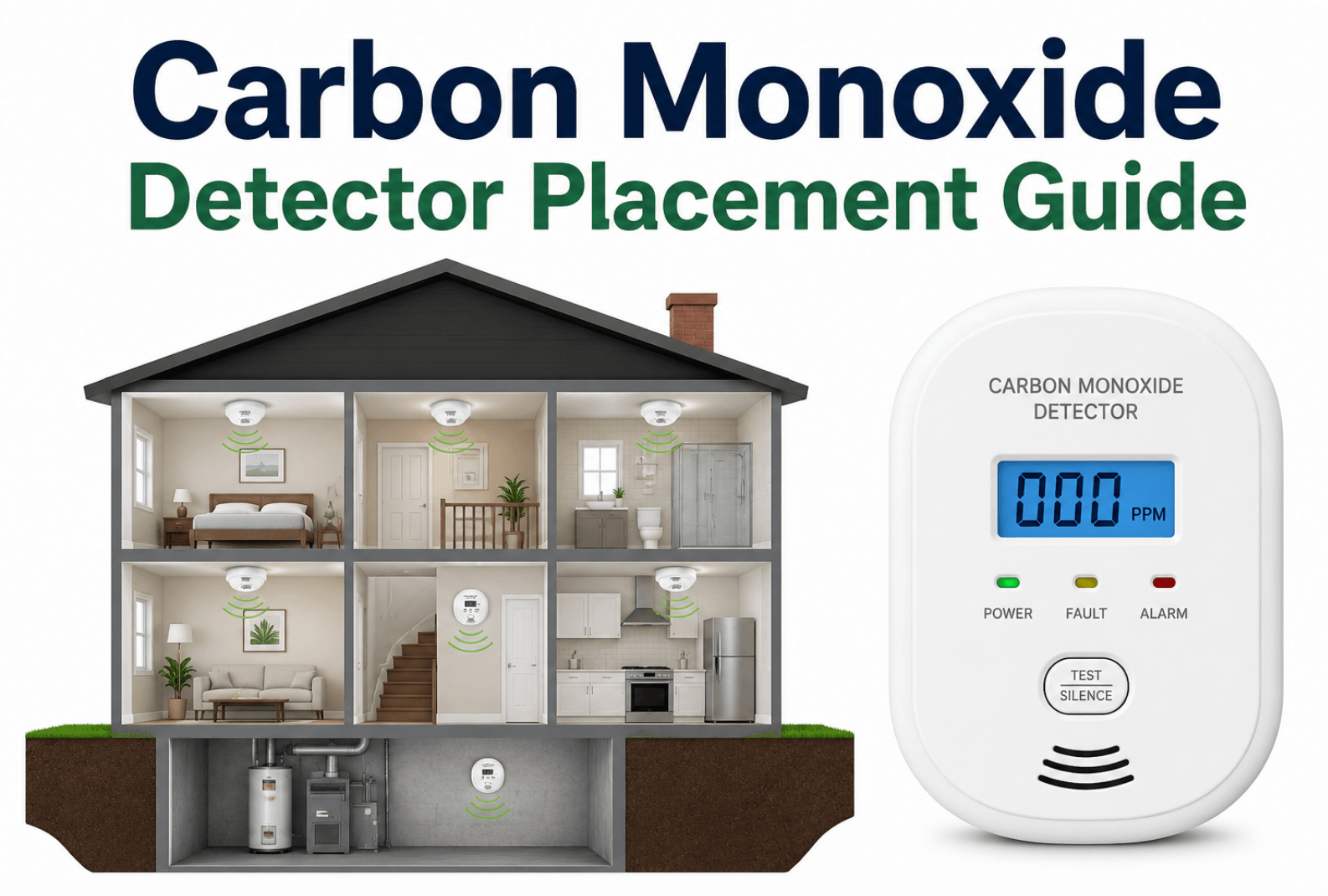
This guide walks through carbon monoxide detector placement room by room, explains the physics of why placement matters, and clears up the height myth that trips up most homeowners. By the end, you will know exactly how many detectors you need and where each one should go.
How Carbon Monoxide Behaves in a Room
Placement decisions only make sense once you understand how CO moves. Carbon monoxide has a molecular weight very close to that of air, so it does not sink to the floor like some heavier gases or rise straight to the ceiling like smoke. Instead, it mixes evenly with the surrounding air and disperses throughout the room.
Two practical consequences follow from this. First, CO tends to travel with warm air currents, which is why it can spread from a basement furnace to upstairs bedrooms surprisingly fast.
Second, because it diffuses rather than stratifies, you have more flexibility in mounting height than you do with a smoke alarm.
Manufacturers generally allow CO detectors to be placed on a wall, on a ceiling, or even on a tabletop, as long as the location is not obstructed.
The Golden Rule: Cover Every Sleeping Area
If you remember nothing else, remember this: the single most important job of a CO detector is to wake you up.
Most fatal carbon monoxide poisonings happen at night, when victims are asleep and never notice the early symptoms. That means your placement strategy should start from the bedrooms and work outward.
The widely accepted baseline, reflected in NFPA 720 (now folded into NFPA 72) and most US building codes, is straightforward:
- Install a CO detector on every level of the home, including the basement.
- Install one outside each separate sleeping area, within hearing distance of the bedrooms.
- For added protection, install one inside each bedroom, especially where someone sleeps with the door closed.
A closed bedroom door can significantly slow how fast an alarm in the hallway reaches a sleeper. If anyone in your home sleeps with the door shut, a detector inside that room is not optional in my view; it is the difference between a warning and a tragedy.
Room-by-Room Placement
Bedrooms
Place a detector inside each bedroom or, at minimum, in the hallway immediately outside the cluster of bedrooms.
Mount it where the alarm will be loud enough to wake a sleeping person. Keep it at least 10 feet (about 3 meters) from fuel-burning appliances, if any are present, and avoid placing it directly above or beside a heat or air-conditioning vent, which can blow CO away from the sensor and delay detection.
Hallways and Landings
A detector on each upstairs landing protects the path people travel during an emergency. In multi-story homes, a unit near the top of the stairwell catches CO rising with warm air from lower levels.
This is one of the highest-value placements in the entire house because a single detector covers the transition between floors.
Living Room and Common Areas
If your living room contains a fireplace, wood stove, pellet stove, or gas heater, it needs its own detector.
Mount it on a wall roughly 5 feet (1.5 meters) above the floor, which corresponds to the breathing zone of a seated or standing adult and gives a representative sample of room air.
Keep it at least 10 feet from the appliance itself to avoid nuisance alarms from brief, normal startup emissions.
Kitchen
Gas ranges and ovens produce small amounts of CO during normal operation, so the kitchen does need coverage, but placement requires care to avoid false alarms.
Mount the detector at least 10 to 15 feet (3 to 4.5 meters) from cooking appliances. Placing it too close means it will trigger every time you sear a steak.
Far enough away, it still catches a genuine problem such as a malfunctioning burner or a blocked flue.
Basement and Furnace Room
The basement is where most household CO originates: the furnace, water heater, and sometimes the laundry dryer all live here.
Install a detector in the basement, mounted on the wall about 5 feet above the floor, and keep it 10 to 20 feet from the furnace or water heater.
You want it close enough to detect a developing problem but not so close that routine combustion cycling sets it off.
If you have an attached garage, this level matters even more, because exhaust from a running engine migrates indoors fast.
Attached Garage
Never start a vehicle, generator, or gas-powered tool in a closed or attached garage. CO concentration climbs to lethal levels within minutes.
Place a detector in the living space adjacent to the garage, particularly near the door connecting the garage to the house.
Detectors inside the garage itself can be triggered by normal vehicle entry and exit, so the protective unit belongs on the house side of that shared wall.
The Height Myth: Does CO Detector Height Matter?
This is the most common question I get, and the answer surprises people. Because carbon monoxide mixes evenly with air rather than rising or sinking, mounting height is far less critical than it is for smoke alarms.
You can place a CO detector low on a wall, high on a wall, on the ceiling, or on a shelf, and it will still sample a representative slice of room air.
That said, there are sensible defaults. Wall-mounted units are usually placed at about eye level or roughly 5 feet from the floor.
Always follow the specific manufacturer’s instructions for your model, since some combination smoke-and-CO units must be ceiling-mounted to satisfy the smoke detection requirement. When in doubt, the manufacturer’s manual wins over any general rule of thumb.
Where NOT to Place a CO Detector
Just as important as the right spots are the wrong ones. Avoid these locations, which either blind the sensor or cause constant nuisance alarms.
- Within 10 to 15 feet of fuel-burning appliances such as furnaces, stoves, and water heaters, where normal startup emissions cause false alarms.
- Directly above or beside heating and cooling vents, fans, or open windows, where moving air sweeps CO past the sensor.
- In humid, steamy areas like directly inside bathrooms, where moisture can damage the sensor over time.
- In dead air spaces such as the peak of a vaulted ceiling or tight wall-ceiling corners, where air circulation is poor.
- In unconditioned spaces that get extremely hot or cold, like an unheated attic or an exposed garage, which fall outside most units’ rated operating range.
- Behind curtains, furniture, or anything that blocks airflow to the sensor.
Quick Reference: Detectors by Home Size
| Home Type | Minimum Detectors | Key Placement Priorities |
|---|---|---|
| Single-level apartment / condo | 2 | Outside sleeping area + main living space |
| Two-story house | 3 to 4 | One per floor + outside bedrooms + basement |
| House with attached garage | 4+ | Add unit on house side of garage door |
| Multi-story with finished basement | 4 to 5 | Every level + each bedroom + near furnace |
Treat these as minimums. More coverage is always safer, and interconnected detectors that all sound when one triggers offer the best protection.
Installation and Maintenance Tips
- Mount each detector firmly and confirm it is not loosened by vibration or drafts.
- Test every detector monthly using the test button and after any power outage.
- Replace batteries at least once a year, or choose units with sealed 10-year lithium batteries.
- Replace the entire detector every 5 to 7 years, or per the manufacturer’s stated lifespan, because the electrochemical sensor degrades over time even if the unit still powers on.
- Write the installation date on the back of each unit with a marker so you know when to replace it.
- Never paint over a detector or cover it, as this blocks the sensor.
What to Do When the Alarm Sounds
A CO alarm is not a drill. If it sounds like anyone feels dizzy, nauseous, has a headache, or feels confused, get everyone outside to fresh air immediately and call your local emergency number from outside.
Do not re-enter until emergency responders confirm the home is safe. If the alarm sounds but no one has symptoms, still move to fresh air, then call your gas utility or fire department’s non-emergency line to investigate the source. Resetting the alarm and going back to sleep is the mistake that kills people.
Final Thoughts
Carbon monoxide detection is one of the cheapest, highest-impact safety investments you can make in a home, but only when the detectors are placed correctly.
Start with the sleeping areas, cover every level, keep units away from appliances and vents, and respect the manufacturer’s instructions. Do that, and you turn a silent threat into one you will always hear coming.
This guide is for general educational purposes. Always follow your local building codes and the installation instructions provided with your specific detector model.
1 thought on “Carbon Monoxide Detector Placement Guide: Room by Room”