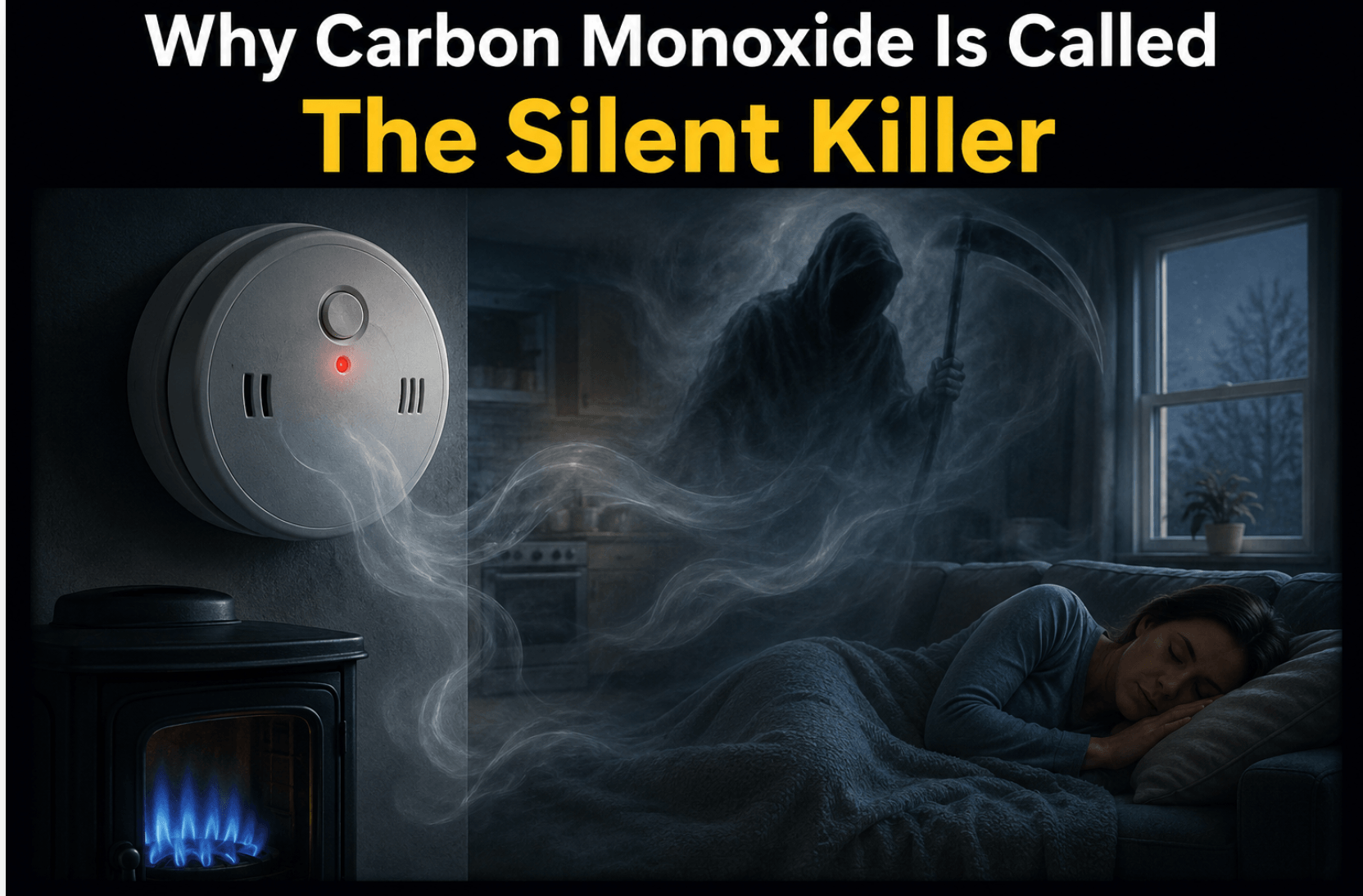
Every year, hundreds of people go to sleep in their homes, cabins, or job site trailers and never wake up.
Others collapse at their workbench, in a boiler room, or inside a confined space with no warning, no smell of danger, and no chance to react.
The cause in these cases is carbon monoxide (CO), a gas so stealthy that safety professionals, firefighters, and toxicologists all use the same nickname for it: The Silent Killer.
But why exactly did carbon monoxide earn that name, and what makes it more dangerous than almost any other common gas hazard?
As someone who has spent years working with industrial gas detection systems, I can tell you the answer comes down to three things: you can’t sense it, your body welcomes it, and its symptoms disguise themselves as something harmless.
Let’s break each one down.
What Is Carbon Monoxide?
Carbon monoxide is a simple molecule: one carbon atom bonded to one oxygen atom (CO). It’s produced whenever a carbon-based fuel burns incompletely, meaning there isn’t enough oxygen present for full combustion.
Common CO sources include:
- Gas furnaces, boilers, and water heaters with poor ventilation or cracked heat exchangers
- Gasoline and diesel engines (vehicles, generators, forklifts, pressure washers)
- Charcoal grills and portable camp stoves used indoors
- Wood-burning stoves and fireplaces with blocked flues
- Industrial processes: steel production, foundries, petrochemical operations, kilns
- Propane-powered equipment like floor buffers and ice resurfacers
Notice a pattern: nearly all of these are everyday appliances and equipment. CO doesn’t come from exotic industrial chemicals.
It comes from the furnace in your basement and the generator in your garage. That ordinariness is part of what makes it so deadly.
Reason #1: CO Is Completely Undetectable by Human Senses
This is the core of the “silent killer” name. Carbon monoxide is
- Colorless: you cannot see it, even at lethal concentrations
- Odorless: it has no smell whatsoever
- Tasteless: it produces no sensation in the mouth or throat
- Non-irritating: unlike ammonia, chlorine, or hydrogen sulfide, CO doesn’t sting your eyes, burn your nose, or make you cough
Compare that to other toxic gases. Hydrogen sulfide smells like rotten eggs (at least at low concentrations).
Chlorine has a sharp, bleach-like odor. Ammonia is immediately irritating. Naturally odorless, and even natural gas has mercaptan added specifically so you can smell a leak.
Carbon monoxide gives you nothing. No smell, no visible haze, no irritation, no warning of any kind. A room can contain a fatal concentration of CO and feel exactly like a room with clean air.
Your senses, the alarm system evolution gave you, are completely blind to it. That’s the first half of “silent.”
Reason #2: Your Body Actively Prefers CO Over Oxygen
Here’s where the killer part comes in, and it’s genuinely one of the cruelest tricks in toxicology.
When you breathe, oxygen enters your lungs and binds to hemoglobin, the protein in red blood cells that transports oxygen to your tissues and organs.
Carbon monoxide binds to that same hemoglobin but with roughly 200 to 250 times greater affinity than oxygen.
In other words, if both oxygen and carbon monoxide are present in your lungs, your blood chooses the poison.
When CO binds to hemoglobin, it forms carboxyhemoglobin (COHb). Every hemoglobin molecule occupied by CO can no longer carry oxygen.
As COHb levels rise, your body slowly suffocates from the inside even though you’re breathing normally and your lungs are full of air.
Approximate effects by carboxyhemoglobin level.
| COHb Level | Typical Effects |
|---|---|
| 0–5% | Normal range (smokers may run higher) |
| 10–20% | Headache, fatigue, shortness of breath on exertion |
| 20–30% | Throbbing headache, dizziness, nausea, impaired judgment |
| 30–40% | Severe headache, vomiting, confusion, fainting |
| 40–50% | Loss of consciousness, collapse |
| 50%+ | Seizures, coma, death |
And CO doesn’t leave quickly. The half-life of carboxyhemoglobin is around 4–6 hours breathing normal air, which means exposure accumulates over a shift or overnight.
A “low” concentration breathed for eight hours can be just as dangerous as a high concentration breathed briefly.
Reason #3: The Symptoms Disguise Themselves as the Flu
The third reason CO is called the silent killer might be the most insidious: its early symptoms mimic common, harmless illnesses.
Early CO poisoning feels like
- Headache
- Fatigue and drowsiness
- Nausea
- Dizziness
- Mild confusion or “brain fog”
Sound familiar? That’s a flu, a hangover, a bad night’s sleep, or simple tiredness at the end of a long shift. Victims routinely misdiagnose themselves. They take a painkiller. They lie down to rest.
And that’s the fatal decision because if the CO source is in the home, lying down to “sleep it off” means continuing to breathe the gas, often at even higher concentrations near a faulty appliance. Many CO fatalities are found in bed.
Worse, CO impairs judgment and cognition as levels rise. By the time symptoms become severe, victims are often too confused or weak to recognize the danger, call for help, or even walk out the door. The gas disables the very mental faculties you’d need to escape it.
Entire families have died this way, one by one, assuming they’d caught the same “stomach bug.”
The Numbers: How Deadly Is Carbon Monoxide?
Carbon monoxide is consistently among the leading causes of accidental poisoning deaths worldwide.
In the United States alone, unintentional, non-fire-related CO poisoning is responsible for roughly 400+ deaths and tens of thousands of emergency department visits every year.
Cases spike in winter, when heating systems run continuously and homes are sealed tight, and after storms and power outages, when portable generators get run in garages or too close to windows.
In industrial settings, CO is a constant concern in steel mills, foundries, mines, warehouses with propane forklifts, boiler rooms, and any confined space where combustion has occurred.
Occupational Exposure Limits for CO
For readers on the industrial side, these are the key exposure benchmarks in the United States:
- OSHA PEL: 50 ppm (8-hour time-weighted average)
- NIOSH REL: 35 ppm (8-hour TWA), with a 200 ppm ceiling
- ACGIH TLV: 25 ppm (8-hour TWA)
- NIOSH IDLH: 1,200 ppm (Immediately Dangerous to Life or Health)
Put those numbers in context: a poorly ventilated garage with a running vehicle can exceed the IDLH level in minutes.
A faulty furnace can quietly push a home well past occupational limits all night long.
Concentrations of 3,200 ppm can cause loss of consciousness in under 30 minutes; above 12,000 ppm, death can occur within one to three minutes.
The Only Defense: Detection Technology
Because human senses are useless against CO, the only reliable protection is electronic detection. This is not optional equipment; it’s the single layer standing between occupants and a gas they will never perceive.
In Homes
- Install CO alarms on every level of the home and outside every sleeping area (this is code in most jurisdictions)
- Choose alarms certified to UL 2034
- Test monthly and replace units per the manufacturer’s end-of-life date (typically 5–10 years; the sensor degrades even if the unit still powers on)
- Never run generators, grills, or engines indoors or in attached garages, even with the door open
In Industrial and Commercial Settings
- Fixed CO detection systems with electrochemical sensors for continuous monitoring in boiler rooms, parking structures, warehouses, and process areas
- Portable single-gas or multi-gas monitors for workers entering areas with combustion sources or confined spaces. CO is one of the four standard gases on virtually every 4-gas monitor (alongside O₂, H₂S, and LEL) precisely because it is so common and so undetectable
- Regular bump testing and calibration of a CO sensor that hasn’t been verified is a false sense of security, which is arguably worse than no sensor at all
Electrochemical CO sensors work by oxidizing CO at a sensing electrode, generating a current proportional to gas concentration.
They’re accurate, selective, and inexpensive; there is no economic excuse for leaving people unprotected.
What to Do If You Suspect CO Exposure
Get to fresh air immediately
Don’t stop to open windows or find the source.
Call emergency services
(911 in the US/Mexico area codes vary; use your local emergency number) and report suspected CO poisoning.
Get everyone out
Including pets, animals often show symptoms before humans do.
Do not re-enter
Do not re-enter until the fire department or a qualified technician confirms the space is safe.
Seek medical attention
Even if symptoms seem mild. COHb levels can be measured with a blood test, and treatment with high-flow oxygen dramatically shortens the half-life of carboxyhemoglobin.
The Bottom Line
Carbon monoxide is called “the silent killer” because it attacks through a perfect storm of stealth.
- It’s invisible to every human sense: no color, no odor, no taste, no irritation.
- Your own blood betrays you, binding CO 200+ times more readily than the oxygen you need to live.
- Its symptoms impersonate the flu, convincing victims to rest in the very environment that’s killing them while eroding the judgment they’d need to escape.
Against an adversary like that, awareness and detection technology aren’t just recommendations. They’re the entire defense.
A $30 CO alarm in a home, or a properly calibrated monitor on a worker’s belt, is quite literally the only voice this silent killer can’t take away.
FAQ: Why Carbon Monoxide Is Called “The Silent Killer”
Why can’t you smell carbon monoxide?
Carbon monoxide is a naturally odorless molecule. Unlike natural gas, no odorant is added to it because CO isn’t a distributed fuel.
It’s an unwanted byproduct of incomplete combustion, so there’s no supply chain where an odorant could be introduced.
How long does it take for carbon monoxide to kill you?
It depends on concentration. At extreme levels (12,000+ ppm), death can occur in 1–3 minutes. At moderate levels (400–800 ppm), serious symptoms develop within 45 minutes, and death can occur within 2–3 hours. Even low levels can be fatal over a full night of exposure.
Can carbon monoxide poisoning happen with windows open?
Open windows reduce risk but don’t eliminate it. If a strong CO source (like a generator or running vehicle) is nearby, dangerous concentrations can still accumulate. Never rely on ventilation alone; use a CO alarm.
Do carbon monoxide detectors expire?
Yes. The electrochemical sensor inside degrades over time, typically lasting 5–10 years. Every certified CO alarm has a replacement date printed on it; replace the entire unit by that date even if it still passes its test button check.