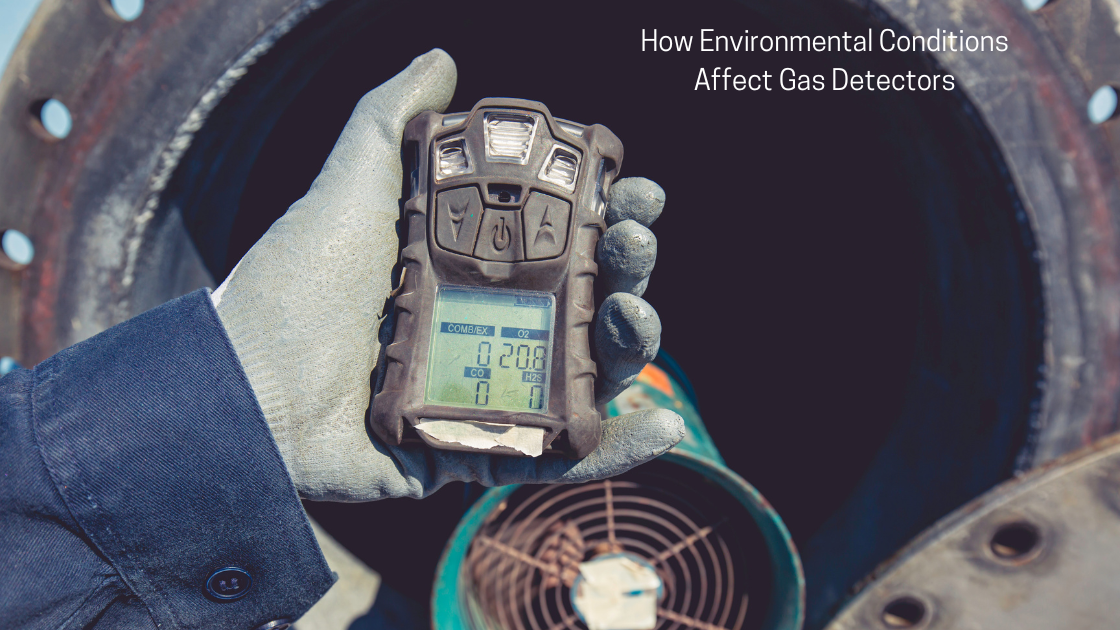
A gas detector doesn’t measure gas in a vacuum. It measures gas in a real plant, refinery, rooftop, or confined space, where the air is hot, cold, damp, dusty, or at a different altitude than the day it was calibrated.
Those conditions change how the sensor behaves, sometimes in small ways that stay within tolerance and sometimes in ways that make a reading dangerously wrong.
After years of field work with fixed and portable detection systems, I can tell you that many “mystery” alarms, drifting baselines, and failed bump tests trace back to the environment rather than a faulty sensor.
This guide explains how humidity, temperature, and pressure each affect gas detectors, what the effects look like in practice, and what you can do about them.
Why Environmental Conditions Matter for Gas Detection
Most gas sensors, whether electrochemical, catalytic bead, infrared, or photoionization (PID), rely on a physical or chemical reaction that is sensitive to its surroundings. Three things happen when conditions shift
The reaction rate changes
Chemical reactions speed up in heat and slow in cold.
The gas itself behaves differently
Pressure and temperature change how many gas molecules are in a given volume of air.
The sensor’s materials respond
Electrolytes, membranes, and optics can dry out, swell, fog, or contract.
Manufacturers publish operating ranges and compensation specs for exactly this reason. Staying inside those ranges, and understanding what happens near their edges, is a core part of reliable gas detection.
How Humidity Affects Gas Detectors
Humidity is the most underestimated variable. It affects almost every sensing technology, and in different ways.
Electrochemical sensors
Electrochemical sensors (commonly used for CO, H₂S, O₂, Cl₂, and other toxic gases) contain a liquid or gel electrolyte that is hygroscopic, meaning it absorbs and releases water depending on ambient humidity.
- Prolonged high humidity can cause the electrolyte to absorb water and swell, which in severe cases can lead to leakage and permanent sensor damage.
- Prolonged low humidity can dry the electrolyte out, reducing sensitivity and shortening sensor life.
- Rapid humidity changes (for example, moving from an air-conditioned control room into a humid process area) cause temporary baseline shifts and can trigger spurious readings until the sensor stabilizes.
Catalytic bead (LEL) sensors
Catalytic sensors are less sensitive to humidity than electrochemical cells, but high humidity and condensation can affect the heated beads and reduce responsiveness. Water vapor also changes heat transfer around the bead, which can slightly shift the reading.
Infrared (NDIR) sensors
Infrared detectors measure how much IR light a gas absorbs. Water vapor itself absorbs infrared at some wavelengths, and condensation on optical surfaces scatters or blocks light.
The result can be signal loss, drift, or fault conditions, especially when a warm instrument is exposed to cooler, moist air. If this is a recurring problem on your site, see our deeper article on how condensation affects infrared gas detection.
PID sensors
Photoionization detectors are notably sensitive to humidity. Moisture can reduce lamp output and cause water to condense on the lamp window, lowering sensitivity to volatile organic compounds (VOCs). Humidity-related drift is one reason PID lamps need regular cleaning.
Practical effects of humidity
- Slow or sluggish response
- Zero drift and unstable baselines
- Cross-sensitivity changes
- Sensor faults in IR devices
- Shortened sensor life with chronic extremes
How Temperature Affects Gas Detectors
Temperature affects both the sensor and the gas, and it is the main reason manufacturers build temperature compensation into the instrument.
Effect on sensor output
For electrochemical sensors, signal output rises with temperature and falls as it gets colder. A sensor calibrated at 20 °C may read noticeably differently at 40 °C or at 0 °C unless the instrument compensates.
Good detectors use a built-in temperature sensor and correction algorithm, but compensation is never perfect at the extremes.
Cold-weather problems
- Slower response times, since reactions and gas diffusion slow down
- Reduced sensitivity and signal, especially below about 0 °C
- Electrolyte freezing in some sensors at very low temperatures
- Battery capacity loss in portable detectors, so devices die early in cold conditions
Hot-weather problems
- Higher baseline and noise, which can raise the risk of false alarms
- Faster electrolyte evaporation, shortening electrochemical sensor life
- Thermal drift in electronics and IR optics
- Accelerated aging of components overall
Rapid temperature swings
Thermal shock is a hidden cause of trouble. Moving a detector from a cold truck into a warm facility (or the reverse) can cause temporary zero shifts, condensation inside the housing, and transient alarms. Letting the instrument acclimate before zeroing and bump testing is a simple, effective habit.
The “calibrate where you use it” rule
If you calibrate a detector in a 22 °C workshop and then deploy it in a 45 °C process area, you are introducing error from the start.
Where possible, calibrate and zero under conditions close to operating conditions, or confirm that the manufacturer’s compensation covers your range.
How Pressure Affects Gas Detectors
Pressure is the factor people mention least, but it matters in refineries, offshore platforms, high-altitude sites, and anywhere with pressurized sampling lines.
Partial pressure versus concentration
Many sensors, especially oxygen and electrochemical sensors, respond to the partial pressure of the target gas rather than its percentage by volume. That has a direct consequence:
- At higher altitude, total air pressure is lower, so oxygen partial pressure is lower even though the air is still about 20.9% oxygen by volume. An oxygen sensor calibrated at sea level may therefore read lower at altitude.
- A sudden pressure change (weather fronts, ventilation changes, or entering a pressurized area) can cause short-lived reading changes, particularly in electrochemical sensors.
Pressure and sampling systems
In pumped or remote-sampling detectors, pressure and flow go hand in hand:
- Blocked or restricted lines reduce flow, delay response, and can cause low-flow faults.
- Pressurized or vacuum process lines change sample flow and can skew readings if not regulated.
- Pressure differences between the calibration gas supply and ambient air can cause errors if you apply calibration gas with the wrong regulator or flow rate. Fixed-flow regulators (typically 0.5 L/min for many portables) exist for this reason.
Altitude and calibration
Always calibrate at the altitude of use, or use a detector that compensates for pressure. This is especially important for oxygen monitoring, where small errors can mean the difference between a safe and an unsafe confined space entry.
Quick Reference: Environmental Effects by Sensor Type
| Sensor type | Humidity | Temperature | Pressure |
|---|---|---|---|
| Electrochemical | Electrolyte swelling or drying, drift | Output rises with heat, slows in cold | Transient shifts; O₂ reads via partial pressure |
| Catalytic bead (LEL) | Moderate sensitivity, condensation issues | Mild drift; compensated well | Affects heat transfer slightly |
| Infrared (NDIR) | Condensation fogs optics; water vapor interference | Optical and electronics drift | Minimal, but affects gas density |
| PID | Strong sensitivity; lamp window fouling | Moderate drift | Sampling flow dependent |
Signs Your Detector Is Being Affected by the Environment
Watch for these symptoms before assuming the sensor is bad:
- Readings that drift up or down with the time of day or the weather
- Alarms during morning warm-up or after rain
- Baselines that won’t zero cleanly in the field
- Frequent bump test failures in only one season
- Repeated sensor faults in humid or cold locations
- Oxygen readings that differ between sites at different elevations
If you recognize a pattern tied to season, weather, or location, the environment is a prime suspect. For related troubleshooting steps, see our guide on zeroing and span issues in gas sensors, and our breakdown of false alarms in gas detection.
How to Reduce Environmental Effects on Gas Detectors
Choose the right detector for the environment
Check the manufacturer’s rated operating temperature, humidity (typically stated as % RH non-condensing), and pressure range. Specify extended-range or arctic/tropical-rated models where conditions demand them.
Calibrate under realistic conditions
Calibrate and zero at, or close to, the temperature, humidity, and pressure where the instrument will operate. Allow time for stabilization.
Acclimate the instrument
Give portable detectors time to adjust to the new environment before zeroing, bump testing, or entering a hazardous area.
Use accessories and protection
- Weather protection and sunshields to limit solar heating
- Hydrophobic filters and moisture traps for humid or wet environments
- Heated sensor housings or sample lines in cold, condensing conditions
- Dust and water ingress protection appropriate to the IP rating required
Maintain a sensible bump test and calibration schedule
Harsh environments accelerate drift. Increase the frequency of functional checks where conditions are extreme, rather than relying on a fixed interval from a mild environment.
Track trends
Fleet and device-management software can reveal patterns, such as drift that correlates with a specific site or season, long before they cause failures.
Store instruments properly
Keep spare sensors and portable detectors in stable, moderate conditions. Don’t leave them in hot vehicles or freezing sheds.
Frequently Asked Questions
Does humidity affect gas detector accuracy?
Yes. Humidity can swell or dry out electrochemical sensor electrolytes, fog infrared optics, and reduce PID lamp output.
Most detectors specify a non-condensing humidity range, and operating outside it increases drift and shortens sensor life.
How does temperature affect gas sensor readings?
Temperature changes the speed of the sensing reaction and the behavior of the gas. Electrochemical output generally rises with heat and falls in the cold. Most modern detectors compensate, but accuracy still degrades near the extremes of the rated range.
Does altitude or pressure affect oxygen sensors?
Yes. Oxygen sensors respond to partial pressure, so at higher altitude they may read lower than at sea level even though the oxygen percentage in air is the same. Calibrate at the altitude of use.
Why does my gas detector alarm in the morning or after rain?
Temperature and humidity swings are common causes. Condensation, thermal shock, and baseline shifts can trigger transient alarms, particularly in infrared and electrochemical sensors.
Should I calibrate gas detectors in the field or the workshop?
Calibrate in conditions as close as practical to where the detector operates, and always allow the unit to stabilize first. If you calibrate in a workshop, confirm the instrument’s compensation covers your field conditions.
Can environmental conditions cause false alarms?
Yes. Rapid humidity or temperature changes, condensation, and pressure transients are well-known contributors to false alarms and baseline drift.
Final Thoughts
Humidity, temperature, and pressure don’t just sit in the background of gas detection. They actively shape sensor behavior, calibration accuracy, and the life of the instrument.
The best defense is a combination of the right equipment for the conditions, calibration that reflects reality, sensible accessories, and a maintenance schedule that respects how harsh your environment really is.
Understanding these effects helps you separate real gas events from environmental artifacts, and that is what keeps both people and plants safe.
Always follow your manufacturer’s instructions and your site’s safety procedures. Specifications vary by model and sensor type.
.