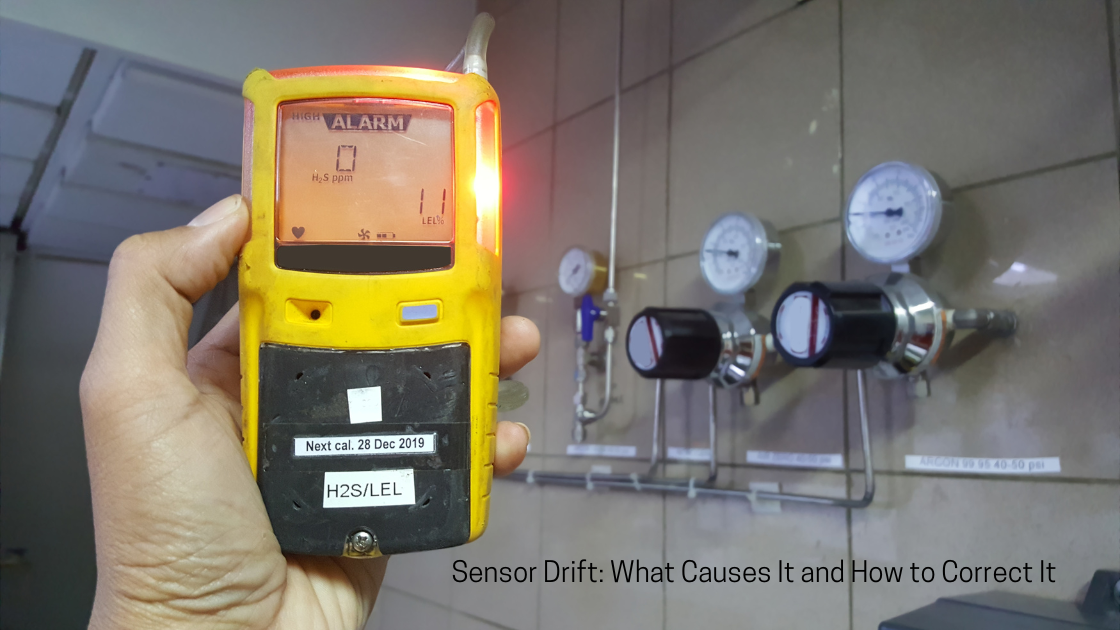
Sensor drift is the gradual change in a sensor’s output over time when the gas concentration, or the measured condition, has not changed.
In gas detection, it is one of the most common reasons an instrument that looked perfectly healthy at the start of the year can no longer be trusted to protect the person wearing it.
The danger is that drift is quiet. A drifting detector doesn’t throw an obvious fault. It simply reads a little low, or a little high, and keeps going.
Drift toward under-reading is the dangerous direction: the atmosphere gets worse, but the instrument tells you it’s fine.
This guide explains what sensor drift is, what causes it in each major sensor technology, how to detect it, and how to correct and prevent it, so your detectors stay accurate between calibrations.
What Is Sensor Drift?
Every sensor has a baseline (what it reads in clean air) and a sensitivity (how much signal it produces per unit of gas). Drift is a slow shift in one or both.
There are two types you need to know:
Zero drift (baseline drift)
The reading in clean air creeps away from zero (or from 20.9% for oxygen). A detector might show 3 ppm CO in clean air, or show a negative reading.
Span drift (sensitivity drift)
The sensor responds with a weaker or stronger signal than it should when exposed to a known gas. A sensor that reads 40 ppm when exposed to 100 ppm calibration gas has lost span.
Both can happen at the same time, and they can go in either direction. This is why a zero check alone is never enough to prove a detector is working.
Field note
In practice, a surprising share of “drift problems” turn out not to be the sensor at all. Expired calibration gas, the wrong flow rate, and zeroing the instrument in contaminated air all produce readings that look exactly like drift. Rule these out before you blame, or replace, the sensor.
Why Sensor Drift Matters for Safety
A gas detector is a safety-critical device. Drift affects safety in three ways:
Missed hazards
A sensor with reduced sensitivity may not alarm at the set point, or may alarm late.
False alarms
Positive zero drift can trigger nuisance alarms, which leads crews to distrust or bypass the detector.
Compliance risk
Standards, insurers, and site procedures expect documented evidence that detectors are within tolerance.
What Causes Sensor Drift?
Drift comes from a mix of sensor aging, environment, contamination, and handling. The mechanisms differ by sensing technology.
Natural aging
Every sensor is a consumable or semi-consumable component. Electrochemical cells slowly consume or lose electrolyte and catalyst activity.
Catalytic beads change as the active material sinters. Infrared sources and detectors degrade. Even with perfect care, sensitivity declines over the sensor’s service life.
Temperature changes
Temperature affects almost every sensor’s baseline and sensitivity. Most industrial detectors apply temperature compensation, but compensation is imperfect, especially during rapid temperature swings or when the instrument is calibrated at one temperature and used at another.
Calibrating a portable detector in an air-conditioned room and then using it in a hot process area is a classic source of apparent drift.
Humidity and condensation
Very dry air can dry out electrochemical sensors over time, while sudden humidity changes can cause temporary baseline shifts.
In optical sensors such as NDIR, condensation on windows or reflectors scatters and absorbs infrared light and changes the signal.
Pressure changes
Sensors respond to the partial pressure of gas. Large changes in barometric pressure, or moving between altitude levels, can shift readings, particularly for oxygen sensors.
Contamination and poisoning
Certain substances permanently degrade sensors:
- Catalytic (pellistor) sensors are poisoned by silicones, sulfur compounds such as H₂S, halogenated compounds, and lead compounds, which coat or deactivate the active bead and cut sensitivity.
- Electrochemical sensors can be affected by solvents, corrosive vapors, and cross-interfering gases.
- PID sensors lose sensitivity as the lamp window becomes fouled with deposits.
- NDIR sensors lose signal when dust, oil mist, or residue coats the optics.
Exposure to high gas concentrations
Exposing a sensor to gas well above its measuring range can saturate or damage it. Catalytic sensors in particular can show zero shift or reduced sensitivity after an over-range event. Many manufacturers recommend a bump test or full calibration after any high exposure.
Cross-sensitivity
Gases other than the target gas can produce a response. A CO sensor, for example, may respond to hydrogen. This is not drift in the strict sense, but it shifts the baseline and is often mistaken for it.
Mechanical shock and vibration
Drops, hard impacts, and constant vibration can disturb sensor internals, connections, and seals, leading to sudden baseline shifts or gradual sensitivity loss.
Electronics and power supply
Component aging, unstable supply voltage, and a low battery can all move the signal chain. This applies to both the sensor’s electronics and the transmitter or monitor.
Calibration errors
Poor calibration practice can introduce drift-like errors: wrong calibration gas concentration, expired or poorly stored cylinders, incorrect flow rate, incomplete stabilization time, kinked tubing, or zeroing in air that isn’t actually clean.
Sensor Drift by Technology: Quick Reference
| Sensor type | Main causes of drift | Typical symptoms | Common correction |
|---|---|---|---|
| Electrochemical (CO, H₂S, SO₂, O₂ and others) | Electrolyte loss, temperature and humidity swings, cross-sensitivity, end of life | Slow loss of span, baseline offset, slow response | Zero in clean air, span with certified gas, replace sensor at end of life |
| Catalytic bead (LEL) | Poisoning, thermal aging, over-range exposure | Reduced sensitivity, under-reading of combustibles | Calibrate, replace if span can’t be reached; avoid poisons |
| NDIR (infrared) | Dirty or fogged optics, source aging, condensation, temperature | Baseline drift, noisy readings, fault codes | Clean optics, zero with correct gas, replace if degraded |
| PID | Lamp window contamination, lamp aging, humidity | Loss of sensitivity, unstable baseline | Clean lamp and window, recalibrate, replace lamp |
| Semiconductor (MOS) | Humidity, aging, contamination, baseline wander | Drifting baseline, inconsistent response | Frequent zeroing and calibration, replace when unstable |
How to Detect Sensor Drift
You can’t correct drift you haven’t detected. Use these methods together.
Bump tests (functional checks)
Expose the detector to a known concentration of gas and confirm it responds and alarms. Many manufacturers specify a pass window, often within roughly ±10 to 20% of the test gas value, but always follow the manufacturer’s instructions and your site procedure. A bump test confirms function; it does not replace calibration.
Zero checks
In confirmed clean air (or the correct zero gas), the instrument should read zero (or 20.9% for oxygen). A reading that has moved from previous checks is an early warning.
Span checks
Apply calibration gas at the correct flow rate and compare the reading to the cylinder value. Loss of span is the most reliable indicator of a declining sensor.
Trend your calibration records
Compare “as-found” readings before adjustment with “as-left” readings after. If the as-found reading is moving further from true at each calibration, the sensor is on a drift path, and you can predict when it will fail.
Watch for secondary signs
Slow response time, noisy signal, frequent fault messages, and recurring nuisance alarms all point to a sensor that is going out of specification.
How to Correct Sensor Drift: Step by Step
Always follow the manufacturer’s calibration procedure for your specific model. The general approach looks like this.
Check the basics first
Confirm the calibration gas is in date, the concentration matches what the instrument expects, and the regulator, tubing, and calibration cap are in good condition with no leaks or kinks.
Let the instrument stabilize
Allow the detector to warm up and equalize to the ambient temperature before zeroing or spanning.
Zero in clean air or zero gas
Make sure the air is truly clean. For sensors that respond to ambient gases (for example, NDIR CO₂ sensors), use nitrogen or zero air rather than room air. Oxygen sensors are typically set to 20.9% in fresh air.
Span with certified gas
Apply the gas at the flow rate specified by the manufacturer (portables commonly use around 0.5 L/min), and allow the reading to stabilize fully before adjusting.
Inspect and clean
Check filters, dust screens, sensor guards, and (where accessible) optics or PID lamp windows. Replace clogged filters.
Record as-found and as-left values
This is your evidence of drift and your compliance record.
Replace the sensor if calibration can’t bring it into range
If the sensor can’t be zeroed or spanned within the manufacturer’s limits, or needs large adjustments each time, adjustment is no longer a fix. Replace the sensor.
A key warning
Repeatedly re-spanning a sensor that keeps losing sensitivity can hide a failing sensor. Calibration compensates for drift up to a point. Beyond that point the sensor has simply reached the end of its life.
How to Prevent Sensor Drift
You can’t eliminate drift, but you can slow it down and catch it early.
- Set calibration and bump-test intervals based on risk. Harsh environments, poison exposure, and critical applications justify more frequent checks than clean, stable ones.
- Bump test before each day’s use for portable detectors where your site procedure requires it.
- Protect sensors from poisons and contaminants. Keep silicone-based products away from catalytic sensors, use particulate and hydrophobic filters, and avoid unnecessary solvent exposure.
- Store detectors properly. Keep them within the manufacturer’s temperature and humidity range, and avoid long periods in hot vehicles or sealed cases.
- Allow time to acclimatize when moving instruments between very different temperatures.
- Use certified calibration gas from a reliable supplier, stored correctly and used before expiry.
- Use data logging or fleet management software to track calibration results, bump-test failures, and sensor age across your whole fleet so trends are visible before they become failures.
- Plan sensor replacement. Treat sensors as consumables with an expected service life, and replace them proactively on critical instruments.
How Often Should You Calibrate to Control Drift?
There is no single answer. Intervals depend on the manufacturer’s recommendations, the sensor type, the application, site policy, and applicable regulations.
Many manufacturers specify calibration at intervals measured in months, with more frequent functional checks.
If your as-found results show consistent drift, shorten the interval. If they stay stable over many cycles, any extension should be documented and justified under your safety program.
Frequently Asked Questions
What is sensor drift in a gas detector?
Sensor drift is the gradual change in a gas sensor’s reading over time without a change in actual gas concentration. It shows up as either a shifted baseline (zero drift) or a change in sensitivity (span drift).
What is the difference between zero drift and span drift?
Zero drift is an offset in the reading in clean air. Span drift is a change in how strongly the sensor responds to a known gas. Calibration needs to check both.
What causes sensor drift most often?
The most common causes are sensor aging, temperature and humidity changes, contamination or poisoning, exposure to high gas concentrations, and calibration errors such as expired gas or incorrect flow.
Can sensor drift be fixed by calibration?
Often yes, as long as the sensor is within its serviceable range. Calibration resets zero and span. If the sensor can’t be brought within the manufacturer’s limits, it should be replaced.
How do I know if my gas sensor needs replacing?
Common signs are failure to zero or span, large adjustments needed at each calibration, slow response, erratic readings, fault messages, and reaching the sensor’s rated service life.
Does a bump test detect sensor drift?
A bump test confirms that the sensor responds and alarms, and it can reveal significant loss of sensitivity. It doesn’t measure accuracy precisely, so it doesn’t replace calibration.
Is sensor drift the same as a faulty sensor?
Not necessarily. Some drift is normal and correctable. A faulty sensor is one whose drift or instability exceeds what calibration can correct.
Key Takeaways
- Sensor drift is a slow change in baseline (zero drift) or sensitivity (span drift) that happens to every sensor.
- Causes include aging, temperature, humidity, pressure, contamination, over-range exposure, shock, electronics, and calibration errors.
- Each technology drifts differently, so match your checks to the sensor type.
- Detect drift with bump tests, zero and span checks, and trend analysis of as-found data.
- Correct it with proper calibration using in-date certified gas, and replace sensors that can no longer be brought into range.
- Prevent it with sensible intervals, good storage, poison protection, and fleet-level data tracking.
Drift can’t be stopped, but it can be managed. A detector that is bump tested, calibrated on a sensible schedule, and tracked over its whole life is a detector you can trust when it counts.
Disclaimer: This article is for general educational purposes. Always follow the manufacturer’s instructions, your site safety procedures, and applicable regulations for your gas detection equipment.
Related reading on SafeguardSense