I have been working in the gas detection industry for the last 8 years and one of the most frequently question i get is how to select the right fixed gas detector.
How to Select the Right Fixed Gas Detector
Whether it is for your own application or you are helping the customer to select the right solution for them, this is the right sequence of questions and steps I go.
Step 1: Define the Hazard
This is the first step, you want to know what you are dealing with, you need to identify exactly what you are trying to detect, some of the most common hazards are the following.
- Flammable gases (methane, propane, hydrogen, solvents)
- Toxic gases (H₂S, CO, NH₃, Cl₂, silane, arsine)
- Oxygen deficiency or enrichment
- Volatile Organic Compounds (VOCs)
These are the questions you need to ask
What gas could be released?
- What concentration is dangerous?
- Is the primary concern toxicity, explosion risk, or oxygen displacement?
A detector must be selected for the specific target gas. No single technology can detect every gas effectively.
Step 2: Understand the Application
Knowing the specific gas they you want to detect is not enough, you need to determine where the detector will be installed.
Here are some of the examples.
| Application | Typical Hazard |
| Refinery | Hydrocarbon leaks |
| Chemical plant | Toxic gas releases |
| Semiconductor facility | Specialty toxic gases |
| Wastewater treatment | H₂S, CH₄ |
| Boiler room | CO, natural gas |
| Refrigeration plant | NH₃ |
| Battery room | H₂ accumulation |
The environment often dictates the detector technology and housing requirements. Honeywell industrial references highlight different detector solutions for oil & gas, chemical processing, wastewater, cold storage, and semiconductor applications.
Step 3: Select the Proper Sensor Technology
Selecting the right sensor technology is crucial for the gas detection system to work as it was designed, depending of the type of gas and environment you can select the right sensor for the application, here are some of the technologies recommended depending on what is the target gas.
Electrochemical Sensors
Best for:
- CO
- H₂S
- NH₃
- O₂
- Cl₂
Advantages:
- High sensitivity
- Excellent ppm-level measurement
Limitations:
- Limited sensor lifespan
- Potential cross-sensitivity
Catalytic Bead Sensors
Best for:
- Combustible gases
- General LEL detection
Advantages:
- Broad combustible gas response
- Cost effective
Limitations:
- Can be poisoned by contaminants
- Requires oxygen to function
Infrared (IR) Sensors
Best for:
- Hydrocarbon gases
- CO₂
Advantages:
- Resistant to poisoning
- Low maintenance
- Fast response
Honeywell’s Searchpoint Optima Plus IR detector is designed for harsh industrial environments where catalytic poisons may be present.
PID Sensors
Best for:
- VOCs
- Solvents
Advantages:
- Highly sensitive
- Fast response
Limitations:
- Requires regular calibration
Ultrasonic Gas Leak Detectors
Best for:
- Pressurized gas releases
- Outdoor windy environments
Advantages:
- Detects leaks before a gas cloud reaches a sensor
Step 4: Determine Detection Range
I have seen customers who select a 0 to 250 ppm co detector in an application that the co leaks can reach to 500 ppm and the detector is in constant overrange and it is alarming all the time.
You need to figure out the range of the leaks expected in your application and select the sensor range acordingly.
Select an appropriate measurement range.
Examples:
| Gas Type | Typical Range |
| H₂S | 0–100 ppm |
| CO | 0–500 ppm |
| Oxygen | 0–25% vol |
| Methane | 0–100% LEL |
The range must match both:
- Expected operating concentrations
- Safety limits
Step 5: Evaluate Environmental Conditions
You need to select your detector depending on the environment, for example if you want to detect Methane in normal environment you need a maybe the catalytic bead sensor is the best option but if you want to detect the same gas (methane) in the environment where the O2 levels are less than 10%, the infrared sensor is the best option.
Here are conditions you need to consider.
Temperature
- Extreme heat or cold
Humidity
- Condensation risk
- Corrosive environments
Dust and Water
- IP66/IP67 requirements
Vibration
- Compressors
- Rotating equipment
Corrosive Atmospheres
- Offshore platforms
- Chemical plants
Detector materials should be selected accordingly, often using stainless steel in harsh environments.
Step 6: Choose Point Detection or Open-Path Detection
In fixed gas detection you can select to detect the gas at a specific point or on a certain path.
Point Detectors
Used when:
- Leak source is known
- Monitoring pumps, valves, flanges, compressors
Pros:
- Highly localized measurement
- Lower cost
Open-Path Detectors
Used when:
- Large areas need coverage
- Perimeters or fence lines require monitoring
Pros:
- Covers long distances
- Detects moving gas clouds
Many facilities use a combination of both technologies.
Step 7: Determine Detector Placement
The location of the sensor is critical, you need to study the guy you are detection and check it is relative density ( you can find this on the msds).
For Light Gases
Install high.
Examples
- Hydrogen
- Methane
For Heavy Gases
Install low.
Examples:
- Propane
- Butane
- H₂S
Also you need to consider the following.
- Leak sources
- Airflow patterns
- Ventilation systems
- Obstructions
A poorly placed detector can miss a leak even if the detector itself is correct.
Step 8: Verify Required Certifications
Certifications are important, they are both required by local authorities and insurance companies.
Depending on the location of your project, check with local authorities and figure out which certifications are needed.
Typical certifications include
- ATEX
- IECEx
- UL
- CSA
- FM
Industrial installations often require detectors certified for hazardous locations. Honeywell fixed gas detection products include multiple global certifications for hazardous-area applications.
Step 9: Consider System Integration
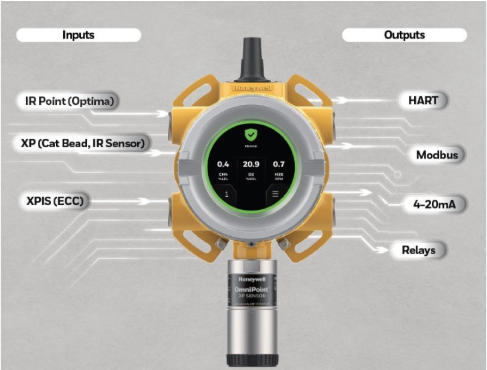
Fixed detector usually are connected to a larger control or building management system, you need to select the detector that can easily integrate with the current or future system.
Determine how the detector will communicate with the control system.
Common outputs
- 4-20 mA
- HART
- Modbus
- Relay outputs
Also verify compatibility with:
- DCS
- PLC
- Gas controllers
- Safety systems
Many modern transmitters support multiple communication methods and hot-swappable sensors to simplify maintenance.
Step 10: Evaluate Maintenance Requirements
Before you commit to buy the detector, you need to contact the manufacturer or the distributor and check what is the maintenance requirements like calibrations, you need to understand the frequency and the procedure, you need to figure out if your technicians will need new training or they can do it with minimum training.
These are some questions you can ask yourself.
- How often must calibration be performed?
- What is the expected sensor life?
- Are replacement sensors available?
- Can calibration be performed remotely?
Consider total lifecycle cost, not just purchase price.
Step 11: Perform a Risk-Based Coverage Assessment
This step with help you to figure out how many detectors you need, and to make sure that the area is protected properly.
Create a detector mapping study
- Identify credible leak sources.
- Determine gas release scenarios.
- Model dispersion patterns.
- Confirm detector coverage.
- Validate alarm actions.
A detector that is technically correct but poorly located provides little protection.
Quick Selection Matrix
| If You Need to Detect | Recommended Technology |
| H₂S | Electrochemical |
| CO | Electrochemical |
| Oxygen | Electrochemical |
| Methane | IR or Catalytic |
| Hydrocarbons | IR or Catalytic |
| CO₂ | IR |
| VOCs | PID |
| High-pressure gas leaks outdoors | Ultrasonic |
Final Rule of Thumb
When selecting a fixed gas detector, always answer these five questions first:
- What gas am I detecting?
- What concentration must be detected?
- Where will the detector be installed?
- What environmental conditions exist?
- What action should occur when gas is detected?
If these five questions are answered correctly, the proper detector technology, location, and system architecture usually become clear.