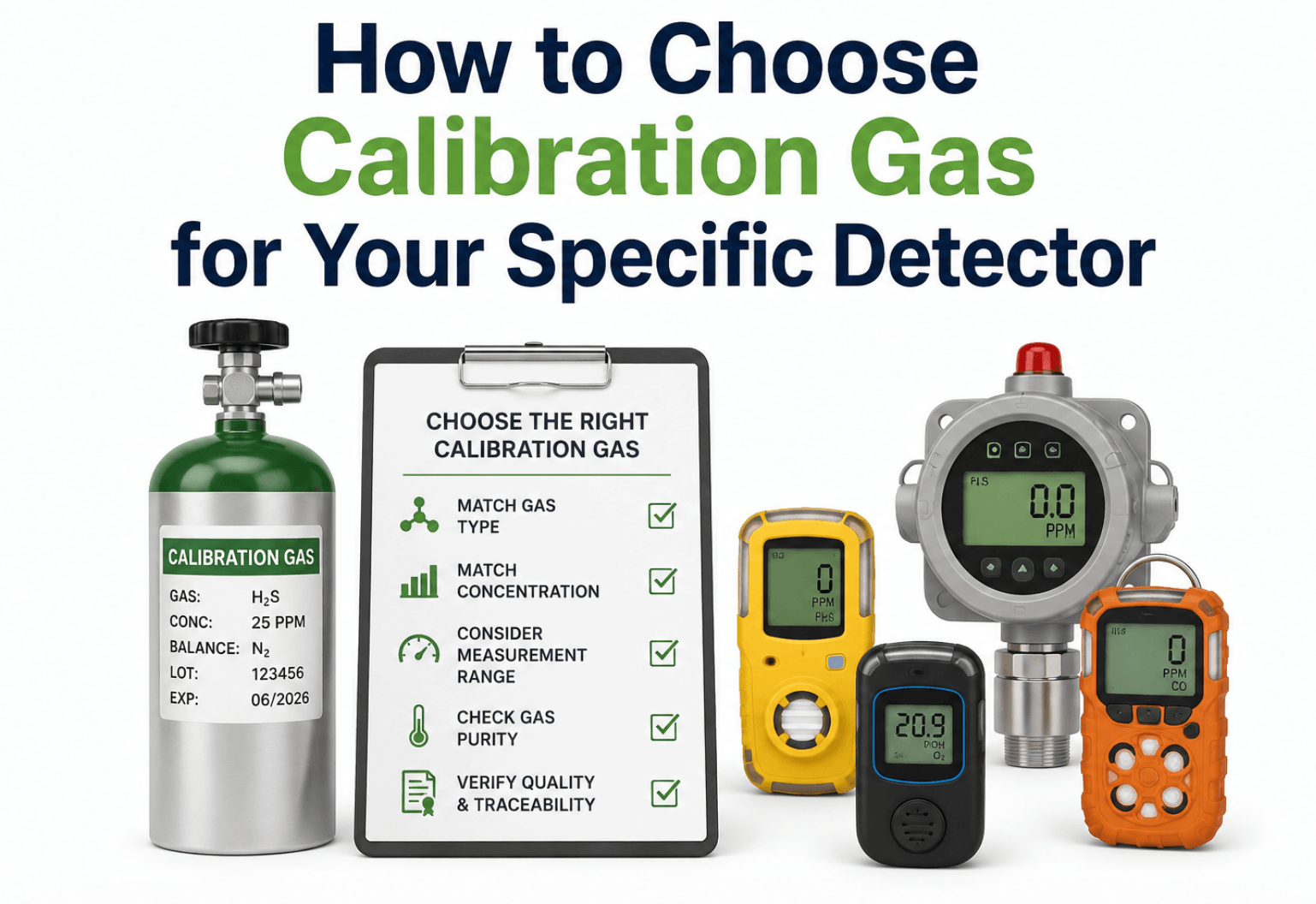
I worked in the gas detection industry for the last 8 years, and one thing I always tell my customers is to make sure you calibrate your unit using the right gas. In this article, I share how to choose calibration gas for your specific detector.
A gas detector is only as trustworthy as its last calibration, and a calibration is only as good as the gas you use to perform it.
Choose the wrong calibration gas concentration, balance, or cylinder type, and you can end up with a monitor that reads low when a real hazard is present, alarms falsely on a clean atmosphere, or drifts out of compliance with the standards your facility is audited against.
This guide walks you through exactly how to select the right calibration gas for your detector, covering target gases, concentrations, balance gases, cylinder sizing, and the documentation you need to stay audit-ready.
What Calibration Gas Actually Does
Calibration gas is a certified mixture of one or more gases at a known concentration, used to verify and adjust a detector’s response. There are two distinct operations people often confuse.
Bump test (functional test)
A short exposure to gas that confirms the sensor responds and the alarms trigger. It checks that the detector works, not how accurately.
Learn more about the bump tests.
Calibration (span calibration)
A full adjustment that aligns the detector’s reading to the certified concentration of the gas. It confirms how accurately the detector measures.
How to Choose Calibration Gas for Your Specific Detector
Here are the 6 steps you need to follow in order to select the right calibration gas for your detector.
Both rely on accurate, traceable calibration gas. If the gas is wrong, expired, or mislabeled, every reading downstream is suspect.
Step 1: Match the Calibration Gas to Your Sensor
The single most important rule: calibrate each sensor with the gas it is designed to detect, unless the manufacturer specifies a cross-calibration gas.
Common pairings include
Combustible (LEL) sensors
Typically calibrated with methane or pentane in air. Always confirm which one your monitor’s curve is set to, because a methane-calibrated unit will misread pentane and vice versa.
Oxygen sensors
Calibrated with a known O₂ concentration (often 20.9% in fresh air for the zero/span baseline, with a low-O₂ mix for span on some units).
Carbon monoxide (CO) sensors
Calibrated with CO in air or in a nitrogen balance.
Hydrogen sulfide (H₂S) sensors
Calibrated with H₂S, usually in a nitrogen balance to keep the reactive gas stable.
Photoionization detectors (PIDs)
Calibrated with isobutylene, the industry-standard reference gas, then corrected for the target VOC using a response factor.
For multi-gas monitors, you’ll generally use a four-gas mix (commonly CH₄/LEL, O₂, CO, and H₂S) so all sensors are calibrated in a single operation.
Step 2: Choose the Right Concentration
Concentration matters as much as the gas itself. The certified value should align with how your detector’s alarm points and measuring range are configured.
- Span the sensor near its alarm setpoints, not at the very bottom or top of its range. A span value in the middle of the working range gives the most reliable accuracy where it counts.
- Common four-gas mix values: Many facilities standardize on a mix such as 2.5% CH₄ (≈50% LEL), 18% O₂, 25 ppm or 100 ppm CO, and 25 ppm H₂S, but always verify against your detector manufacturer’s recommended span concentrations, as these vary by model.
- Single-gas detectors: Match the concentration to the manufacturer’s spec sheet. Using a higher-than-recommended concentration won’t make the detector “more sensitive”; it can saturate the sensor and skew the span.
When in doubt, the detector’s operations manual lists the exact recommended calibration gas concentration and balance.
Step 3: Select the Correct Balance Gas
The “balance” is the inert gas that makes up the remainder of the mixture. It is not a minor detail. It directly affects sensor behavior.
- Balance air is used when an oxygen sensor is part of the calibration because the sensor needs a realistic O₂ background.
- Balance nitrogen is used for reactive or single-gas mixes (like standalone H₂S or CO) where you don’t want oxygen present and where nitrogen keeps the reactive component stable longer.
A frequent mistake is using a nitrogen-balanced cylinder on a multi-gas monitor with an O₂ sensor, which throws off the oxygen reading. Match the balance to your sensor suite.
Step 4: Confirm Reactivity and Cylinder Material
Reactive gases like H₂S and chlorine can degrade inside the wrong cylinder, slowly lowering the actual concentration below the label value.
- Buy reactive gas mixes in treated/passivated aluminum cylinders designed to preserve concentration stability.
- Respect the shelf life printed on the certificate. Reactive mixes expire faster than stable mixes like methane or CO. An expired cylinder may still hold pressure while reading well below its certified value, producing a bad calibration that looks fine.
Step 5: Size the Cylinder for Your Usage
Cylinder size is a cost-and-logistics decision, not a calibration-accuracy one, but getting it wrong wastes money.
- High-volume / frequent calibration: Larger cylinders (e.g., 58L or 116L) lower the per-test cost.
- Occasional or field use: Smaller, lightweight cylinders are more portable and reduce the risk of paying for gas that expires before you use it.
- Match the regulator flow rate to your detector’s requirements (typically 0.25–0.5 LPM for diffusion sensors, higher for pumped/aspirated units). Too little flow starves the sensor; too much wastes gas.
Estimate your annual number of bump tests and calibrations, then choose a size where the cylinder will be used before its expiration date.
Step 6: Verify Traceability and Certification
For compliance and audits, calibration gas should be certified and traceable to a recognized standard (such as NIST-traceable in the U.S.). Each cylinder should ship with a certificate of analysis showing it.
- The exact certified concentration of each component
- The balance gas
- The lot number
- The expiration / use-by date
Keep these certificates on file. During an OSHA or internal safety audit, the certificate is what proves your monitor was calibrated against a known, valid standard.
Quick Reference: Calibration Gas Selection Checklist
Before you order, confirm:
- Target gas(es) match every sensor in the detector.
- Concentration aligns with the manufacturer’s recommended span values and alarm setpoints.
- Balance gas (air vs. nitrogen) suits your sensor suite, especially if an O₂ sensor is present.
- Cylinder material is appropriate for any reactive components.
- Cylinder size and regulator flow fit your calibration frequency and detector type.
- The certificate of analysis is traceable, current, and filed.
Common Mistakes to Avoid
Using expired gas, the pressure remaining in the cylinder does not mean the concentration is still valid.
Mismatching the LEL reference gas (methane vs. pentane) to the detector’s configured curve.
Using nitrogen balance with an O₂ sensor corrupts the oxygen calibration.
Spanning at the wrong concentration, leaving the detector inaccurate near its alarm thresholds.
Skipping the certificate leaves you unable to prove compliance later.
Final Thoughts
Choosing the right calibration gas comes down to a disciplined match: the correct target gases at the correct concentration, in the correct balance, in a cylinder that preserves the mixture and is certified to a traceable standard. Get those five elements right, and your detector will read true when it matters most.
Always defer to your detector manufacturer’s documentation for exact span values and procedures.
This guide explains the why behind each choice, but the spec sheet provides the precise numbers for your specific model.