Choosing between remote sampling and direct (diffusion-based) gas detection is one of the most consequential decisions in a gas detection system design and one that’s frequently made backwards, with the sensor technology picked before the sampling method is even considered.
Get it wrong, and you end up with a detector that’s technically accurate but physically incapable of catching a leak in time, or a system so maintenance-heavy that operators start bypassing it.
This guide breaks down how each method actually works in the field, where each one earns its keep, and how to make the call for your specific application, drawing on hands-on experience specifying and commissioning both types of systems in industrial environments.
What “Remote Sampling” and “Direct Detection” Actually Mean
Before comparing performance, it’s worth being precise about what these terms describe, because they’re often used loosely.
Direct (diffusion) gas detection places the sensor itself at the point where gas is expected to accumulate.
Ambient air diffuses naturally across the sensor element. No pump, no tubing. The sensor reads the air right where it sits.
Remote sampling (aspirated/extractive) detection separates the sensing element from the sample point.
A pump draws air through tubing from one or more remote locations back to a centrally located sensor or analyzer. The gas is measured “remotely” relative to where it’s actually present.
Both approaches can use the same underlying sensor technologies: catalytic bead, infrared (NDIR), electrochemical, or photoionization.
The difference is entirely in how the sample reaches the sensor, not in the sensing chemistry itself.
How Direct Detection Works in Practice
A diffusion-type detector relies on passive gas movement. Because there’s no pump pulling air through the unit, placement is everything: the sensor has to physically sit where the target gas is likely to be, accounting for vapor density, ventilation patterns, and likely leak points.
Typical applications
- Fixed point detectors mounted near compressors, valves, or flanges.
- Confined space monitors positioned at breathing zone height.
- Area monitors in process areas with known leak sources.
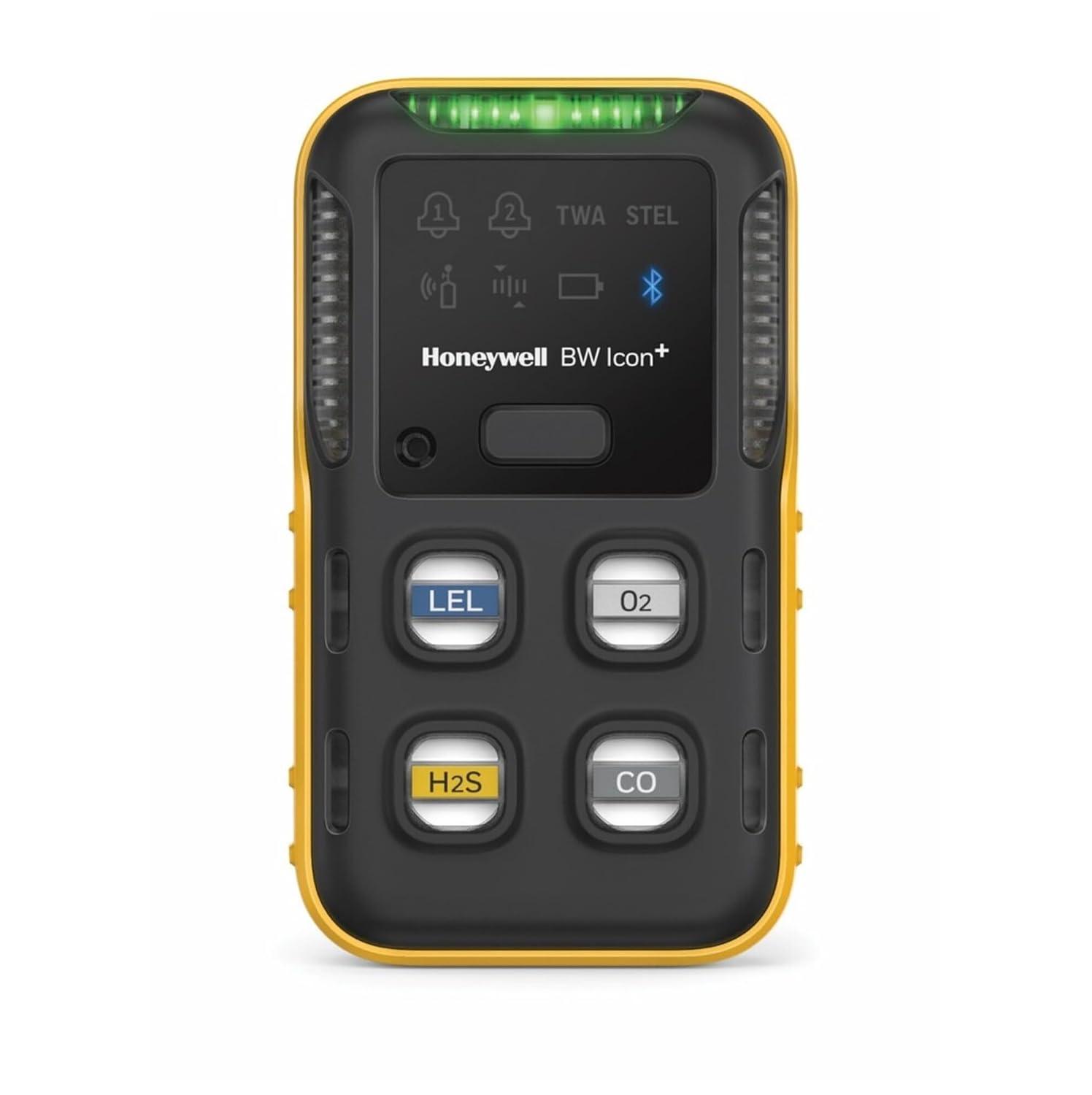
- Portable single- and multi-gas personal monitors.
Because the sensor is exposed directly to ambient conditions, direct detection tends to respond faster to a local leak.
There’s no transit time through tubing. It’s also mechanically simpler: fewer failure points, no pump to maintain, no tubing to crack or clog.
The tradeoff is coverage. A diffusion sensor only “sees” gas that reaches it by natural diffusion or air currents.
In areas with poor air movement, or where the leak source could be anywhere across a large or inaccessible space, a fixed grid of diffusion detectors gets expensive fast, and you can still miss pockets between units.
How Remote Sampling Works in Practice
An aspirated system uses a pump (integral or centralized) to actively draw air samples through tubing from one or more remote points to the sensor housing. This decouples sensor placement from sample point location entirely.
Typical applications
- Hazardous or hard-to-access locations (tank interiors, ductwork, elevated equipment, pits).
- Locations too hot, wet, or corrosive for a sensor to survive directly.
- Multi-point monitoring from a single centralized analyzer.
- Locations requiring the electronics to sit in a non-hazardous or easily serviceable area.
Because the sensor and its electronics can be mounted somewhere accessible and environmentally protected, remote sampling is often the only practical option in harsh or physically inaccessible locations.
It also enables true multipoint sequential sampling, one analyzer cycling through several sample points, which can reduce the total sensor count and calibration burden versus installing a diffusion detector at every location.
The tradeoff is response time and system complexity. Every meter of sample tubing adds transport lag before the gas reaches the sensor.
Long tubing runs, small-bore tubing, or low flow rates can push response times well past what a diffusion sensor would show for the same leak.
The pump, tubing, filters, and any moisture traps are additional components that need inspection, and a blocked or cracked line can silently defeat the entire system, a failure mode that direct detection doesn’t have.
Side-by-Side Comparison
| Factor | Direct (Diffusion) Detection | Remote Sampling (Aspirated) Detection |
|---|---|---|
| Response time | Fast, gas reaches sensor by ambient diffusion | Slower; depends on tube length, bore, and flow rate |
| Sensor placement | Must be at or very near the leak source | Sensor can be located away from the sample point |
| Best for hazardous/hot/wet areas | The limited sensor is directly exposed | Well suited; sensors and electronics stay protected |
| Multi-point monitoring | Requires one detector per point | One analyzer can sequence multiple sample points |
| Mechanical complexity | Low, no pump or tubing | Higher, pump, tubing, filters, possible moisture traps |
| Failure modes | Sensor drift, poisoning, physical damage | Tubing blockage, leaks, pump failure, in addition to sensor issues |
| Maintenance burden | Sensor calibration/replacement only | Sensor calibration plus tubing integrity checks and pump service |
| Typical calibration approach | Calibration gas applied directly at the sensor. | Calibration gas often applied at the sample point to validate the full sample path |
| Installation cost per point | Lower per point, scales linearly with points | Higher upfront (pump, tubing runs), but can be lower per point at scale |
| Coverage in low-airflow areas | Can miss pockets between sensors | Can actively pull samples from stagnant zones |
Response Time: The Detail That Gets Overlooked
This is where remote sampling systems most often disappoint on paper vs. in the field. Sample transport time isn’t a fixed number.
It depends on tubing length, internal diameter, pump flow rate, and even the gas being sampled (heavier or “sticky” gases like ammonia can lag further behind the calculated transport time due to adsorption on tubing walls).
As a working rule, every sample line should be time-tested during commissioning, not assumed from a manufacturer’s flow-rate spec sheet.
A system that calculates to a 20-second transport time on paper can easily run 40–60 seconds in practice once real tubing routing, elbows, and filter resistance are accounted for. For life-safety applications where alarm response time is part of the safety case, that gap matters.
Direct detection sidesteps this problem entirely, which is why it remains the default choice anywhere fast response at a known point is the priority, near a compressor seal, at a cylinder manifold, or in a confined space entry point.
Where Remote Sampling Wins Despite the Lag
Response time isn’t the only variable in the safety case. Remote sampling earns its place in scenarios where direct detection simply can’t function reliably.
Elevated or physically inaccessible points
Stack monitoring, ductwork, or equipment mounted where a technician can’t easily reach a sensor for calibration.
Extreme temperature or moisture environments
Furnace exhaust, steam-heavy process areas, or outdoor locations with condensation cycling that would degrade a directly mounted sensor
Classified area cost reduction
Keeping the sensor and electronics in a general-purpose or lower-classification area can reduce enclosure and wiring costs versus running intrinsically safe wiring to every point
Sequential multi-point sampling
One centralized analyzer monitoring a dozen points is often more cost-effective to maintain and calibrate than a dozen standalone detectors, especially for gases requiring more expensive sensor technology (PID, certain IR bands)
Where Direct Detection Wins Despite the Coverage Limits
Confined space entry
Response time is safety-critical, and the monitor typically travels with the entrant anyway
Portable and personal monitoring
Remote sampling isn’t practical for a worker moving through a facility.
Point-source leak detection
Flanges, seals, and connections with a known, specific leak risk.
Simplicity-driven reliability
Fewer components means fewer things to fail silently between inspections, which matters in facilities without dedicated instrumentation staff.
Maintenance Considerations That Change the Calculus
A detail that often gets underweighted during system design: aspirated systems require ongoing verification that the entire sample path is intact, not just that the sensor itself is functioning.
A pinhole leak in a sample line upstream of the pump can dilute the sample with ambient air, producing a falsely low reading, a failure that won’t necessarily trigger a fault alarm the way a dead sensor would.
Best practices for aspirated systems include
- Routine visual and pressure/flow checks on tubing runs, not just sensor calibration
- Bump testing and calibration gas applied as close to the actual sample point as feasible, not just at the analyzer inlet to validate the full path periodically
- Filter and moisture trap inspection on a defined interval, since clogged filters slow response time long before they trigger a fault
Direct detectors avoid this category of failure entirely, but they carry their own maintenance profile: more individual units to calibrate and inspect if a facility needs multi-point coverage.
Making the Decision: A Practical Framework
In practice, the choice usually comes down to answering four questions in order:
- Can a sensor physically survive and be serviced at the leak-risk location? If not, remote sampling is likely required regardless of response time tradeoffs.
- How fast does the alarm need to trigger relative to the hazard? For rapid-release hazards near workers, direct detection’s speed advantage often outweighs remote sampling’s flexibility.
- How many points need coverage, and how far apart are they? A handful of nearby points often favors individual diffusion detectors; many scattered points can favor a centralized aspirated system.
- What’s the realistic maintenance capacity of the site? A facility without dedicated instrument technicians may be better served by the simpler failure modes of direct detection, even at higher per-point hardware cost.
Many well-designed systems use both: direct detectors at critical, easily accessible, fast-response points and remote sampling for elevated, hazardous, or hard-to-reach locations that would otherwise go uncovered.
Treating this as an either/or choice for an entire facility is usually the wrong framing. The right framing is matching the method to each specific monitoring point’s constraints.
FAQ
Is remote sampling less accurate than direct detection?
Not inherently. The sensor technology and its accuracy are the same either way. What changes is response time and the risk of sample path issues (leaks, blockages, and adsorption) introducing error that a directly mounted sensor doesn’t have to contend with.
Can remote sampling be used for confined space monitoring?
It’s technically possible for pre-entry testing of a space before entry, but for continuous monitoring during entry, direct/portable detection is the standard approach since it travels with the worker and responds immediately to changing conditions.
How much does sample tubing length affect response time?
It varies with tubing bore, pump flow rate, and gas properties, but transport lag increases with tubing length in a roughly linear fashion up to typical manufacturer-rated maximum run lengths. Any run should be time-tested during commissioning rather than calculated from spec sheets alone.
Do remote sampling systems need more frequent calibration than direct detectors?
The sensor calibration interval itself is usually similar. What remote sampling adds is periodic verification of the sample path integrity, tubing, filters, and pump on top of standard sensor calibration.
Which method is better for outdoor installations?
It depends on the specific hazard. Remote sampling protects sensitive electronics from weather extremes, but wind and open-air dispersion can also make diffusion detection less predictable outdoors regardless of method.
Sensor placement relative to likely leak points matters more than the sampling method itself in open areas.