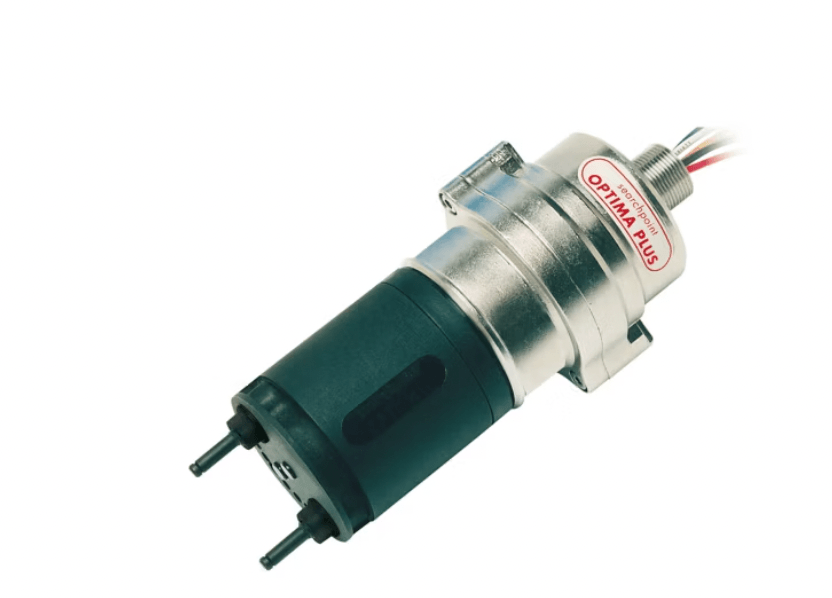
No, an NDIR sensor cannot detect hydrogen, and it never will. This isn’t a limitation of current technology or something manufacturers will eventually engineer around. It’s a hard boundary set by molecular physics.
I’ve spent years commissioning gas detection systems in industrial facilities, and this question comes up constantly, especially now that hydrogen projects are multiplying across energy, transport, and battery storage.
Engineers see NDIR performing brilliantly on methane and CO₂ and reasonably assume it can handle hydrogen too.
It can’t, and specifying the wrong sensor technology for a hydrogen application is a mistake that can have serious safety consequences.
Let’s break down exactly why NDIR is blind to hydrogen and which technologies you should use instead.
How NDIR Sensors Work (A 60-Second Refresher)
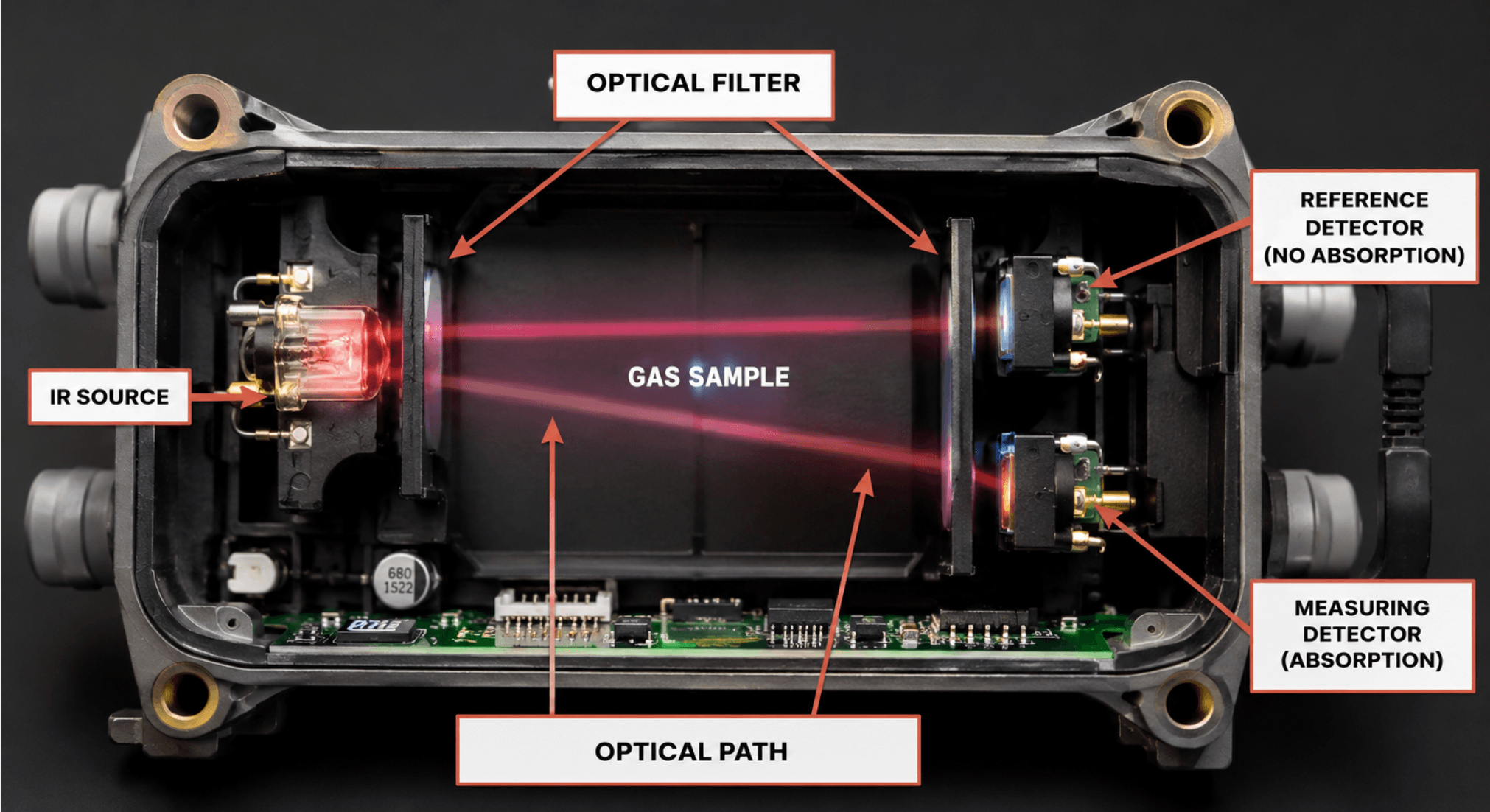
NDIR stands for non-dispersive infrared. The operating principle is elegant in its simplicity:
- An infrared source emits broadband IR light through a sample chamber containing the ambient gas.
- Target gas molecules in the chamber absorb IR energy at specific wavelengths unique to that gas (methane absorbs strongly around 3.3 µm, CO₂ around 4.26 µm).
- An optical filter isolates the wavelength of interest, and a detector measures how much IR energy made it through.
- More target gas in the chamber = more absorption = less energy reaching the detector. The electronics convert that attenuation into a concentration reading.
The entire technology depends on one thing: the target gas must absorb infrared radiation. And that’s precisely where hydrogen fails the entry requirement.
Why Hydrogen Is Invisible to Infrared
For a molecule to absorb infrared radiation, its vibration or rotation must produce a change in dipole moment, an asymmetry in how electrical charge is distributed across the molecule as it moves.
Hydrogen (H₂) is a homonuclear diatomic molecule: two identical hydrogen atoms sharing electrons perfectly symmetrically.
When an H₂ molecule vibrates, the charge distribution stays symmetric. There is no dipole moment, no change in dipole moment, and therefore no IR absorption at any wavelength an NDIR sensor can use.
This is the same reason NDIR can’t detect:
- Oxygen (O₂), homonuclear diatomic
- Nitrogen (N₂), homonuclear diatomic
- Chlorine (Cl₂), homonuclear diatomic
- Helium and argon, monatomic, no molecular vibration at all
Compare that with CO₂ or methane. These molecules have asymmetric vibration modes that create strong dipole changes, which is why they absorb IR so strongly and why NDIR is the gold standard for detecting them.
No filter, no wavelength selection, and no clever signal processing changes this. If the gas doesn’t interact with infrared light, an infrared sensor has nothing to measure.
What This Means in the Field
I’ve seen this misunderstanding cause real specification errors. A common one: a facility installs IR-based combustible gas detectors (calibrated for methane or propane) in an area that also has hydrogen risk, battery charging rooms, electrolyzer skids, and hydrogen-cooled generators.
The IR detectors work perfectly for hydrocarbons and give the team a false sense of coverage. Meanwhile, a hydrogen leak in the same space would pass through completely undetected.
If your hazard assessment includes hydrogen, an infrared point or open-path detector does not count toward your detection coverage for that gas. Full stop.
Sensor Technologies That DO Detect Hydrogen
Here are the technologies that actually work for H₂, and where each one fits.
Catalytic Bead (Pellistor) Sensors
The workhorse for combustible gas detection, including hydrogen. A heated catalytic element oxidizes the flammable gas, raising the bead’s temperature and changing its resistance.
Hydrogen oxidizes readily, so catalytic sensors respond well to it, typically reported in % LEL (hydrogen’s LEL is 4% by volume in air).
Strengths
It’s proven, affordable, and responds to virtually all flammables.
Limitations
It requires oxygen to operate, can be poisoned by silicones and sulfur compounds, and needs regular bump testing and calibration, ideally calibrated on hydrogen itself, since correction factors from methane calibration introduce error.
Electrochemical Hydrogen Sensors
These use an electrochemical cell where hydrogen oxidizes at a sensing electrode, generating a current proportional to concentration.
They’re the go-to for low-level (ppm-range) hydrogen monitoring, think battery rooms, hydrogen leak detection around process equipment, and medical or laboratory settings.
Strengths
Excellent sensitivity at ppm levels, low power, compact.
Limitations
Finite cell life (typically 2–3 years), cross-sensitivity to CO and other gases, and temperature and humidity effects.
Thermal Conductivity (TC) Sensors
Hydrogen has extremely high thermal conductivity, roughly seven times that of air. TC sensors exploit this by measuring how quickly the surrounding gas carries heat away from a heated element.
Strengths
Works without oxygen, no catalyst to poison, handles very high concentrations (0–100% volume), and has a fast response.
Limitations
Poor sensitivity at low concentrations; best suited for high-range measurement like inerting operations, hydrogen purity monitoring, and generator cooling systems.
Metal Oxide Semiconductor (MOS) Sensors
A heated metal oxide film changes resistance when reducing gases like hydrogen adsorb onto its surface.
Strengths
Very sensitive, long life, low cost.
Limitations
Broad cross-sensitivity (responds to many gases, not just H₂), drift, and humidity dependence are better for leak indication than precise measurement.
MEMS and Solid-State Hydrogen-Specific Sensors
A newer generation of sensors includes palladium-based and MEMS thermal conductivity designs built specifically for the hydrogen economy: fuel cell vehicles, refueling stations, and electrolyzers.
These are increasingly common where hydrogen selectivity and fast response (per standards like ISO 26142) are required.
Hydrogen Detection Technology Comparison
| Technology | Detects H2? | Typical Range | Needs O2? | Best For |
|---|---|---|---|---|
| NDIR (infrared) | ❌ No | N/A | No | CO₂, methane, hydrocarbons, never H₂ |
| Catalytic bead | ✅ Yes | 0–100% LEL | Yes | General combustible/LEL monitoring |
| Electrochemical | ✅ Yes | ppm range | No | Battery rooms, low-level leak detection |
| Thermal conductivity | ✅ Yes | % volume to 100% | No | High concentrations, purity, inerting |
| MOS / semiconductor | ✅ Yes | ppm–% | No | Low-cost leak indication |
| MEMS / Pd-based solid state | ✅ Yes | Varies | No | Fuel cells, refueling stations, H₂ economy |
Choosing the Right Approach
From a system design standpoint, here’s how I approach hydrogen detection specification:
Define the measurement goal first
Are you protecting against explosion risk (measure % LEL), monitoring for early leaks (ppm), or verifying gas purity (% volume? Each points to a different technology.
For flammability protection
Catalytic bead detectors calibrated on hydrogen remain the most common choice in fixed systems, often paired with thermal conductivity elements for full-range coverage.
For battery rooms and UPS installations
Electrochemical ppm-level sensors provide early warning long before concentrations approach the 4% LEL, usually with alarms at 1% and 2% volume (25% and 50% LEL).
Mind the placement
Hydrogen is the lightest gas that exists; it rises fast and accumulates at ceiling level, in roof peaks, and under canopies. Hydrogen detectors mount high, unlike propane or LPG sensors that mount low. Ventilation patterns matter enormously.
Never rely on odor
Hydrogen is colorless and completely odorless, and unlike natural gas, it’s typically not odorized because odorants poison fuel cells. Instrumented detection is the only reliable safeguard.
Frequently Asked Questions
Can an NDIR sensor detect hydrogen at any concentration?
No. The limitation is physical, not one of sensitivity. Hydrogen doesn’t absorb infrared radiation at all because it’s a symmetric homonuclear molecule with no dipole moment. No concentration of hydrogen produces any NDIR signal.
Why does NDIR work for methane but not hydrogen?
Methane (CH₄) has asymmetric vibration modes that change its dipole moment, producing strong IR absorption around 3.3 µm. Hydrogen’s vibration is perfectly symmetric, so it produces no dipole change and no IR absorption.
What is the best sensor for detecting hydrogen gas?
It depends on the range you need. Electrochemical sensors excel at ppm-level leak detection, catalytic bead sensors are the standard for % LEL flammability monitoring, and thermal conductivity sensors handle high-percentage concentrations. Many fixed hydrogen detection systems combine technologies.
Can infrared open-path detectors see a hydrogen cloud?
No. Open-path IR detectors have the same physical limitation as point NDIR sensors. For hydrogen, alternatives include ultrasonic leak detectors (which “hear” the acoustic signature of a pressurized leak) combined with catalytic or electrochemical point detection.
Does hydrogen affect NDIR sensors calibrated for other gases?
Hydrogen won’t produce a direct reading, but at very high concentrations it can slightly alter the thermal and optical properties of the sample chamber. In practice, treat NDIR as completely non-responsive to hydrogen for safety purposes.
Where should hydrogen detectors be mounted?
High, at or near ceiling level, above potential leak sources. Hydrogen is about 14 times lighter than air and rises rapidly, collecting at the highest points of an enclosure.
The Bottom Line
An NDIR sensor cannot detect hydrogen today, not with better engineering, not ever. Hydrogen’s symmetric molecular structure makes it fundamentally invisible to infrared absorption measurement.
If hydrogen appears anywhere in your hazard assessment, your detection layer needs catalytic bead, electrochemical, thermal conductivity, or hydrogen-specific solid-state sensors selected according to the concentration range that matters for your application.
Infrared detection is superb technology for the gases it can see. Knowing which gases it can’t see is just as important, and hydrogen tops that list.
2 thoughts on “Can an NDIR Sensor Detect Hydrogen?”