If you manage a facility where flammable gases, toxic vapors, or oxygen-deficient atmospheres are a risk, you already know that your gas detectors are one of your most critical lines of defense.
But knowing you need them is only half the battle. The other half is making sure they actually work when it matters, and that comes down to calibration.
So, how often should gas detectors be calibrated? The short answer is: at minimum annually, often more frequently, and always according to the manufacturer’s specifications and applicable standards. But that answer leaves a lot of important details on the table.
In this guide, we’ll break down the calibration intervals recommended by major safety standards, the factors that can push your schedule shorter, the difference between a bump test and a full calibration, and what happens if you skip calibration altogether.
What Is Gas Detector Calibration?
Before we get into frequency, it’s worth being precise about what calibration actually means.
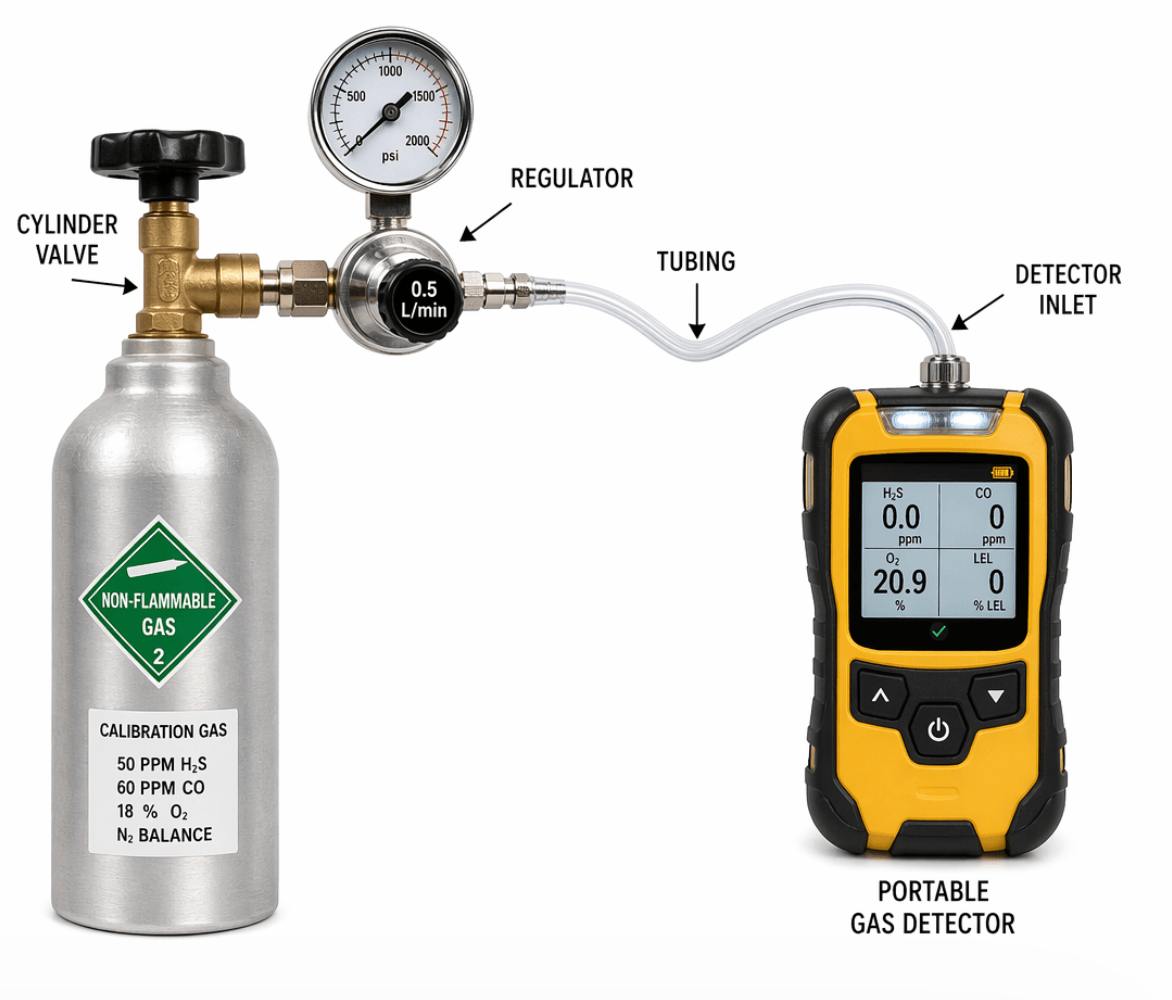
Calibration is the process of exposing a gas detector to a known concentration of target gas, called a calibration gas or span gas, and adjusting the instrument’s response until its reading matches the known concentration. This ensures the sensor is reading accurately across its detection range.
Most fixed and portable gas detectors have two key calibration points:
- Zero calibration: exposing the sensor to a clean, gas-free air source and setting that as the baseline reading.
- Span calibration: exposing the sensor to a known concentration of the target gas and confirming (or correcting) the reading at that point.
Both steps are required for a complete calibration. Skipping either one means you’re not fully calibrated, even if the instrument shows no error code.
Read more about gas detector calibration
Bump Testing vs. Full Calibration: What’s the Difference?
This is one of the most frequently misunderstood areas in gas detection maintenance, and confusing the two can create serious safety gaps.
A bump test (also called a functional test or challenge test) is a quick check to confirm the sensor responds to gas and triggers the alarm at the correct threshold.
You expose the instrument to a concentration of gas above its alarm setpoint and verify that the alarm activates. A bump test does not verify the accuracy of the reading, only that the sensor reacts.
A full calibration actually verifies and corrects the accuracy of the reading by comparing the instrument’s output against a traceable reference gas concentration.
Which one do you need, and when?
| Test Type | What It Confirms | How Often |
|---|---|---|
| Bump Test | Sensor responds, alarms trigger | Before each use (portable detectors) |
| Full Calibration | Reading accuracy is within spec | Per manufacturer / standard (typically every 6–12 months) |
Many safety standards allow bump testing to substitute for daily full calibrations, but only if the instrument passes the bump test. If it fails, you must perform a full calibration before the instrument returns to service.
How Often Should Gas Detectors Be Calibrated? Industry Standards Explained
There is no single universal law that dictates a calibration interval for all gas detectors in all applications. Instead, the required frequency depends on:
- The applicable regulatory standard or industry code
- The manufacturer’s recommendations
- The type of detector (portable vs. fixed)
- The operating environment
- Your company’s internal safety management system
Here’s how the major standards and authorities address calibration frequency.
OSHA Requirements
OSHA does not publish a universal, specific calibration interval for gas detectors. Instead, OSHA generally defers to the instrument manufacturer’s recommendations and requires that equipment be maintained in proper working condition. Key OSHA standards that reference gas detection include:
- 29 CFR 1910.146 (Permit-Required Confined Spaces) requires atmospheric testing with properly maintained equipment.
- 29 CFR 1926.103 (Respiratory Protection in Construction) requires equipment inspection and maintenance per the manufacturer’s specifications.
In practice, OSHA compliance means following the manufacturer’s calibration schedule as a minimum and documenting that you’ve done so.
NIOSH and CDC Guidance
NIOSH recommends that portable direct-reading instruments used in industrial hygiene and confined space entry be bump tested before each use and calibrated at intervals specified by the manufacturer, which for most sensors means every 3 to 6 months at a minimum for high-risk environments.
ISA-92.0.01 and ISA Standards
ISA (the International Society of Automation) standards for toxic gas detector installations generally recommend calibration at least every 6 months for fixed detectors, with more frequent intervals in challenging environments.
CSA Z94.4 (Canada)
For environments governed by Canadian standards, CSA Z94.4 recommends that portable gas detectors be bump tested before each use and calibrated according to manufacturer specifications, typically at least every 6 months.
The Manufacturer Recommendation Rule
Whatever standard governs your facility, the manufacturer’s recommendation is always the floor, never the ceiling. Some manufacturers specify:
- Monthly calibration for sensors in high-humidity or chemically aggressive environments
- Quarterly calibration is the standard interval for most applications
- Annual calibration is acceptable for low-exposure, controlled indoor environments
Always check your specific instrument’s manual. If the manufacturer says calibrate every 6 months and OSHA says follow the manufacturer, then 6 months is your regulatory minimum.
Factors That Require More Frequent Calibration
A 6- or 12-month calibration schedule is a starting point, not a ceiling. Several real-world conditions can cause sensor drift between scheduled calibrations and should push your interval shorter.
Sensor Exposure to High Gas Concentrations
If your detector has been exposed to a high-concentration gas event, a spill, a leak, or an alarm condition, the sensor may be saturated or partially poisoned. Calibrate before returning it to service.
Harsh Environmental Conditions
Sensors used in.
- High humidity or condensation environments
- Extreme heat or cold
- Environments with airborne contaminants (dust, oil mist, silicone vapors)
…will drift faster than sensors in controlled indoor environments. If your detector lives in a boiler room, a chemical processing unit, or an outdoor compressor station, calibrate more often.
Sensor-Poisoning Substances
Certain compounds can permanently or temporarily impair electrochemical and catalytic bead sensors.
Silicones, sulfur compounds, and halogenated hydrocarbons are common offenders for LEL (lower explosive limit) catalytic sensors.
If your environment contains any known sensor poisons, increase calibration frequency and budget for earlier sensor replacement.
After Storage or Inactivity
A gas detector that has been in storage or not used for an extended period should be calibrated before returning to service. Sensors can drift during inactivity, and battery charge levels affect some sensor types.
After Physical Impact or Damage
Any time an instrument has been dropped, submerged, or physically stressed, perform a full calibration before returning it to service, regardless of when the last calibration was.
Change in Application or Target Gas
If a detector originally calibrated for methane is now being used near a hydrogen source, it needs to be recalibrated with the appropriate span gas. Cross-sensitivity and correction factors must be accounted for.
Calibration Frequency by Detector Type
Portable Gas Detectors
Portable detectors used for confined space entry, personal protection, or area monitoring should be:
- Bump tested before every use. This is the industry standard expectation and cannot be skipped in regulated environments
- Fully calibrated at least every 3–6 months, or more frequently per manufacturer specification or environmental conditions
Many safety programs require portable detector calibration to be documented for each individual unit by serial number.
Fixed Gas Detectors
Fixed detector calibration intervals are often set in the facility’s Process Safety Management (PSM) plan, mechanical integrity program, or preventive maintenance schedule. Typical intervals.
- Bump test: Monthly or quarterly
- Full calibration: Every 3–6 months for high-risk environments; every 6–12 months for lower risk applications
Fixed detector calibration typically requires a technician to apply a test gas directly to the sensor head in place, or to remove the sensor and test it in a calibration station. In some facilities, remote calibration capabilities are built into the system.
What Happens If You Skip Calibration?
Skipping calibration doesn’t just mean your paperwork is incomplete. It means your detection system may be providing false confidence. The consequences fall into three categories.
Safety Risk
A sensor that has drifted will either:
- Under-read, failing to alarm at a dangerous concentration, potentially allowing a toxic or explosive atmosphere to develop undetected
- Over-read, nuisance alarming in clean air, which leads workers to distrust the equipment and bypass alarms
Both outcomes are dangerous. Under-reading is an obvious hazard. Over-reading creates alarm fatigue, which is one of the leading contributors to workers ignoring alarms in genuine emergencies.
Regulatory and Liability Exposure
If an incident occurs and your gas detectors have not been calibrated per manufacturer or regulatory requirements, you are exposed to:
- OSHA citations and fines
- Liability in civil litigation
- Loss of insurance coverage in some jurisdictions
- Potential criminal liability under egregious violation standards
Calibration records are discoverable in any investigation or lawsuit. The absence of records is as damaging as a bad reading.
Financial Risk
Sensor drift, if undetected, can also cause false negatives that lead to process upsets, equipment damage from undetected gas exposure, or false positives that trigger unnecessary plant shutdowns.
The cost of an emergency shutdown or an incident response dwarfs the cost of a calibration program by orders of magnitude.
How to Build a Gas Detector Calibration Schedule
If your facility doesn’t have a documented calibration program yet, here’s a straightforward framework:
Step 1: Inventory Your Detectors
List every gas detector by type (portable/fixed), model, serial number, sensor type, and target gas.
Step 2: Pull Manufacturer Specifications
For each instrument, record the manufacturer’s recommended calibration interval and the required calibration gas type and concentration.
Step 3: Apply the More Stringent Requirement
If the manufacturer recommends 6 months and your internal safety standard says quarterly, use quarterly. Never use the less stringent of two applicable requirements.
Step 4: Document and Schedule
Enter calibration due dates into your CMMS (Computerized Maintenance Management System) or a dedicated calibration management tool. Each calibration record should include:
- Date and time of calibration
- Instrument serial number
- Technician name
- Zero and span gas concentrations were used
- Pre-calibration reading
- Post-calibration reading
- Pass/fail result
- Any corrective action taken
Step 5: Review Annually
Review your calibration program annually. If instruments are consistently drifting between calibrations, shorten the interval.
If sensors are failing calibration repeatedly, investigate the root cause. Sensor age, environment, or a process change may be the driver.
Calibration Gas: Using the Right Reference
The calibration is only as good as the reference gas you use. Calibration gas cylinders should be:
- NIST-traceable (or equivalent national standard traceable) with a certificate of analysis
- Within the expiration date, gas concentrations change over time, especially reactive gases like hydrogen sulfide
- Appropriate concentration, typically 40–60% of full scale for span calibration, or as specified by the manufacturer
- Stored properly, away from heat, direct sunlight, and ignition sources
Never use field gas drawn from the process itself as a calibration reference. You cannot confirm its concentration, and cross-contamination can damage the sensor.
FAQ: How Often Should Your Gas Detectors Be Calibrated?
Can I calibrate my own gas detector, or do I need a certified technician?
Most portable gas detectors are designed to be calibrated by a trained user, not necessarily a third-party technician.
Fixed detector calibration often requires a technician with system access. Your company should have a trained, documented procedure for whoever performs calibrations.
How long does a gas detector calibration take?
A full calibration for a portable 4-gas monitor typically takes 5–15 minutes. Fixed detector calibration may take longer depending on access requirements and the complexity of the detector system.
Does calibration reset the sensor lifespan?
No. Calibration corrects the sensor’s output but does not restore a degraded sensor. Electrochemical sensors typically have a 2–3 year lifespan; catalytic bead (pellistor) sensors can last 3–5 years under good conditions. Sensors that fail to calibrate or drift rapidly are approaching the end of their life.
What is a calibration certificate?
A calibration certificate is a document confirming that an instrument was tested against a known reference standard on a specific date and time, and the results were within acceptable tolerances. Some regulatory environments require certified calibrations performed by accredited laboratories.
The Bottom Line
Gas detector calibration frequency depends on the instrument, the environment, the regulatory standard, and the risk level of your application.
But the guiding principle is simple: calibrate at the interval that ensures your sensors are reading accurately, and document every step.
At a minimum
- Bump test portable detectors before every use
- Fully calibrate every 3–6 months, or per your manufacturer’s specification
- Calibrate any detector that has been exposed to high gas concentrations, physical shock, or adverse conditions before returning it to service
- Keep traceable records for every calibration event
A gas detector that isn’t calibrated isn’t a safety device. It’s a false sense of security. Build your calibration program before you need it, not after.