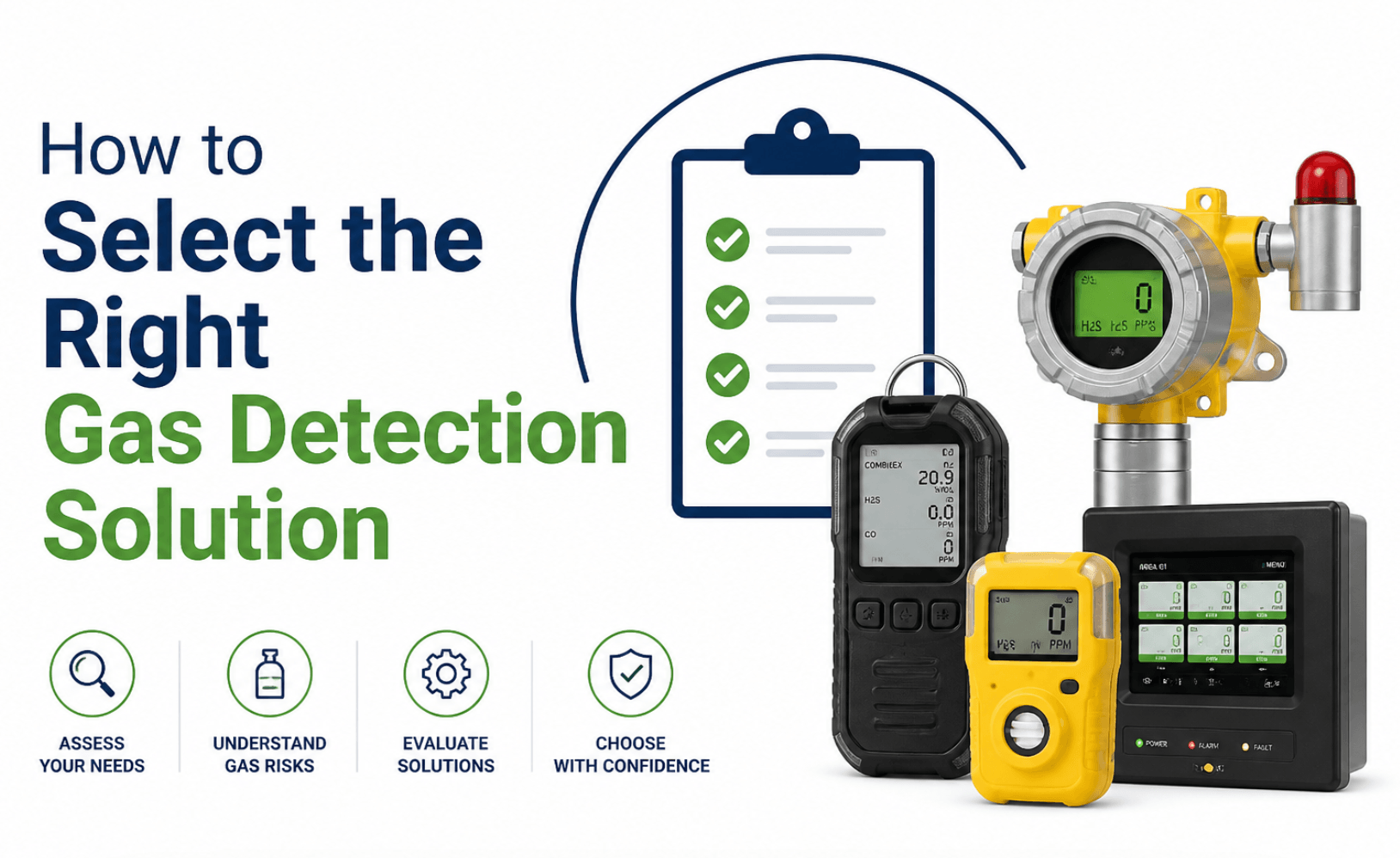
Selecting the right gas detection solution is one of the most consequential safety decisions a facility manager, safety engineer, or plant operator can make.
Get it right, and your team works inside a well-protected environment with reliable early warning against invisible, potentially fatal hazards.
Get it wrong, and you risk false alarms that erode trust in the system, missed detections that lead to tragedy, or costly over-engineering that drains your safety budget.
This guide walks you through every factor that matters, from understanding the hazards you face to matching sensor technology to your specific gases to deciding between fixed and portable instruments so you can make a confident, defensible selection.
Start With a Hazard Identification Assessment
Before you compare datasheets, you need to clearly define what you are protecting against. A gas detection solution is only as good as your understanding of the hazards it must detect.
Ask these questions at the outset
What gases are present or could be present?
List all gases associated with your process, feedstock, stored chemicals, combustion equipment, and maintenance activities.
Common industrial hazards include methane (CH₄), hydrogen sulfide (H₂S), carbon monoxide (CO), ammonia (NH₃), chlorine (Cl₂), oxygen (O₂ deficiency and enrichment), and volatile organic compounds (VOCs).
What are the credible release scenarios?
A slow flange leak behaves very differently from a catastrophic pipe rupture. Your detection strategy must cover both low-level chronic exposure and acute emergency scenarios.
What are the regulatory and code requirements?
Depending on your industry and jurisdiction, specific standards may govern your detection system. In the United States, relevant frameworks include NFPA 72 (fire and gas alarm systems), NFPA 101 (life safety), OSHA permissible exposure limits (PELs), and industry-specific standards such as API RP 505 for the petroleum industry.
In Mexico, NOM-029-STPS governs maintenance of electrical equipment in hazardous areas, while NOM-022-STPS covers static electricity in workplaces with flammable atmospheres.
A formal hazard identification, whether a simplified risk assessment or a full HAZOP study, should be your starting point.
Understand the Two Core Categories: Fixed vs. Portable Gas Detection
Every gas detection solution falls into one of two broad categories, and many facilities require both working together.
Fixed Gas Detection Systems
Fixed detectors are permanently installed at strategic locations throughout a facility. They are hardwired to a control panel or safety controller, providing continuous, 24/7 monitoring even when no personnel are present.
Best suited for
- High-hazard process areas such as compressor rooms, pump stations, boiler rooms, and chemical storage
- Confined spaces with permanent equipment
- Locations where a gas release could affect multiple workers or ignite before being detected by portable instruments
- Facilities that must comply with codes requiring continuous monitoring (e.g., NFPA 72 for carbon monoxide in commercial buildings)
Key advantages
- Continuous monitoring with no human action required
- Integration with alarm systems, ventilation interlocks, and emergency shutdown (ESD) systems
- Permanent record of gas concentrations over time
- Cost-effective per-point coverage for large facilities
Limitations:
- Cannot move with workers to changing locations
- Require periodic calibration and maintenance schedules
- Higher upfront installation cost
Portable Gas Detectors
Portable instruments are carried by workers into areas where gas hazards may exist. They provide personal protection and are essential for confined space entry, maintenance activities, and inspection rounds.
Best suited for
- Pre-entry atmosphere testing in confined spaces (OSHA 29 CFR 1910.146 requirement)
- Workers who move between multiple locations
- Facilities where the hazard location is not fixed
- Supplementing fixed systems during maintenance, when fixed sensors may be bypassed
Key advantages
- Personal protection that moves with the worker
- Flexibility for changing hazard scenarios
- Immediate visual, audible, and vibration alarms for the person at risk
- Essential for confined space entry procedures
Limitations
- Dependent on worker compliance (must be worn/carried and calibrated)
- Battery-dependent with finite operating time
- Does not provide area-wide continuous monitoring
Match Sensor Technology to Your Target Gas
Not all gas sensors are created equal, and no single technology detects every gas optimally. Choosing the wrong sensor technology is one of the most common and expensive mistakes in gas detector selection.
Catalytic Bead (Pellistor) Sensors
The most widely used technology for combustible gas detection, catalytic bead sensors oxidize flammable gases on a heated catalyst, measuring the temperature rise as a proxy for gas concentration.
- Best for: Methane, propane, butane, hydrogen, and most hydrocarbons
- Output: Percentage of Lower Explosive Limit (% LEL)
- Limitations: Can be poisoned by silicones, lead compounds, and chlorinated solvents; require oxygen to function (minimum ~10% O₂); do not work in oxygen-deficient atmospheres
Infrared (IR) Sensors
Infrared sensors measure the absorption of IR light at wavelengths specific to a target gas. They are inherently more robust than catalytic bead sensors for many applications.
- Best for: Carbon dioxide (CO₂), methane, hydrocarbons, refrigerants
- Output: % LEL for combustibles or % volume for CO₂
- Key advantage: Not poisoned by catalyst poisons; can operate in oxygen-deficient and oxygen-enriched atmospheres
- Limitations: Generally higher cost; cannot detect hydrogen (H₂) or other non-IR-active gases
Electrochemical Sensors
Electrochemical sensors pass the target gas through an electrolyte where an oxidation-reduction reaction generates a current proportional to concentration. They are the standard for toxic gas and oxygen detection.
- Best for: Carbon monoxide (CO), hydrogen sulfide (H₂S), oxygen (O₂), nitrogen dioxide (NO₂), ammonia (NH₃), chlorine (Cl₂)
- Output: Parts per million (ppm) for toxics; % volume for O₂
- Limitations: Cross-sensitivity to interfering gases; finite sensor life (typically 1–3 years); performance degrades at temperature extremes
Photoionization Detectors (PID)
PID sensors use a UV lamp to ionize gas molecules, enabling detection of VOCs and many other gases at very low concentrations.
- Best for: Volatile organic compounds (benzene, toluene, xylene), aromatics, solvents
- Output: Parts per million (ppm) or parts per billion (ppb)
- Key advantage: Extremely sensitive, capable of sub-ppm detection
- Limitations: Cannot detect methane or other simple hydrocarbons with high ionization potentials; lamp requires cleaning and replacement
Semiconductor (Metal Oxide) Sensors
Semiconductor sensors change electrical resistance in the presence of target gases. They are common in low-cost consumer devices.
- Best for: General-purpose leak detection in residential settings (smoke alarms, consumer CO detectors)
- Limitations: Poor selectivity, high cross-sensitivity, not suitable for most industrial applications requiring accurate quantitative measurement
Define Your Detection Range and Alarm Setpoints
Once you know your target gas and sensor technology, you need to define what concentration levels are meaningful in your application.
For combustible gases, detection is expressed as a percentage of the Lower Explosive Limit (% LEL). The LEL is the lowest concentration of a gas in air that can ignite. Best practice alarm setpoints are.
| Alarm Level | Typical Setpoint | Required Action |
|---|---|---|
| Low Alarm (A1) | 10% LEL | Evacuate the area, shut down ignition sources |
| High Alarm (A2) | 20–25% LEL | Evacuate area, shut down ignition sources |
| Shutdown (A3) | 40–60% LEL | Emergency shutdown, emergency response |
For toxic gases and oxygen, detection is expressed in ppm (parts per million) or % volume, benchmarked against occupational exposure limits:
- TWA (Time-Weighted Average): The concentration a worker can be exposed to over an 8-hour workday
- STEL (Short-Term Exposure Limit): The maximum concentration for a 15-minute exposure
- IDLH (Immediately Dangerous to Life or Health): NIOSH-defined concentration above which escape is impaired
Your low alarm should typically be set at or below the TWA, and your high alarm at or below the STEL. Always verify setpoints against the applicable regulatory standard for your jurisdiction.
Evaluate the Installation Environment
The environment where your gas detection solution will operate is just as important as the gas it must detect. A detector that performs perfectly in a lab may fail within weeks in a harsh industrial environment.
Hazardous Area Classification
If your facility contains flammable gases or vapors, the installation area is likely classified under a hazardous area standard.
In the US, the NEC uses a Class/Division system (Class I, Division 1 or 2 for flammable gases). Internationally and increasingly in the Americas, the IEC Zone system (Zone 0, 1, 2) is also used.
All gas detectors installed in classified areas must carry the appropriate certification — ATEX in Europe, IECEx internationally, or FM/CSA/UL listings in North America. Using an uncertified detector in a classified area is both a safety violation and a liability risk.
Environmental Conditions
Consider the following when selecting a detector for your specific location.
Temperature range
Standard detectors typically operate between -20°C and +55°C. Extreme cold (compressor inlet piping, outdoor arctic installations) or high heat (near furnaces, boilers) requires temperature-rated instruments.
Humidity and water ingress
Outdoor and wash-down environments require a minimum IP65 or IP66 enclosure rating.
Corrosive atmospheres
Salt spray, acidic environments, or chemical exposure may require stainless steel housings or special coatings.
EMI/RFI interference
High-EMI environments near large motors or radio transmitters can affect sensor electronics. Look for instruments that meet EMC standards.
Vibration
Rotating equipment platforms require vibration-rated enclosures and sensor heads.
Choose the Right Output and Integration Architecture
How your gas detection solution communicates with the rest of your safety system is a critical design decision, especially for fixed systems.
Analog (4–20 mA) Outputs
The 4–20 mA signal is the traditional workhorse of industrial process control. It provides a continuous, linear representation of gas concentration from 0% (4 mA) to full scale (20 mA), with the live current indicating a healthy loop (a broken wire reads 0 mA, clearly indicating a fault).
Most safety controllers, DCS systems, and standalone gas alarm controllers accept 4–20 mA inputs directly. It remains the most universally compatible output for fixed gas detectors.
Digital Protocols (Modbus, HART, FOUNDATION Fieldbus)
Modern gas detectors increasingly support digital communication protocols that transmit not just the measured value, but also diagnostics, calibration data, alarm status, and device health information over the same wiring.
- HART (Highway Addressable Remote Transducer): Can be overlaid on a standard 4–20 mA loop, providing digital access to advanced diagnostics without rewiring
- Modbus RTU/TCP: Common in industrial automation and SCADA systems
- FOUNDATION Fieldbus / Profibus: Used in large DCS-integrated installations
Wireless Gas Detection
Wireless gas detectors eliminate cable runs, making them practical for temporary hazard monitoring, remote locations, or facilities where running conduit is cost-prohibitive.
Most use ISA100.11a or WirelessHART protocols. Consider battery life (typically 2–5 years), communication reliability, and latency requirements, wireless is generally not suitable for safety-critical applications requiring sub-second response unless the system is specifically designed and validated for functional safety.
Safety Integrity Level (SIL) Requirements
If your gas detection solution is part of a Safety Instrumented System (SIS), for example, triggering an emergency shutdown on high gas concentration, it must meet the SIL requirements of that function as defined by IEC 61511.
SIL-rated detectors carry additional requirements for proof-test intervals, diagnostic coverage, and spurious trip rate. Always consult your functional safety engineer when a detector forms part of a safety loop.
Plan for Maintenance, Calibration, and Lifecycle Costs
The purchase price of a gas detector is only a fraction of its total cost of ownership. A well-selected system should be maintainable in your environment, with readily available calibration gases, replacement sensors, and local service support.
Calibration frequency
Most gas detectors require bump testing (functional verification with a known concentration of target gas) before each use for portable instruments, and span calibration every 3–6 months for fixed detectors.
Some modern instruments with auto-calibration or reference cell technology can extend calibration intervals.
Sensor replacement
Electrochemical sensors typically last 1–3 years. Catalytic bead sensors last 3–5 years under normal conditions, but can fail prematurely if poisoned. Budget for sensor replacement as an ongoing operating cost.
Calibration gas
Ensure calibration gas mixtures are commercially available for your target gas(es) and at the appropriate concentration. Some exotic or highly toxic calibration gases require special handling procedures.
Cross-calibration and interference
If your environment contains multiple gases, verify that your selected sensors do not produce false readings from common interferents. Request cross-sensitivity data from the manufacturer.
A Practical Selection Framework
Bring it all together with this step-by-step selection framework.
Identify hazards
What gases? What are the credible release scenarios? What are the applicable standards?
Determine monitoring strategy
Fixed, portable, or both? Where are the detection points?
Select sensor technology
Match the technology to the target gas based on accuracy, robustness, and environmental compatibility.
Define alarm setpoints
Based on LEL percentages or occupational exposure limits, aligned with regulatory requirements.
Evaluate the installation environment
Area classification, IP rating, temperature range, and EMC requirements.
Choose integration architecture
4–20 mA, digital protocol, or wireless? Does any part of the system require SIL certification?
Plan for lifecycle costs
Calibration, sensor replacement, training, and service support.
Document and review
Create a written basis of design. Review your selections with your safety team, insurance carrier, and any applicable AHJ (Authority Having Jurisdiction).
Frequently Asked Questions
What is the most important factor when selecting a gas detection solution?
Hazard identification comes first. No amount of sophisticated technology compensates for detecting the wrong gas or missing a release because detection points were placed incorrectly.
Start with a thorough understanding of what gases can be present, at what concentrations, and where releases are most likely to occur.
Can I use a single detector to monitor multiple gases?
Yes. Multi-gas detectors, particularly portable instruments, routinely monitor four or more gases simultaneously (typically O₂, LEL, CO, and H₂S as a minimum in confined space entry).
Fixed multi-channel controllers can also monitor multiple detection points. However, ensure each sensor channel is calibrated and appropriate for its specific target gas.
How do I know if my area requires a certified (ATEX/IECEx/FM) detector?
If your area has been classified as a hazardous location under the NEC Class/Division system or the IEC Zone system, you are legally required to use instruments rated for that classification.
Consult the electrical area classification drawings for your facility. If no drawings exist, work with a qualified electrical engineer to conduct an area classification study.
What is the difference between LEL and ppm measurement?
LEL (Lower Explosive Limit) is a percentage-based scale used for combustible gas measurement, where 100% LEL represents the lowest concentration that can ignite.
PPM (parts per million) is used for toxic gas measurement, where the hazard is that physiological exposure to even very small concentrations can cause harm before explosive concentrations are reached.
A gas can be both combustible and toxic (H₂S is a classic example), and may require measurement in both units.
How often should fixed gas detectors be calibrated?
Most manufacturers and standards recommend span calibration every three to six months for fixed detectors, with more frequent bump testing in critical applications.
Always follow the manufacturer’s recommendations and any applicable regulatory requirements.
Facilities with functional safety requirements under IEC 61511 will have calibration intervals determined by their SIL verification calculations.
Conclusion
Selecting the right gas detection solution requires a systematic approach that begins with hazard identification and works through sensor technology, installation environment, integration architecture, and lifecycle costs.
There is no universal “best” detector; the right choice is always the one properly matched to your specific hazard, environment, and operational requirements.
At SafeguardSense, we cover gas and flame detection in depth from the fundamentals of sensor technology to the latest industry standards and product comparisons.
If you found this guide useful, explore our other resources on fixed gas detection system design, confined space monitoring, and NFPA 72 compliance.