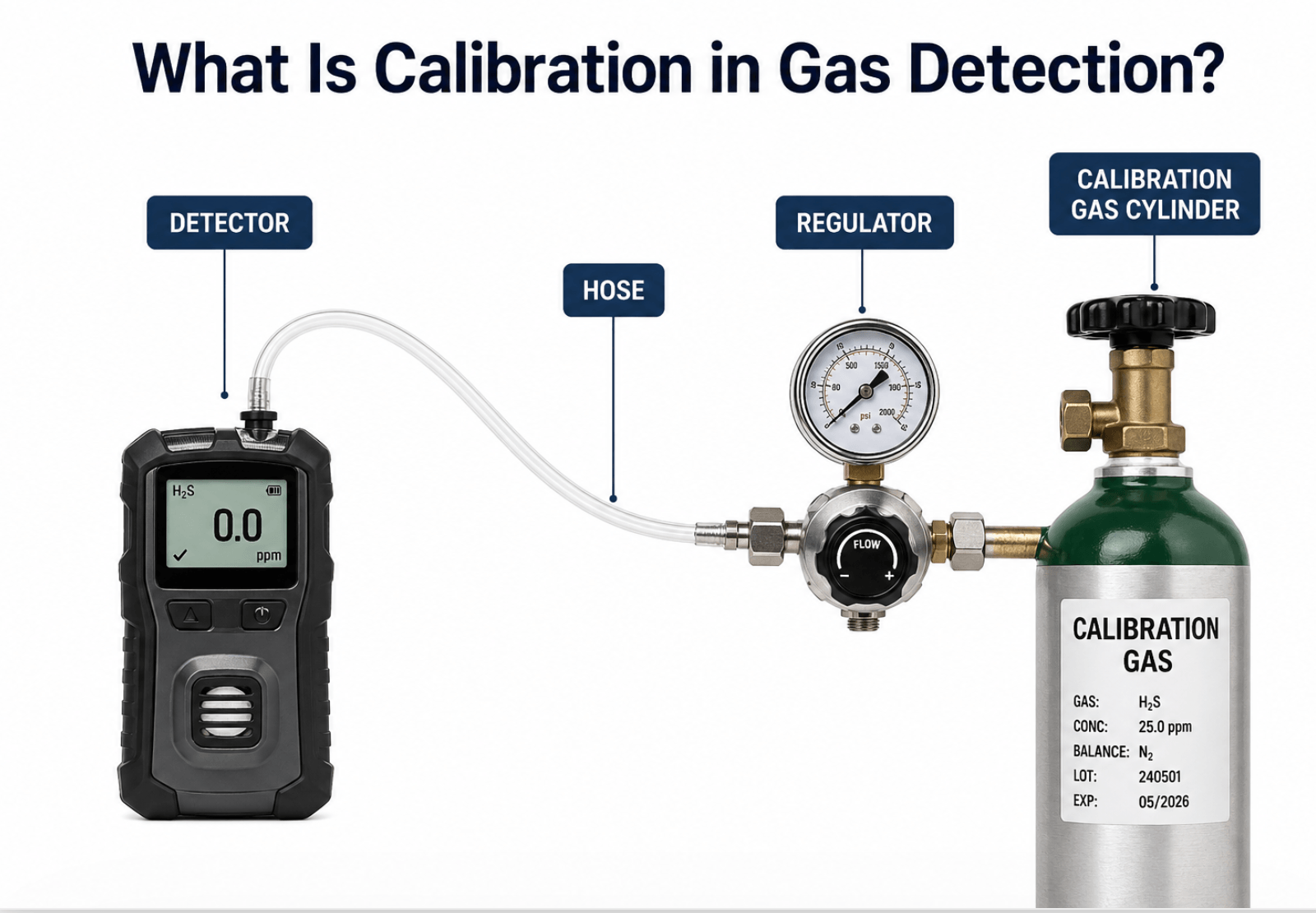
If you work with portable or fixed gas detection equipment, you have almost certainly been told that your detectors need calibration.
But what does that actually mean? What happens during calibration, why does it matter, and how often does it need to be done?
This guide answers all of those questions in plain language. Whether you are a safety officer managing a fleet of gas monitors, a technician responsible for bump testing instruments on a plant site, or simply someone trying to understand what the regulations require, this article will give you a solid foundation.
| ⚡ Key Takeaway Calibration in gas detection is the process of exposing a gas detector to a known concentration of target gas and adjusting the instrument’s response to match that known value. Without regular calibration, a detector may fail to alarm in a genuinely hazardous atmosphere, silently putting workers at risk. |
What Is Gas Detector Calibration?
Gas detector calibration is the process of exposing an instrument to a precisely known concentration of target gas called calibration gas or span gas, and adjusting the detector’s output so that it accurately displays that concentration.
The goal is to verify and correct the instrument’s response curve, ensuring the readings shown on the display reflect the actual gas concentration in the air.
To understand this, it helps to know how most electrochemical and catalytic bead sensors work. Over time, sensor output drifts.
Electrochemical sensors age as their electrolyte gradually depletes. Catalytic bead sensors (also called pellistors) can be poisoned by silicones, halogenated compounds, or lead vapors, which coat the catalytic bead and reduce its sensitivity.
Environmental factors, such as heat, humidity, and UV exposure, also contribute to drift. Without calibration, a sensor that has drifted may still power on and appear functional, but its reading may be meaningfully off from the true gas concentration.
Calibration corrects for that drift by resetting the instrument’s span point to a verified reference. Most modern detectors also include a zero calibration step, which sets the baseline reading in clean, fresh air before the span adjustment is made.
Why Calibration Matters in Industrial Safety
The entire purpose of a gas detector is to warn workers before a hazardous atmosphere develops. If the detector’s readings are inaccurate, that warning system fails, and the failure is invisible.
A detector that underreads by 30% will not alarm at the correct threshold. A detector that overreads may trigger nuisance alarms that workers learn to ignore. Both scenarios create serious safety problems.
Consider a confined space entry scenario. The permit requires oxygen levels above 19.5% and combustible gas below 10% of the Lower Explosive Limit (LEL).
If the LEL sensor is drifting low due to sensor aging, it may read 8% LEL when the actual concentration is already at 15% LEL well into the warning zone. The worker enters based on a false reading, and the true hazard is invisible.
This is not a hypothetical risk. Incident reports across the oil and gas, chemical, mining, and utilities sectors document cases where sensor drift contributed to fatalities and serious injuries.
Calibration is the primary technical control that prevents sensor drift from becoming a hidden hazard.
| ???? Safety Principle A gas detector with an uncalibrated sensor is not a safety instrument. It is a false sense of security. Regular calibration is the only way to confirm that an alarm threshold is meaningful. |
Bump Testing vs. Calibration: Understanding the Difference
These two terms are often confused, and the confusion can lead to inadequate maintenance programs. They are related but not the same thing.
Bump Test (Function Check)
A bump test, also called a function check or challenge test, involves briefly exposing a gas detector to a low concentration of target gas to confirm that the sensor responds and the alarm activates.
It is a qualitative check: it answers the question “does this detector respond to gas?” but does not verify the accuracy of the reading.
A bump test is fast (typically 10–30 seconds per sensor channel), uses relatively small quantities of calibration gas, and can be performed before every shift using a simple docking station or a bump test cap.
What Is a Bump Test in Gas Detection?
Full Calibration (Span Calibration)
A full calibration exposes the instrument to a certified concentration of gas for a sufficient period and adjusts the sensor’s output to match. It answers a more precise question: “Does this detector read accurately?”
This process takes longer, requires a certified calibration gas cylinder with a traceable concentration, and must be performed at defined intervals regardless of bump test results.
| Bump Test | Full Calibration | |
| Purpose | Confirm sensor responds to gas | Verify and adjust reading accuracy |
| Frequency | Before each use (recommended) | Typically every 3–6 months |
| Duration | 10–30 seconds | Several minutes per channel |
| Typically, every 3–6 months | Low concentration, any suitable gas | Certified calibration gas with traceable concentration |
| Result | Pass / Fail | Sensor adjusted to match known value |
| Replaces calibration? | No | Yes (is the calibration) |
The practical recommendation from most instrument manufacturers and safety standards is to bump test before every use and perform full calibration at intervals defined by the manufacturer, site conditions, and applicable regulations.
Types of Gas Detector Calibration
Zero Calibration (Fresh Air Calibration)
Zero calibration sets the detector’s baseline reading in a clean atmosphere. The instrument is exposed to either certified zero air (a cylinder of clean, dry air free of target gases) or ambient air that has been verified to be free of contaminants.
The instrument’s zero point is then adjusted to read 0 ppm (or 0% LEL for combustible gas sensors, or 20.9% for oxygen sensors).
Zero calibration should always be performed before span calibration. If the zero is incorrect, the span adjustment will simply shift a drifted baseline rather than correcting it.
Span Calibration
Span calibration is what most people refer to when they say “calibration.” The detector is exposed to a calibration gas cylinder with a certified concentration of the target gas, for example, 50 ppm of hydrogen sulfide (H2S), or 2.5% methane (equivalent to 50% LEL for methane).
The instrument’s display reading is then adjusted until it matches the certified concentration on the calibration gas cylinder certificate.
Two-Point vs. Multi-Point Calibration
Most field instruments use a two-point calibration: zero and one span point. This is sufficient for most industrial applications where the detector operates within a predictable concentration range.
Analytical instruments used in laboratory settings or high-precision monitoring applications may require multi-point calibration, where the instrument’s response is verified and adjusted at several concentrations to characterize the full response curve.
Automatic vs. Manual Calibration
Modern instruments increasingly support automatic calibration via docking stations or calibration controllers.
The instrument is placed in the dock, the calibration gas flows automatically, the instrument adjusts itself, and a calibration record is generated without technician intervention.
Manual calibration requires the technician to control gas flow, observe the reading stabilize, and make adjustments using instrument menus.
Both approaches are valid; automatic calibration reduces human error and is preferred for large fleets of instruments.
How Calibration Works: Step-by-Step
The exact procedure varies by instrument model and manufacturer, but the following sequence describes the general process for a typical portable multi-gas detector.
- Allow the instrument to warm up fully. Most electrochemical sensors require 30–60 seconds of stabilization time after powering on.
- Perform a zero calibration in clean, fresh air (or using certified zero air). Verify the reading stabilizes at the correct zero value before proceeding.
- Attach the calibration gas regulator and demand-flow fitting (or use a calibration dock). Confirm you are using the correct calibration gas mixture for all sensor channels.
- Initiate the span calibration mode through the instrument menu. Apply calibration gas at the flow rate specified by the manufacturer, typically 0.5 to 1.0 L/min for most portable instruments.
- Wait for the reading to stabilize. This typically takes 30–90 seconds per sensor channel. Electrochemical sensors may take longer in cold or humid conditions.
- Accept the calibration. The instrument adjusts its internal coefficients to match the certified gas concentration.
- Remove the calibration gas. Verify the reading returns to zero in clean air. A reading that does not return to zero after gas removal may indicate sensor contamination or a failing sensor.
- Record the calibration results: instrument serial number, sensor type, calibration gas concentration, cylinder lot number, date, technician name, and pass/fail status. Retain this record according to your site’s document control requirements.
Calibration Gas: What You Need to Know
Calibration gas quality directly determines calibration accuracy. A gas detector can only be as accurate as the calibration gas used to set it.
Certified Reference Mixtures
Calibration gases should be certified reference mixtures (CRMs) with a traceable concentration accuracy of ±2% or better, certified against national standards such as NIST (National Institute of Standards and Technology) in the United States.
The cylinder should come with a certificate of analysis (COA) showing the certified concentration, the expiry date, and the traceability chain.
Never use calibration gas from an expired cylinder. The gas mixture stability cannot be guaranteed beyond the certified shelf life.
Common Calibration Gas Mixtures
Multi-gas detectors require a calibration gas blend that contains all the target gases in a single cylinder. A typical four-gas monitor calibration mixture might contain.
- Methane (CH4) at 50% LEL (approximately 2.5% by volume in air).
- Oxygen (O2) at 18% by volume (to challenge both the oxygen sensor and, in some instruments, the catalytic bead sensor).
- Carbon monoxide (CO) at 100 ppm.
- Hydrogen sulfide (H2S) at 25 ppm.
The balance gas (the remainder of the cylinder contents) matters. Nitrogen-balanced calibration gas is appropriate for instruments used in oxygen-deficient environments.
Air-balanced calibration gas is more common for general industrial use and is required for catalytic bead LEL sensors, which need oxygen present to oxidize the combustible gas on the bead.
Cross-Gas Calibration
When it is not practical to calibrate with the actual target gas, for example, when the target gas is highly toxic or difficult to handle safely, some instruments can be calibrated using a surrogate gas and a correction factor.
This is called cross-gas calibration or relative response calibration. The instrument manufacturer provides conversion factors for each sensor and surrogate gas combination.
Cross-gas calibration introduces additional uncertainty and should be used only when direct calibration is not feasible.
How Often Should You Calibrate a Gas Detector?
There is no single universal answer, but there are several authoritative sources of guidance that most safety professionals follow.
Manufacturer Recommendations
Most portable gas detector manufacturers recommend full calibration every 3 to 6 months under normal use conditions, combined with a bump test before each use.
Always consult your specific instrument’s manual. Some sensors, such as photoionization detector (PID) lamps used for VOC monitoring, may require more frequent calibration due to lamp aging and contamination.
Regulatory Requirements
Regulations vary by jurisdiction and industry. In the United States, OSHA does not prescribe specific calibration intervals for gas detectors in most standards, but does require that equipment be maintained in a safe operating condition. However, specific industry standards and consensus standards do set calibration requirements.
- ANSI/ISA-92.00.01 (Performance Requirements for Gas Detection Instruments) provides technical standards for fixed gas detection equipment.
- The International Safety Equipment Association (ISEA) published the “Agreement on Gas Detector Bump Testing and Calibration,” which recommends bump testing before each use and calibration at intervals not exceeding the manufacturer’s recommendation or 6 months, whichever is shorter.
- In regulated industries such as offshore oil and gas, mining, and utilities, company HSE management systems and third-party audit requirements often specify calibration intervals of 3 months or less.
| ???? Practical Rule of Thumb Bump test before every use. Calibrate every 3–6 months, or immediately after any event that may have compromised sensor accuracy: high-concentration gas exposure, sensor replacement, instrument repair, or any instance where the detector failed a bump test. |
Factors That Affect Calibration Frequency
A fixed interval schedule is a minimum baseline. Several real-world factors should prompt more frequent calibration.
Sensor Type
Electrochemical sensors for toxic gases (CO, H2S, SO2, NH3, Cl2, etc.) typically have working lifespans of 2–3 years and drift gradually over that period.
Catalytic bead (pellistor) sensors for combustible gases are more susceptible to rapid drift from poisoning events.
Infrared (IR) sensors for CO2 and hydrocarbons are more stable and may support longer calibration intervals, but still require regular verification.
Environmental Exposure
Instruments used in harsh environments, such as high temperature, high humidity, corrosive atmospheres, or high-concentration gas exposure events, drift faster than instruments used in mild conditions.
A detector used in a petrochemical plant where H2S concentrations routinely approach alarm thresholds needs more frequent calibration than one used for occasional confined space entry in a municipal utility.
Storage Conditions
Electrochemical sensors can degrade during storage if exposed to temperature extremes or if the sensor dries out.
Instruments that have been stored for extended periods should be calibrated before use, regardless of when the last calibration was performed.
Failed Bump Tests
If a bump test shows the sensor is not responding correctly, either no response, delayed response, or failure to alarm at the correct concentration, the instrument must be removed from service and either calibrated or repaired before it is used again. A failed bump test is a strong indicator that more frequent calibration is warranted.
Regulatory Requirements for Gas Detector Calibration
Navigating the regulatory landscape around gas detector calibration requires understanding which regulations apply to your industry and jurisdiction. Here is a practical overview for safety professionals working in common regulated sectors.
| Sector | Applicable Standard / Authority | Key Calibration Requirement |
| Regular inspection and calibration per the manufacturer | OSHA 29 CFR 1910 | Equipment in safe operating condition; follow manufacturer specs |
| Construction (US) | OSHA 29 CFR 1926 | Confined space and hazardous atmosphere requirements |
| Oil & Gas (Offshore US) | BSEE / API RP 505 | Regular inspection and calibration per manufacturer |
| Mining (US) | MSHA 30 CFR | Specific methane detector calibration requirements for underground coal |
| European Union | ATEX Directive / EN 60079-29 | Calibration per manufacturer; documented maintenance records |
| International | IEC 60079-29-2 | Installation, testing, and maintenance of flammable gas detectors |
Beyond regulatory minimums, many industries operate under management system standards (ISO 45001, OSHA’s Voluntary Protection Programs) and client-mandated HSE requirements that specify calibration intervals more precisely than the underlying regulations. Always review your site’s safety management system documentation alongside applicable regulations.
Common Calibration Mistakes to Avoid
Calibration errors are more common than most safety programs acknowledge. Here are the mistakes that most frequently undermine calibration quality.
Using Expired Calibration Gas
Calibration gas cylinders have a certified shelf life, typically 12–36 months, depending on the gas mixture and cylinder type.
After the expiry date, the certified concentration can no longer be guaranteed; reactive gases may have degraded, and the balance gas composition may have shifted.
Using expired calibration gas means you are adjusting the instrument to an unknown reference, which defeats the entire purpose of calibration.
Wrong Flow Rate
Applying calibration gas at too low a flow rate starves the sensor and produces a falsely low reading, causing the instrument to over-correct.
Too high a flow rate can also affect some sensor types. Always use the demand-flow regulator and calibration fixtures specified by the instrument manufacturer, and verify that the flow rate matches the calibration procedure requirements.
Calibrating in a Contaminated Environment
Zero calibration performed in an atmosphere that contains trace concentrations of target gas will produce a falsely elevated baseline.
This is a particular risk when calibrating instruments in areas near chemical storage, fuel dispensing, or process areas.
Always perform zero calibration in fresh, clean air, either outdoors upwind of any potential contamination or using a certified zero-air cylinder.
Skipping the Zero Step
Span calibration alone, without a prior zero calibration, can produce a misleadingly accurate-looking result while the actual response curve remains offset. Both steps are required for a valid full calibration.
Ignoring Sensor Warm-Up Time
Electrochemical sensors require time to reach thermal and electrochemical equilibrium after powering on.
Calibrating immediately after startup, before the sensor has stabilized, produces unreliable results.
Follow the manufacturer’s specified warm-up time, which is typically at least 30 seconds but may be several minutes for some sensor types.
No Documentation
An undocumented calibration cannot be verified, audited, or used to identify drift trends over time.
Without records, you cannot demonstrate compliance to regulators, insurers, or incident investigators. Every calibration must be documented.
Calibration Records and Documentation
Good calibration records serve multiple purposes: they demonstrate regulatory compliance, they create a maintenance history that can identify sensor degradation trends, and they provide evidence of due diligence in the event of an incident investigation.
At a minimum, each calibration record should capture.
- Instrument manufacturer, model, and serial number.
- Date and time of calibration.
- Name and qualification of the technician performing calibration.
- Sensor type and gas being monitored for each channel.
- Calibration gas mixture composition, certified concentration, cylinder lot number, and expiry date.
- Pre-calibration readings (as-found values) for each sensor channel.
- Post-calibration readings (as-left values) for each sensor channel.
- Calibration pass/fail status for each channel.
- Any corrective actions taken (sensor replacement, instrument quarantine, etc.),
Many safety-critical industries now use calibration management software or instrument docking stations that generate electronic records automatically.
These systems eliminate transcription errors and make it easy to retrieve calibration history for specific instruments during audits or incident reviews.
Retain calibration records for the period required by applicable regulations and your site’s document retention policy.
In many jurisdictions, safety equipment records should be retained for a minimum of 3–5 years, though some regulations (particularly in mining and offshore sectors) may require longer retention periods.
Frequently Asked Questions About Gas Detector Calibration
Can I calibrate a gas detector myself, or does it require a specialist?
Most portable gas detectors are designed to be calibrated in the field by trained technicians without specialist equipment beyond the calibration gas cylinder, regulator, and calibration accessories.
The key requirements are proper training on the procedure, use of the correct calibration gas, and accurate documentation.
For fixed gas detection systems with multiple channels and safety system integration, calibration may require a qualified instrumentation technician and adherence to a formal maintenance procedure.
What happens if I skip calibration?
If calibration is skipped, sensor drift goes uncorrected. The detector may still appear to function normally; it will power on, run self-diagnostics, and produce readings, but those readings may be meaningfully inaccurate.
An instrument that reads 40 ppm CO when the actual concentration is 60 ppm will not alarm at the correct threshold, potentially exposing workers to hazardous concentrations without warning.
Beyond the safety risk, using uncalibrated instruments can constitute a regulatory violation and may affect insurance coverage and liability in the event of an incident.
Does bump testing replace calibration?
No. A bump test confirms that the sensor responds to gas and that the alarm activates, but it does not verify reading accuracy.
A sensor can pass a bump test, detecting gas and alarming, while its span sensitivity has drifted enough that the reading is significantly inaccurate.
Bump testing and calibration serve complementary but distinct functions in a gas detector maintenance program.
How do I know when a sensor needs to be replaced rather than calibrated?
Most instrument manufacturers specify sensor replacement intervals (typically 2–3 years for electrochemical sensors, though this varies by sensor type and environmental conditions).
Indicators that a sensor may need replacement rather than calibration include: repeated calibration failures; a very large offset between the as-found reading and the calibration gas concentration (sometimes called a high calibration coefficient); slow or absent response during a bump test; and response time that exceeds the manufacturer’s specification.
When a sensor consistently fails to calibrate within acceptable limits, replacement is the appropriate corrective action.
What is the difference between calibration and certification?
Calibration is the technical process of adjusting a detector’s sensor response to match a known reference. Certification (or calibration certification) refers to the documentation, the calibration certificate, or record that attests that calibration was performed correctly on a specific instrument on a specific date using traceable calibration gas. The certificate is the documentary evidence; the calibration is the physical process it documents.
Conclusion
Calibration is not a bureaucratic checkbox. It is the technical foundation of gas detection reliability. Every alarm threshold, every confined space entry decision, and every permit-to-work that relies on a gas detector reading depends on calibration being performed correctly and consistently.
The key principles to carry forward from this guide.
- Calibration adjusts a gas detector’s sensor response to match a certified known concentration of gas, correcting for sensor drift over time.
- Bump testing confirms the sensor responds to gas; calibration verifies and corrects the accuracy of that response. Both are necessary; neither replaces the other.
- Use certified reference gas mixtures with a traceable concentration certificate, and never use expired cylinders.
- Calibrate at the interval specified by the manufacturer, typically every 3–6 months, and bump test before every use.
- Document every calibration with instrument serial number, technician name, calibration gas lot number, as-found and as-left readings, and the calibration date.
- Environmental severity, sensor type, and any calibration failure event are all reasons to calibrate more frequently than the minimum recommended interval.
A gas detector that is regularly calibrated and bump tested is an instrument you can trust. One that is not is simply an object that looks like a safety instrument while offering none of the protection.