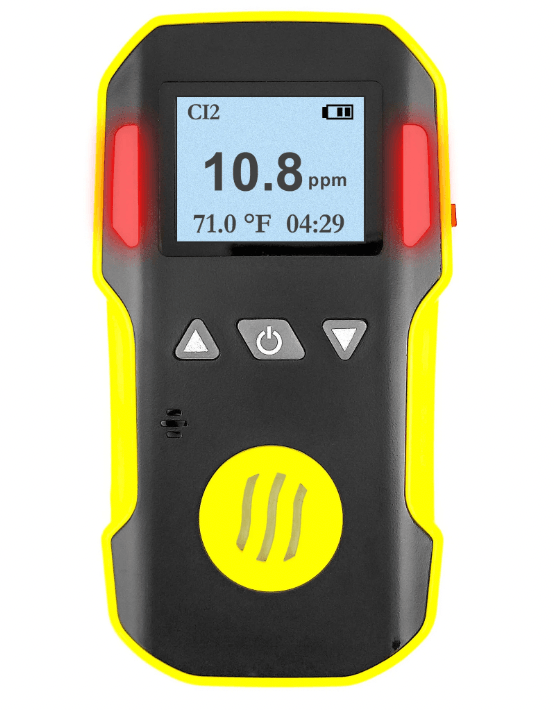
If you’ve ever looked at a gas detector readout and wondered what “PPM” means, you’re not alone.
PPM is one of the most important and most misunderstood measurements in workplace gas safety.
Whether you’re managing confined space entry, monitoring industrial air quality, or simply trying to understand your equipment, knowing what PPM means (and what it means for you) could save a life.
In this guide, we’ll break down everything you need to know about PPM in gas detectors: what it is, how it works, why it matters, and how to interpret the readings on your device.
What Does PPM Stand For?
PPM stands for “parts per million.” It is a unit of concentration used to express how many units of a substance exist within one million units of a mixture, in this case, air.
Think of it this way: if you dropped one drop of ink into roughly 50 liters of water, the resulting concentration would be about 1 PPM.
Now apply that concept to toxic or flammable gases in the air you breathe at work, and the importance of precision becomes clear.
PPM is used because many hazardous gases become dangerous at extremely low concentrations, far too small to be expressed in percentages without adding many decimal places.
Instead of writing “0.0001% carbon monoxide,” we write “1 PPM CO.” It’s cleaner, more precise, and more practical for real-world safety monitoring.
What is PPM in a Gas Detector?
In the context of a gas detector, PPM refers to the concentration of a specific target gas in the surrounding air, measured in parts per million by volume (ppmv).
Your gas detector continuously samples the ambient air and uses an internal sensor to identify and quantify gas molecules.
The result is displayed on the screen as a PPM value, a real-time reading of how much of that gas is present in the environment around you.
For example.
- A carbon monoxide (CO) reading of 35 PPM means there are 35 molecules of CO for every 1,000,000 molecules of air.
- A hydrogen sulfide (H₂S) reading of 10 PPM is already approaching dangerous exposure levels for many workers.
These numbers directly inform whether an area is safe to enter, whether you need to evacuate, or whether ventilation is required.
PPM vs. Percentage (%): What’s the Difference?
Gas detectors often display readings in both PPM and percentage (%), and it’s critical not to confuse them.
| Unit | Best For | Example |
|---|---|---|
| PPM (Parts Per Million) | Toxic gases at low concentrations | CO at 35 PPM |
| % Volume | High-concentration gases (oxygen, CO₂) | O₂ at 20.9% |
| % LEL (Lower Explosive Limit) | Flammable/combustible gases | Methane at 10% LEL |
The conversion is straightforward:
1% = 10,000 PPM
So 0.005% CO is the same as 50 PPM CO. When your detector switches between these units, it’s not changing what it’s measuring, just how it’s expressing it.
Why Some Gases Use %, and Others Use PPM
Gases like oxygen and carbon dioxide exist in large concentrations in normal air (20.9% O₂ and ~0.04% CO₂), so percentages make sense.
Toxic gases like carbon monoxide, hydrogen sulfide, ammonia, and chlorine are dangerous at trace levels measured in the single-digit or low double-digit PPM, so using percentages would produce unwieldy numbers like 0.001%, which is far harder to interpret quickly in a hazardous environment.
Why PPM Matters for Gas Detection Safety?
Understanding PPM is not just academic; it directly affects worker safety decisions and regulatory compliance.
Regulatory Exposure Limits Are Set in PPM
OSHA, NIOSH, and ACGIH all publish occupational exposure limits in PPM for dozens of hazardous gases. If your detector reads above those thresholds, immediate action is legally and ethically required.
Some Gases Are Lethal at very low ppm
Hydrogen cyanide (HCN), for instance, can be immediately dangerous to life or health (IDLH) at just 50 PPM. Without a device measuring concentrations at that level of precision, the hazard would be invisible.
Trend Monitoring Relies on PPM Accuracy
In confined space entry and industrial hygiene, workers and safety officers monitor how PPM values change over time.
Rising readings may indicate a developing leak or failing ventilation, even before alarm thresholds are reached.
Common Gases Measured in PPM
Below are the most frequently monitored gases in workplace safety applications, with their typical measurement ranges and relevant exposure limits:
Carbon Monoxide (CO)
- Measurement Range: 0–500 PPM (standard); 0–2,000 PPM (high-range)
- OSHA PEL: 50 PPM (8-hour TWA)
- IDLH: 1,200 PPM
- Sources: Combustion engines, gas-powered equipment, fires
Hydrogen Sulfide (H₂S)
- Measurement Range: 0–100 PPM
- OSHA Ceiling: 20 PPM (never exceed)
- IDLH: 100 PPM
- Sources: Wastewater treatment, oil and gas, sewers, chemical plants
Ammonia (NH₃)
- Measurement Range: 0–300 PPM
- OSHA PEL: 50 PPM (8-hour TWA)
- IDLH: 300 PPM
- Sources: Refrigeration systems, agricultural facilities, fertilizer production
Chlorine (Cl₂)
- Measurement Range: 0–10 PPM
- OSHA Ceiling: 1 PPM
- IDLH: 10 PPM
- Sources: Water treatment, chemical manufacturing, bleach production
Sulfur Dioxide (SO₂)
- Measurement Range: 0–20 PPM
- OSHA PEL: 5 PPM (8-hour TWA)
- IDLH: 100 PPM
- Sources: Mining, smelting, power plants, combustion
Hydrogen Cyanide (HCN)
- Measurement Range: 0–50 PPM
- OSHA Ceiling: 10 PPM
- IDLH: 50 PPM
- Sources: Electroplating, chemical synthesis, combustion of plastics
PPM Thresholds: PEL, TLV, STEL, and IDLH Explained
When working with gas detectors, you’ll often see alarm setpoints calibrated to specific PPM thresholds. Here’s what each standard means:
PEL: Permissible Exposure Limit (OSHA)
The maximum average concentration a worker may be exposed to over an 8-hour workday. Exceeding the PEL consistently is a regulatory violation. Most gas detectors use PEL as a low-alarm setpoint.
TLV-TWA: Threshold Limit Value / Time-Weighted Average (ACGIH)
Similar to PEL, but published by the American Conference of Governmental Industrial Hygienists (ACGIH).
Often more stringent than OSHA’s PEL, and frequently used as a best-practice benchmark.
STEL: Short-Term Exposure Limit
The maximum concentration allowed for a 15-minute exposure, not to be exceeded more than 4 times per day. Many gas detectors have a second, higher alarm threshold set at the STEL.
IDLH: Immediately Dangerous to Life or Health (NIOSH)
The concentration at which a 30-minute exposure could cause irreversible health damage or prevent escape. This is typically set as the high-alarm or evacuation threshold.
Alarm Setpoint Example (Carbon Monoxide)
| Alarm Level | PPM Value | Standard |
|---|---|---|
| Low Alarm | 35 PPM | ACGIH TLV-TWA |
| High Alarm | 100 PPM | STEL |
| IDLH | 1,200 PPM | NIOSH |
Most multi-gas detectors allow you to customize these setpoints to match your site’s specific regulatory requirements and risk profile.
How Gas Detectors Measure PPM
Understanding how your device arrives at a PPM reading helps you trust and interpret it more accurately. The two most common sensor technologies used for PPM measurement are.
Electrochemical Sensors
These sensors are the gold standard for toxic gas detection (CO, H₂S, SO₂, NH₃, Cl₂). They work by allowing target gas molecules to diffuse through a membrane and react at an electrode, generating an electrical current proportional to the gas concentration. The device converts that current to a PPM reading.
Advantages: Highly sensitive, accurate at low PPM, long lifespan.
Limitations: Cross-sensitivity to other gases; performance can be affected by temperature and humidity.
Photoionization Detectors (PID)
PID sensors use UV light to ionize gas molecules and detect the resulting current. They are commonly used for volatile organic compounds (VOCs) in the PPM and even sub-PPM range.
Advantages: Broad-spectrum detection, extremely sensitive
Limitations: Cannot detect methane or other non-ionizable gases; requires a clean lamp for accuracy.
Non-Dispersive Infrared (NDIR) Sensors
NDIR sensors shine infrared light through the sampled air. Specific gases absorb certain IR wavelengths, and the degree of absorption correlates with concentration in PPM. Used for CO₂ and some other gases.
Advantages: Long lifespan, minimal calibration drift.
Limitations: Less effective for toxic gas detection at very low PPM.
Reading PPM on Your Gas Detector
Most modern gas detectors display PPM readings in real time on a digital screen. Here’s how to interpret what you’re seeing:
Live Reading
The current instantaneous concentration in the surrounding air. This fluctuates as conditions change.
TWA (Time-Weighted Average)
Many devices calculate and display a rolling 8-hour TWA alongside the live reading, helping you assess cumulative exposure throughout a shift.
STEL Reading
Some detectors display a running 15-minute STEL average useful for short-term peak monitoring without waiting for a full shift.
Peak/Max Reading
The highest PPM value recorded since the device was last reset. Useful for post-incident investigation or shift review.
Practical Tip
Always bump test your gas detector before each use to confirm the sensors respond correctly and the PPM readouts are accurate. A bump test is not a substitute for full calibration, but it’s a critical daily check.
When PPM Alarms Trigger: What to Do
When your gas detector sounds a PPM alarm, the response must be immediate and deliberate.
Low Alarm (First Threshold)
- Do not ignore it. A low alarm signals that gas concentration is approaching hazardous levels.
- Pause work and assess the source.
- Increase ventilation if possible.
- Notify your supervisor and document the reading.
High Alarm (Second Threshold / STEL)
- Stop work immediately.
- Evacuate the area following your site’s emergency action plan.
- Do not re-enter until the area has been cleared by a qualified person with a functioning detector.
- Investigate the source before resuming work.
IDLH Alarm
- Evacuate immediately. Do not stop to gather equipment.
- This concentration level poses an immediate threat to life.
- Emergency response procedures apply.
Remember
Your gas detector is only useful if you act on its readings. A PPM alarm is not a suggestion it is a warning designed to keep you alive.
FAQs About PPM in Gas Detectors
Is a higher PPM reading always more dangerous?
It depends on the gas. A 50 PPM reading for CO is concerning but not immediately life-threatening. A 50 PPM reading for HCN is at the IDLH level and requires immediate evacuation. Always compare readings against the specific exposure limits for each gas.
How often should I calibrate my gas detector?
Most manufacturers recommend full calibration every 3–6 months, with a bump test before every use. Calibration ensures your PPM readings are accurate and traceable to known gas standards.
Can a gas detector read PPM for multiple gases at once?
Yes. Multi-gas detectors (4-gas monitors are the most common) can simultaneously display PPM readings for multiple gases, typically CO, H₂S, O₂ (in %), and combustible gas (in % LEL).
What’s the difference between PPM and PPB?
PPB stands for parts per billion; it is 1,000 times more sensitive than PPM. Some gases (like ozone, mercury vapor, or certain pesticides) are hazardous at sub-PPM levels and require PPB-range detectors.
Why does my detector read a small PPM value even in clean air?
Sensors can have minor baseline drift over time or react to background interference. A consistent near-zero reading in clean air is generally normal.
If readings are consistently elevated without a known source, it may be time to recalibrate or replace the sensor.
Conclusion
PPM is the language of gas detection safety. Understanding what it means and what specific PPM readings mean for the gases you work around is fundamental to protecting yourself and your team from invisible hazards.
At its core, the answer to “what is PPM in a gas detector?” is simple: it’s a precise, real-time measurement of how much of a dangerous gas is in the air around you.
But acting on that number correctly, in compliance with OSHA standards and your site’s safety protocols, is what transforms a number on a screen into a life-saving decision.
Stay calibrated. Stay compliant. Stay safe.