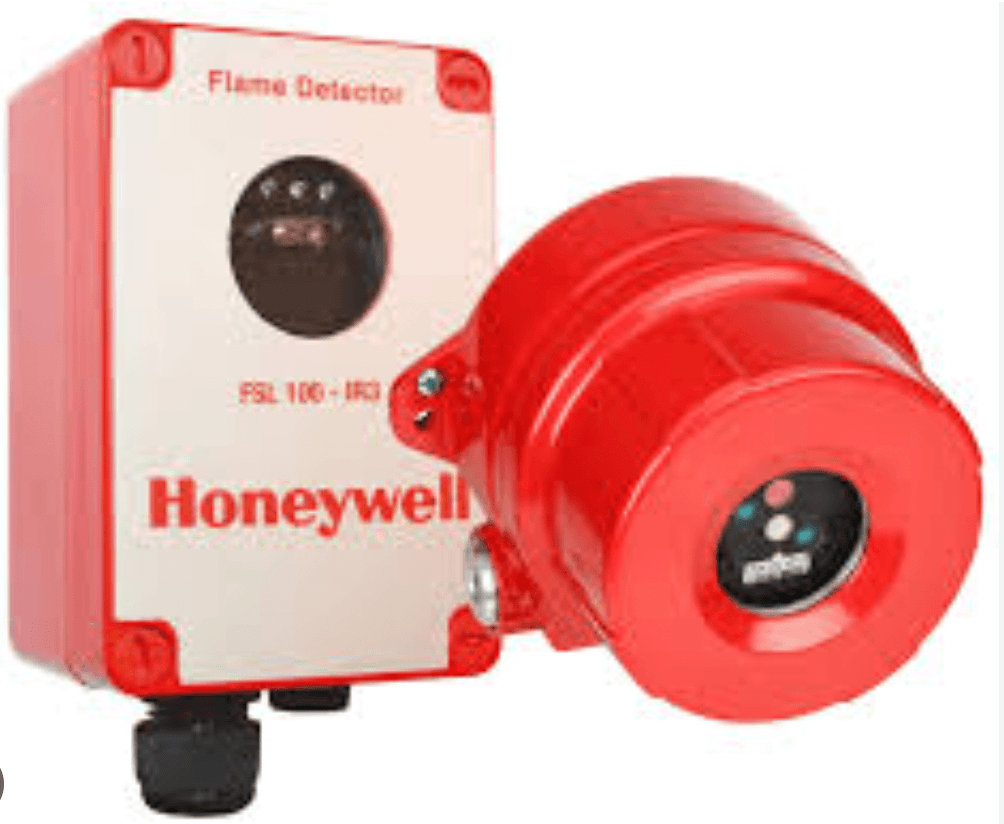
Fire is one of the most destructive forces a facility can face, and in many industrial environments, it can escalate from a small ignition to a catastrophic event in seconds.
That’s where flame detectors come in. Unlike smoke alarms or heat sensors, flame detectors are engineered to identify the actual presence of a fire at its source, often before smoke or significant heat has had time to spread.
In this guide, we’ll break down exactly what flame detectors are, how each detection technology works, where they’re used, and how to choose the right one for your application.
What Is a Flame Detector?
A flame detector is a safety sensor designed to identify the presence of a flame or fire by detecting the specific energy or radiation that a flame emits.
Rather than waiting for smoke to rise or temperatures to climb, flame detectors respond to the electromagnetic radiation produced by combustion, making them among the fastest and most reliable fire detection tools available.
They are a critical component of fire and gas safety systems in environments where rapid fire detection can prevent injuries, equipment damage, environmental hazards, and loss of life.
How Do Flame Detectors Work?
All flames emit energy as they burn. This energy is released across multiple parts of the electromagnetic spectrum, including ultraviolet (UV) light, infrared (IR) radiation, and visible light.
Flame detectors are designed to sense one or more of these energy signatures and trigger an alarm when they are detected.
Different types of flame detectors are optimized to detect different parts of this spectrum, which is why choosing the right technology for your environment matters enormously.
Types of Flame Detectors and How Each Works
Ultraviolet (UV) Flame Detectors
How they work
UV flame detectors use a sensor, typically a Geiger–Müller tube or a UV-sensitive photodiode, to detect the ultraviolet radiation emitted by flames.
Combustion produces a burst of UV energy in the 185–260 nanometer range, which these sensors are tuned to detect.
Response time
UV detectors are among the fastest available, often responding within 3–5 milliseconds.
Limitations
UV detectors can be triggered by non-fire UV sources such as arc welding, lightning, and sunlight. They also perform poorly in smoky environments, as smoke absorbs UV radiation and can block the signal.
Best used in
Indoor environments with controlled conditions, or where extremely fast detection is essential, such as explosive handling areas.
Infrared (IR) Flame Detectors
How they work
IR flame detectors measure the infrared radiation emitted by a fire. Hydrocarbon flames emit a characteristic IR signature, particularly in the 4.3 micron CO₂ absorption band.
Single-frequency IR detectors monitor this specific wavelength; more advanced models use multiple IR frequencies to compare readings and reduce false alarms.
Response time
Typically 3–5 seconds, though this varies by model and environment.
Limitations
Single-frequency IR detectors can be fooled by hot surfaces, sunlight, or other IR-emitting heat sources. They may also struggle to detect non-hydrocarbon fires such as hydrogen fires.
Best used in
Outdoor and indoor hydrocarbon environments, oil and gas facilities, refineries, and chemical plants.
Ultraviolet/Infrared (UV/IR) Flame Detectors
How they work
UV/IR detectors combine both UV and IR sensing technologies. An alarm is triggered only when both sensors detect their respective radiation signatures simultaneously.
Because real fires produce both UV and IR energy, this dual-confirmation approach dramatically reduces false alarms.
Response time
Generally, 3–5 seconds.
Limitations
More complex and typically more expensive than single-technology detectors. Certain fire types (such as hydrogen fires) may not produce enough infrared to trigger both sensors.
Best used in
High-value industrial applications where false alarms are costly or operationally disruptive, such as petrochemical plants, power stations, and offshore platforms.
Multi-Spectrum Infrared (MSIR) Flame Detectors
How they work
MSIR detectors analyze infrared radiation across multiple spectral bands simultaneously. By comparing signals across several IR frequencies rather than just one, these detectors can distinguish between real flames and false alarm sources like hot sunlit surfaces or IR-emitting equipment.
Response time
Typically 3–10 seconds, depending on fire size and distance.
Limitations
More expensive than standard IR or UV/IR detectors; may have reduced sensitivity to some non-hydrocarbon fires.
Best used in
High-interference outdoor environments, large open areas, gas turbine enclosures, and aviation facilities.
Visual Flame Detectors (Video-Based)
How they work
Visual flame detectors use cameras and image-processing algorithms often enhanced by artificial intelligence to analyze video feeds for the characteristic shape, color, and flicker pattern of flames.
These systems can cover large areas and integrate with existing CCTV infrastructure.
Response time
Can vary, but advanced AI-based systems achieve detection in 2–10 seconds.
Limitations
Performance depends heavily on camera placement, lighting conditions, and software sophistication. Obstructions in the camera’s field of view create detection blind spots.
Best used in
Large open areas, warehouses, tunnels, airports, and facilities where camera-based surveillance is already in place.
Key Performance Metrics to Understand
When evaluating flame detectors, you’ll encounter several technical terms worth understanding.
Field of View (FOV)
The angle of coverage within which the detector can sense a flame. Wider FOV means fewer units may be needed to cover a given area, but sensitivity at the edges may be reduced.
Detection Range
The maximum distance at which the detector can reliably identify a reference fire (often a standardized test fire such as a 1-square-foot or 1-square-meter n-heptane pan fire).
Response Time
How quickly the detector triggers an alarm after a flame is present.
False Alarm Rate
How susceptible the detector is to nuisance alarms from non-fire sources. This is often where the technology choice makes the biggest practical difference.
SIL Rating (Safety Integrity Level)
A measure of the detector’s reliability within a safety-instrumented system. SIL 2 or SIL 3 ratings are common requirements for high-risk industrial facilities.
Where Are Flame Detectors Used?
Flame detectors are deployed across a wide range of industries and settings where rapid fire detection is critical.
Oil & Gas
Refineries, offshore platforms, wellheads, compressor stations, and storage terminals rely on flame detectors to catch hydrocarbon fires before they escalate.
Petrochemical & Chemical Plants
Processing environments where flammable gases or liquids are present require highly reliable flame detection with low false alarm rates.
Power Generation
Gas turbine enclosures, transformer areas, and turbine halls require detectors capable of handling extreme temperatures and radiation interference.
Aviation & Aerospace
Aircraft hangars, engine test cells, and fuel storage areas use flame detectors calibrated for jet fuel fires and high-wind outdoor environments.
Manufacturing
Facilities that handle flammable materials, solvents, or dusts use flame detectors as part of broader fire suppression systems.
Warehousing & Logistics
Large open storage spaces, particularly those handling flammable goods, benefit from wide-FOV or video-based flame detection.
Mining
Underground and surface mining operations where methane or coal dust creates fire risk require explosion-rated (intrinsically safe) detectors.
Military & Defense
Armament storage, vehicle maintenance bays, and munitions handling areas all employ specialized flame detection.
Flame Detectors vs. Smoke Detectors vs. Heat Detectors
It’s worth clarifying how flame detectors differ from the other major fire detection technologies.
| Feature | Flame Detector | Smoke Detector | Heat Detector |
|---|---|---|---|
| What it detects | Radiation from flames | Smoke particles in air | Elevated temperature |
| Response speed | Very fast (seconds) | Fast | Slower |
| Best environment | Open, industrial areas | Enclosed spaces | Kitchens, dusty areas |
| False alarm risk | Low–Medium (technology-dependent) | Moderate | Low |
| Fire type coverage | Flaming fires | Smoldering and flaming | Any fire producing heat |
In many real-world applications, these technologies are used together as part of a layered detection strategy to maximize coverage and minimize missed detections or false alarms.
How to Choose the Right Flame Detector
Selecting the right flame detector depends on several factors.
Environment
Is the installation indoor or outdoor? Outdoor environments face sunlight, rain, and temperature extremes that affect performance.
UV detectors, for example, are generally not suitable for outdoor use due to solar interference.
Type of fire risk
What fuel source is most likely to ignite? Hydrocarbon fires are detected well by IR-based systems; hydrogen fires require UV or special multi-spectrum detectors since hydrogen flames produce little to no IR radiation.
Interference sources
Are there welding operations, hot surfaces, or other radiation sources nearby that could cause false alarms?
Required response time
Some applications (such as explosion suppression systems) require near-instantaneous detection, pushing the choice toward UV technology.
Area coverage
How large is the area to be protected? Large open areas may benefit from detectors with a wide field of view or camera-based systems.
Regulatory requirements
Depending on your industry and region, specific standards (such as FM, ATEX, IECEx, or UL listings) may apply to the detectors you install.
Installation and Maintenance Considerations
Even the best flame detector performs poorly if improperly installed or neglected. Keep these principles in mind.
Line of sight matters
Most optical flame detectors require an unobstructed view of the protected area. Equipment, structural beams, or dust buildup on the detector window can all compromise detection.
Positioning is critical
Detectors should be mounted at the correct angle and height to maximize their field of view coverage of the hazard zone.
Regular testing is essential
Flame detectors should be tested regularly using approved test lamps or sources to verify they are functioning correctly.
Window contamination reduces sensitivity
Dust, oil, or condensation on the detector’s optical window can significantly reduce its ability to detect a flame. Cleaning schedules should be established based on the environment.
Calibration over time
UV and IR sensors can degrade over time. Routine calibration checks ensure the detector still meets its original performance specifications.
Final Thoughts
Flame detectors are purpose-built tools for environments where fire risk is real and rapid detection can make the difference between a contained incident and a disaster.
By detecting the actual radiation signature of a flame rather than its downstream effects like smoke or heat, they offer speed and specificity that other fire detection methods simply cannot match.
Understanding the different technologies UV, IR, UV/IR, multi-spectrum infrared, and visual, and their respective strengths and limitations, is the first step toward building a fire safety system that genuinely protects your people, your assets, and your operations.
At SafeguardSense.com, we’re dedicated to helping safety professionals, facility managers, and engineers navigate the complex world of fire and gas detection.
Whether you’re specifying a system for a new facility or evaluating upgrades to an existing one, we’re here to help.
Have questions about flame detection for your specific application? Browse our resources or get in touch with our team at SafeguardSense.com.