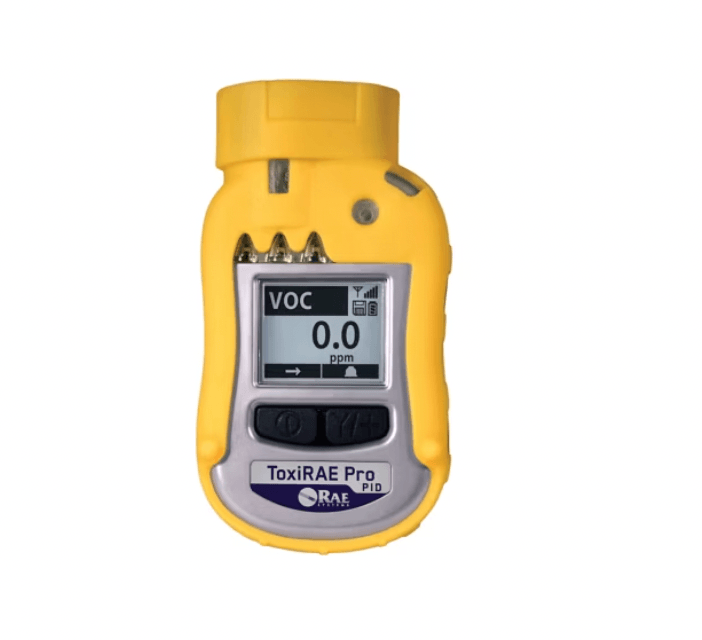
Whether you work in industrial hygiene, hazmat response, environmental monitoring, or confined space entry, you’ve likely heard the term “PID detector.” But what exactly is a PID gas detector, how does it work, and when should you use one?
This guide breaks it all down from the science behind photoionization to real-world applications and buying considerations.
What Is a PID Gas Detector?
A PID gas detector, short for Photoionization Detection gas detector, is a portable or fixed instrument used to detect and measure the concentration of volatile organic compounds (VOCs) and other gases in the air.
PID detectors are widely used in occupational health and safety, environmental site assessment, industrial hygiene, and emergency response.
Unlike combustible gas detectors that only tell you whether a gas is present and flammable, PID detectors can measure very low concentrations of a broad range of chemical compounds, often down to parts per billion (ppb) levels. This makes them an essential tool wherever low-level chemical exposure is a concern.
How Does a PID Gas Detector Work?
The core technology behind a PID detector is photoionization, a process that uses ultraviolet (UV) light to ionize gas molecules and measure their concentration.
Here’s a step-by-step breakdown of how the process works.
Air Sample Enters the Sensor Chamber
Air either drawn in by a pump or diffusing naturally enters the detector’s sensor chamber. The chamber is designed to concentrate the sample around a UV lamp.
UV Light Ionizes Gas Molecules
Inside the chamber, a UV lamp emits photons at a specific energy level (measured in electron volts, or eV).
When those photons strike molecules of certain gases, they knock an electron loose, a process called ionization. This converts the neutral gas molecule into a positively charged ion.
The key point here is that only molecules with an ionization potential (IP) lower than the energy of the UV lamp will be ionized.
This selectivity is what makes PID detectors so powerful. By choosing the right lamp, you can target specific classes of compounds.
Ions Generate an Electrical Current
The freed electrons and positively charged ions move toward oppositely charged electrodes inside the sensor chamber, creating a measurable electrical current. The stronger the current, the higher the concentration of ionizable gas in the sample.
The Detector Converts Current to a Reading
The instrument’s electronics convert the electrical current into a concentration reading typically displayed in parts per million (ppm) or parts per billion (ppb) on the device’s screen.
What UV Lamp Energies Are Used in PID Detectors?
The UV lamp is the heart of a PID detector, and different lamp energies are used to target different groups of compounds. The most common lamp energies are.
| Most common; detects a wide range of VOCs, including benzene, toluene, and xylene | Common Use Cases |
|---|---|
| 10.6 eV | Most common: detects a wide range of VOCs, including benzene, toluene, and xylene. |
| 9.8 eV | More selective; useful when you want to exclude certain compounds like ammonia. |
| 11.7 eV | High-energy lamp; detects compounds with high ionization potentials like formaldehyde and some chlorinated solvents. |
The 10.6 eV lamp is by far the most widely used because it offers the best balance between sensitivity and breadth of detection.
However, it’s important to note that a PID detector cannot detect gases whose ionization potential exceeds the lamp energy. For example, methane (IP: 12.6 eV) is not detectable by a standard 10.6 eV PID lamp.
What Gases Can a PID Detector Detect?
PID detectors are primarily used to detect volatile organic compounds (VOCs), but they can identify a surprisingly wide range of substances. Common gases and compound classes detectable by a PID include:
- Aromatic hydrocarbons: benzene, toluene, ethylbenzene, xylene (BTEX).
- Aliphatic hydrocarbons: hexane, heptane, isobutylene.
- Chlorinated solvents: trichloroethylene (TCE), perchloroethylene (PCE).
- Ketones and alcohols: acetone, isopropyl alcohol (IPA).
- Ammonia and amines (with an appropriate lamp).
- Hydrogen sulfide (with an appropriate lamp).
- Styrene, formaldehyde, and many other industrial chemicals.
What a PID Detector Cannot Detect?
It’s equally important to know the limitations. PID detectors cannot reliably detect.
- Methane and natural gas ionization potentials are too high for standard lamps.
- Carbon monoxide (CO) requires electrochemical sensors.
- Carbon dioxide (CO₂).
- Simple inorganic gases like nitrogen, oxygen, or hydrogen (in most configurations).
For complete workplace gas monitoring, PID detectors are often used alongside multi-gas detectors that cover oxygen deficiency, CO, H₂S, and combustibles.
Correction Factors: Why Raw PID Readings Need Adjustment
One important concept in PID detection is the correction factor (CF). Most PID detectors are calibrated using isobutylene as a reference gas because it responds predictably and is safe to handle.
However, different gases ionize at different efficiencies. A reading of 50 ppm on a PID calibrated to isobutylene doesn’t necessarily mean 50 ppm of the actual gas; the instrument’s response will be higher or lower depending on the compound.
To get an accurate concentration reading, you must apply the appropriate correction factor for the specific compound you’re monitoring.
Most modern PID detectors come with built-in correction factor libraries, allowing you to select the target gas and have the instrument automatically adjust readings.
Common Applications of PID Gas Detectors
PID detectors are used across a wide range of industries and scenarios. Here are some of the most common.
Industrial Hygiene and Worker Safety
Industrial facilities use PID detectors to monitor worker exposure to VOCs in real time. Whether in a paint shop, chemical plant, printing facility, or laboratory, a PID can alert workers before they reach dangerous exposure levels.
Confined Space Entry
Before and during entry into tanks, sewers, vaults, or other confined spaces, PID detectors help identify toxic vapor hazards that might not be detectable by standard combustible gas sensors.
Environmental Site Assessment
Environmental consultants use PID detectors during Phase II environmental assessments, soil sampling, and groundwater investigations to screen for hydrocarbon contamination and identify “hot spots” in real time.
Hazmat and Emergency Response
First responders and hazmat teams carry PID detectors to quickly characterize unknown chemical releases, assess the extent of contamination, and determine safe perimeters.
Leak Detection
Industries handling chemicals, solvents, and fuels use PIDs to locate leaks in pipelines, storage tanks, and processing equipment before they become a major hazard or compliance issue.
Indoor Air Quality (IAQ)
Building inspectors, industrial hygienists, and environmental professionals use PID detectors to evaluate indoor air quality, investigating complaints related to chemical odors, off-gassing materials, or sick building syndrome.
PID Detector vs. Other Gas Detection Technologies
It helps to understand how PID detectors compare to other common sensor technologies:
| Technology | Best For | Limitations |
|---|---|---|
| PID | Broad VOC detection at low concentrations. | Cannot detect methane, CO, or CO₂. |
| Catalytic bead (LEL sensor) | Combustible gases and flammable vapors. | Not sensitive at low ppm levels. |
| Electrochemical | Specific toxic gases (CO, H₂S, O₂). | Limited to the specific gas it’s designed for. |
| Infrared (IR) | Hydrocarbons and CO₂. | More expensive; limited compound range. |
| Flame ionization (FID) | Total hydrocarbon measurement. | Not portable; requires hydrogen fuel gas. |
In many high-risk environments, a combination instrument that pairs a PID sensor with electrochemical sensors for O₂, CO, and H₂S provides the most comprehensive protection.
Key Features to Look for When Buying a PID Detector
If you’re evaluating PID gas detectors for your team or facility, here are the most important features to consider:
Detection Range and Sensitivity
Look for instruments with a detection range appropriate for your application. Some PIDs are optimized for high-concentration measurements (0–2,000 ppm), while others specialize in ultra-low-level detection (ppb range) for indoor air quality work.
Lamp Energy
As discussed, the 10.6 eV lamp is the best all-around choice for most VOC detection. If you’re working with compounds that require higher energy for ionization, look for instruments with 11.7 eV lamp options.
Correction Factor Library
A built-in library of correction factors, preferably updatable, saves time and reduces human error when switching between target compounds.
Pump vs. Diffusion Sampling
Pumped instruments actively draw air samples from a distance, which is useful for confined space pre-entry checks or remote sampling.
Diffusion-based detectors rely on gas passively reaching the sensor, which is simpler and better for continuous personal monitoring.
Data Logging
For regulatory compliance and documentation, choose a PID with onboard data logging and the ability to export readings to a computer or cloud platform.
Wireless Connectivity
Modern PID detectors increasingly offer Bluetooth or Wi-Fi connectivity, enabling real-time monitoring, remote alarms, and fleet management through safety management software.
Battery Life and Ruggedness
Look for instruments rated for your environmental conditions. Dusty, wet, or explosive atmospheres may require intrinsically safe (IS) or ATEX-rated units. Battery life of 8–12 hours is typically sufficient for a full shift.
Lamp Maintenance
UV lamps require periodic cleaning and eventual replacement. Consider how easy it is to clean and replace the lamp on any device you’re evaluating, and factor in the ongoing cost of consumables.
How to Calibrate a PID Gas Detector
Proper calibration is essential for accurate PID readings. Most manufacturers recommend a two-point calibration process.
Zero calibration
The detector is exposed to clean, fresh air (or zero-grade gas) to establish a baseline of zero.
Span calibration
A known concentration of calibration gas (typically isobutylene at a certified concentration) is applied to the sensor to set the upper reference point.
Calibration should be performed before each use or according to manufacturer guidelines, typically daily for instruments used in safety-critical environments.
Annual factory calibrations or service checks are also recommended to verify sensor performance and replace aging lamps.
Frequently Asked Questions About PID Gas Detectors
How accurate are PID gas detectors?
When properly calibrated and used with the correct correction factor, PID detectors can be highly accurate, typically within ±5–10% of the actual concentration.
Accuracy can be affected by humidity, temperature, lamp condition, and the presence of compounds that interfere with ionization.
Can a PID detector be used in explosive atmospheres?
Standard PID detectors are not necessarily rated for use in explosive atmospheres. If you’re working in areas with potentially flammable concentrations of gas, choose an intrinsically safe (IS) or ATEX/IECEx-certified PID detector.
How often should PID lamp windows be cleaned?
The UV lamp’s optical window can become fouled by dust, moisture, or chemical residue, which reduces sensitivity.
Cleaning frequency depends on usage conditions, but many manufacturers recommend inspecting and cleaning the lamp window weekly during regular use.
What is the difference between a PID and an FID?
Both measure VOCs, but a PID (Photoionization Detector) uses UV light and is portable and battery-powered, making it practical for field use.
An FID (Flame Ionization Detector) uses a hydrogen flame and is more sensitive but requires a hydrogen fuel supply, making it primarily a laboratory or vehicle-mounted instrument.
Can a PID detect all VOCs?
No. A PID can only detect compounds with an ionization potential below the energy of its UV lamp. Some VOCs, particularly smaller, simpler molecules like methane and ethane, have high ionization potentials and are essentially invisible to a standard PID detector.
Final Thoughts
A PID gas detector is one of the most versatile and powerful tools in the gas detection toolkit. Its ability to detect a broad spectrum of volatile organic compounds at very low concentrations makes it indispensable for industrial hygiene professionals, environmental consultants, first responders, and safety managers across countless industries.
Understanding how photoionization detection works and knowing the limitations of the technology is the key to using PID detectors effectively and making informed purchasing decisions.
If you’re building out a gas detection program or upgrading your existing equipment, a PID detector paired with a multi-gas monitor gives you the broadest possible coverage for both VOC hazards and common toxic/asphyxiant gases.
Looking for more expert guidance on gas detection equipment? Explore our full library of safety resources at SafeguardSense.com.