Nitrogen dioxide (NO₂) is one of the more unforgiving gases to monitor correctly. It’s highly reactive, it sticks to surfaces, it shows up alongside other gases that fool the wrong sensor, and its occupational exposure limits are low enough that a sloppy instrument choice can leave people unprotected without anyone realizing it.
After more than seven years specifying and commissioning gas detection for industrial sites, I’ve seen more NO₂ monitoring go wrong from a bad purchasing decision than from a bad sensor.
This guide walks through exactly what to weigh when selecting an NO₂ monitor, in the order those decisions actually matter.
Start With the Application, Not the Datasheet
Before comparing any two instruments, answer one question: what problem is this monitor solving? NO₂ monitoring falls into a handful of common scenarios, and each pushes you toward different hardware.
Diesel exhaust exposure in enclosed workshops, loading docks, and underground parking is the most frequent driver.
Here you care about personal exposure over a shift, so a portable diffusion monitor or a fixed unit near the work zone makes sense. Welding, combustion processes, and furnace areas generate NO₂ as a byproduct and often need fixed monitoring tied into ventilation control.
Confined space entry tanks, vaults, and sewers demand a portable multi-gas instrument that includes NO₂ as one channel.
Laboratories and semiconductor facilities that use NO₂ as a process gas need fast, low-range detection tied into emergency shutdown.
Nail this down first. A monitor that’s perfect for confined space entry is often the wrong tool for continuous ambient monitoring, and vice versa.
Sensor Technology: Electrochemical Is Almost Always the Answer
For occupational NO₂ detection in the parts-per-million (ppm) range, electrochemical sensors dominate, and for good reason.
They offer good sensitivity at the low concentrations that matter for exposure limits, they’re compact, and they draw little power, which matters for battery-operated portables.
That said, the sensor decision has nuance
| Sensor Type | Best Range | Strengths | Watch Out For |
|---|---|---|---|
| Electrochemical | 0–20 ppm (low ppb possible) | Sensitive, low power, low cost, good for OEL monitoring | Limited lifespan (2–3 yrs), cross-sensitivity, temperature drift |
| Chemiluminescence | Trace to ambient (µg/m³) | Reference-grade accuracy, low detection limit | Expensive, bulky, needs consumables, mostly for regulatory air quality |
| Metal oxide (MOS) | Higher concentrations | Long life, robust | Poor selectivity, not suited to precise OEL work |
For nearly every industrial safety application, electrochemical is the right choice. Reserve chemiluminescence for environmental compliance monitoring where you’re chasing ambient air-quality limits measured in micrograms per cubic meter. Skip MOS for NO₂ safety work. It can’t give you the selectivity you need.
Match the Measurement Range to Your Exposure Limits
NO₂ exposure limits are low, so range and resolution matter more than for many other gases. Common occupational reference points include an OSHA ceiling limit of 5 ppm, an ACGIH TLV of 0.2 ppm as an 8-hour time-weighted average, and NIOSH’s 1 ppm STEL.
Check the limits that apply in your jurisdiction, because they vary and they’ve tightened over the years.
The practical implication: you want an instrument with resolution of 0.1 ppm or better. A monitor that only resolves to 1 ppm is nearly useless against a 0.2 ppm TLV. It can’t tell you whether you’re compliant.
Confirm both the full-scale range (typically 0–20 ppm for safety work) and the resolution before buying. Don’t assume good resolution just because the range looks appropriate.
Cross-Sensitivity: The Trap That Catches Everyone
This is where NO₂ monitoring goes wrong most often. Electrochemical NO₂ sensors interact with other gases, and the interactions can push readings in either direction.
The big one is the NO₂/O₃/Cl₂ family versus NO and SO₂. Many NO₂ sensors respond to ozone and chlorine as if they were NO₂ (positive interference, false high readings), while nitric oxide and other gases can suppress the reading (negative interference, dangerous false lows).
In diesel exhaust environments, you have NO and NO₂ present together, and if your sensor reads low in the presence of NO, you may badly underestimate the real hazard.
When you evaluate a monitor, ask the manufacturer for the full cross-sensitivity table, not just the headline spec.
Look specifically at how the sensor responds to whatever else lives in your atmosphere. If you’re monitoring diesel exhaust, the NO response matters enormously.
If you’re near a process that emits SO₂ or chlorine, check those. A monitor with strong NO₂ specs and a bad cross-sensitivity profile for your particular environment is the wrong monitor.
Response Time (T90) Matters for Fast-Moving Hazards
T90 is the time a sensor takes to reach 90% of the final reading after exposure. NO₂ sensors tend to be slower than sensors for gases like CO or H₂S, and NO₂’s tendency to adsorb onto surfaces makes both response and clearing (recovery time) sluggish.
For continuous ambient monitoring, a T90 of 30–60 seconds is usually fine. For confined space entry, where you’re bump testing and moving quickly, and for any application where concentrations can spike fast, prioritize a faster T90 and be patient during clearing.
A slow-recovering sensor can carry a reading over from the previous test and confuse your assessment.
Fixed vs. Portable
Your application usually decides this, but the trade-offs are worth stating plainly.
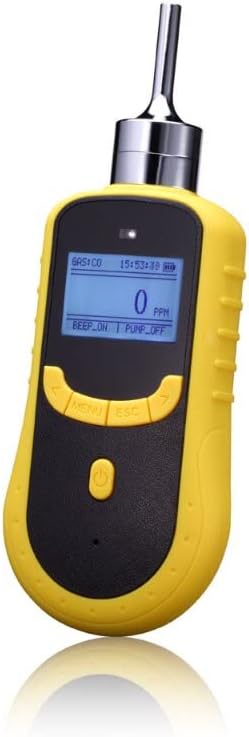
Portable monitors worn on the person or carried protect individual workers and are essential for confined space entry and mobile work.
Look for diffusion (not pumped) sampling for personal monitoring, a rugged IP-rated housing, a battery that outlasts a full shift, datalogging for exposure records, and man-down/motion alarms if workers operate alone.
Fixed monitors provide continuous area coverage and integrate with ventilation, alarms, and shutdown systems.
Placement is critical: NO₂ is heavier than air, so mount sensors lower in the space, near the emission source and in the breathing zone of the work area.
Consider whether you need local relays, 4–20 mA output, or a digital protocol to tie into your control system.
Alarm Configuration and Compliance Features
Confirm the monitor lets you set alarm thresholds that map to your applicable limits, typically a low alarm near the TWA and a high alarm near the STEL or ceiling.
Look for both audible and visual alarms rated loud and bright enough for your environment and, for portables, vibration alarms that work in high-noise areas.
For occupational exposure documentation, datalogging is non-negotiable. You want the instrument to record TWA and STEL calculations and export them so you can demonstrate compliance and investigate incidents.
If a monitor can’t produce an exposure record, it’s a spot-check tool, not a compliance instrument.
Calibration, Bump Testing, and Lifespan
Every gas detector needs regular bump testing (a quick exposure to confirm the sensor and alarms respond) and periodic calibration against a certified reference gas.
NO₂ calibration gas is less stable than many others and has a shorter shelf life, so factor that into your operating cost and logistics.
Electrochemical NO₂ sensors typically last two to three years, sometimes less in harsh or high-concentration environments.
When you compare instruments, look at sensor replacement cost and ease a monitor with field-replaceable smart sensors that auto-recognize on install will save you real downtime versus one that has to go back to the manufacturer.
Budget for the total cost of ownership: sensor replacements, calibration gas, docking/calibration stations, and the labor to maintain a fleet.
A cheaper monitor with expensive consumables and short sensor life often costs more over five years than a pricier, better-supported instrument.
A Practical Selection Checklist
When you’ve narrowed your options, run each candidate through these questions:
- Does the resolution (0.1 ppm or better) let me measure against my applicable exposure limit?
- Does the cross-sensitivity table look clean for the specific gases in my environment, especially NO if diesel exhaust is involved?
- Is the T90 fast enough for how quickly my hazard can change?
- Does it log TWA/STEL and export exposure records?
- Are the sensors field-replaceable, and what’s the two-to-three-year replacement cost?
- Does the alarm setup match my low/high thresholds, and are the alarms perceptible in my environment?
- For fixed units, does the output (relay, 4–20 mA, or digital) integrate with my control and ventilation system?
- What’s the total five-year cost, including gas, calibration, and consumables?
Frequently Asked Questions
What is a good NO₂ alarm level to set?
Set alarms to the exposure limits that apply where you operate. A common approach is a low alarm around the 8-hour TWA (for example, 0.2 ppm against the ACGIH TLV) and a high alarm near the STEL or ceiling (1 ppm STEL or 5 ppm ceiling depending on your standard). Always verify against your local regulations, which may differ.
Can one multi-gas monitor cover NO₂ for confined space entry?
Yes, many portable multi-gas instruments offer an NO₂ channel alongside oxygen, combustibles, CO, and H₂S.
For confined space work, this is usually the right tool. Just confirm the NO₂ channel has adequate resolution and check its cross-sensitivity to the other gases present.
How long do NO₂ sensors last?
Electrochemical NO₂ sensors typically last two to three years, though harsh conditions, high concentrations, and long storage shorten that. Track sensor age and replace proactively rather than waiting for failure.
Why does my NO₂ monitor read differently near diesel engines?
Diesel exhaust contains both NO and NO₂, and NO can cause negative interference on many NO₂ sensors, suppressing the reading.
This is why cross-sensitivity to NO is one of the most important specs to check for any diesel-exposure application.
Do I need to calibrate a new NO₂ monitor out of the box?
You should bump test before first use and calibrate according to the manufacturer’s schedule. NO₂ calibration gas is less stable than many other gases, so use fresh, certified gas and store it properly.
The Bottom Line
Selecting an NO₂ monitor comes down to matching the instrument to your specific application, insisting on resolution fine enough for low exposure limits, scrutinizing cross-sensitivity for the gases actually present in your environment, and budgeting honestly for calibration and sensor life.
Get those four right, and the rest of the decision falls into place. The most expensive mistake in NO₂ monitoring isn’t buying the wrong brand. It’s buying a monitor that reads reassuringly low while people are being exposed.
This guide reflects general industry practice and field experience. Always follow the exposure limits and monitoring requirements set by the regulatory authority in your jurisdiction, and consult the instrument manufacturer’s documentation for device-specific guidance.