Chlorine dioxide (ClO₂) is one of the most useful oxidizers in modern industry and one of the most deceptively dangerous.
It disinfects drinking water, bleaches paper pulp, sanitizes food-processing lines, and controls bacteria in cooling towers.
But it’s toxic at concentrations far below what most people would notice, and it can decompose explosively under the wrong conditions.
That combination is exactly why a reliable chlorine dioxide monitor isn’t optional in facilities that generate or use the gas. It’s a frontline safety control.
This guide walks through what ClO₂ is, why it needs continuous monitoring, the exposure limits you have to design around, how the sensors actually work, and how to choose and maintain the right detector for your application.
What Is Chlorine Dioxide (ClO₂)?
Chlorine dioxide is a reddish-to-yellowish-green gas at room temperature with a sharp, irritating odor similar to chlorine.
It’s a synthetic compound. It doesn’t occur naturally, and it’s valued industrially because it’s a powerful selective oxidizer and biocide.
Common industrial uses include:
- Municipal water treatment: disinfecting drinking water and wastewater and removing tastes and odors.
- Pulp and paper: bleaching wood pulp that becomes paper and cardboard.
- Cooling towers: controlling bacterial and biofilm growth.
- Food and beverage: surface sanitizing and produce washing.
- Healthcare, agriculture, and oil & gas: general disinfection and sanitizing.
Because ClO₂ is unstable to compress and ship, it’s almost always generated on site, which means the leak and exposure risk lives right where people are working.
Why Chlorine Dioxide Needs Continuous Monitoring
Three properties make ClO₂ a serious hazard.
It’s toxic at low concentrations
ClO₂ strongly irritates the upper respiratory tract. When it contacts moisture, it can form acids, and repeated low-level exposure has been associated with chronic bronchitis.
Effects escalate quickly with concentration, from mild respiratory irritation to marked airway irritation to life-threatening exposure.
You can’t rely on your nose
The odor threshold does not reliably warn you before you reach unsafe levels. Smell is not a safety control, and treating it as one is how workers get overexposed.
It’s a fire and explosion hazard
ClO₂ is a strong oxidizer that reacts with organic materials, carbon monoxide, hydrocarbons, and various reducing agents.
At elevated concentrations and at temperatures below the boiling point of water, it can decompose explosively. It’s flagged under GHS as an oxidizer, corrosive to skin and eyes, and fatal if inhaled.
A fixed or portable ClO₂ detector gives you real-time concentration readings and early warning, so you can trigger ventilation, shutdown, or evacuation before levels climb into the dangerous range.
Chlorine Dioxide Exposure Limits You Must Design Around
These are the regulatory and consensus limits that drive alarm setpoints and monitoring strategy in the United States:
| Limit | Value | Basis |
|---|---|---|
| OSHA PEL | 0.1 ppm | 8-hour time-weighted average (TWA) |
| NIOSH REL TWA | 0.1 ppm | 10-hour TWA |
| NIOSH REL STEL | 0.3 ppm | 15-minute short-term exposure limit |
| ACGIH TLV TWA | 0.1 ppm | 8-hour TWA |
| ACGIH TLV STEL | 0.3 ppm | 15-minute STEL |
| NIOSH IDLH | 5 ppm | Immediately Dangerous to Life or Health |
The practical takeaways
The 0.1 ppm 8-hour TWA is your baseline compliance target. 0.3 ppm is the short-term ceiling you don’t want to cross even briefly, and 5 ppm is IDLH, the point at which exposure is immediately life-threatening.
ClO₂ is on the Hazardous Substance List and is regulated or cited by OSHA, NIOSH, ACGIH, EPA, DOT, and others.
Because those thresholds are so low, ClO₂ monitors are typically specified with 0.01 ppm resolution and configured with a low alarm around 0.1 ppm and a high alarm around 0.3 ppm.
How Chlorine Dioxide Monitors Work
Nearly all ClO₂ gas detectors use an electrochemical sensor. Gas diffuses through a membrane into an electrolyte cell where it reacts at an electrode, producing a small current proportional to the gas concentration. That current is converted into a ppm reading and compared against your alarm setpoints.
Key sensor characteristics to look for.
Measurement range
Commonly 0–1 ppm or 0–2 ppm, with 0.01–0.1 ppm resolution, enough granularity to act well below the PEL.
Selectivity
ClO₂ sensors can cross-respond to chlorine and other oxidizers, so cross-sensitivity data matters when other gases share the space.
Response time
Fast enough to catch a rising leak before it reaches the STEL.
Environmental rating
For classified areas, look for detectors rated for Class I, Division 1, or Division 2 environments.
Fixed vs. Portable ClO₂ Monitors
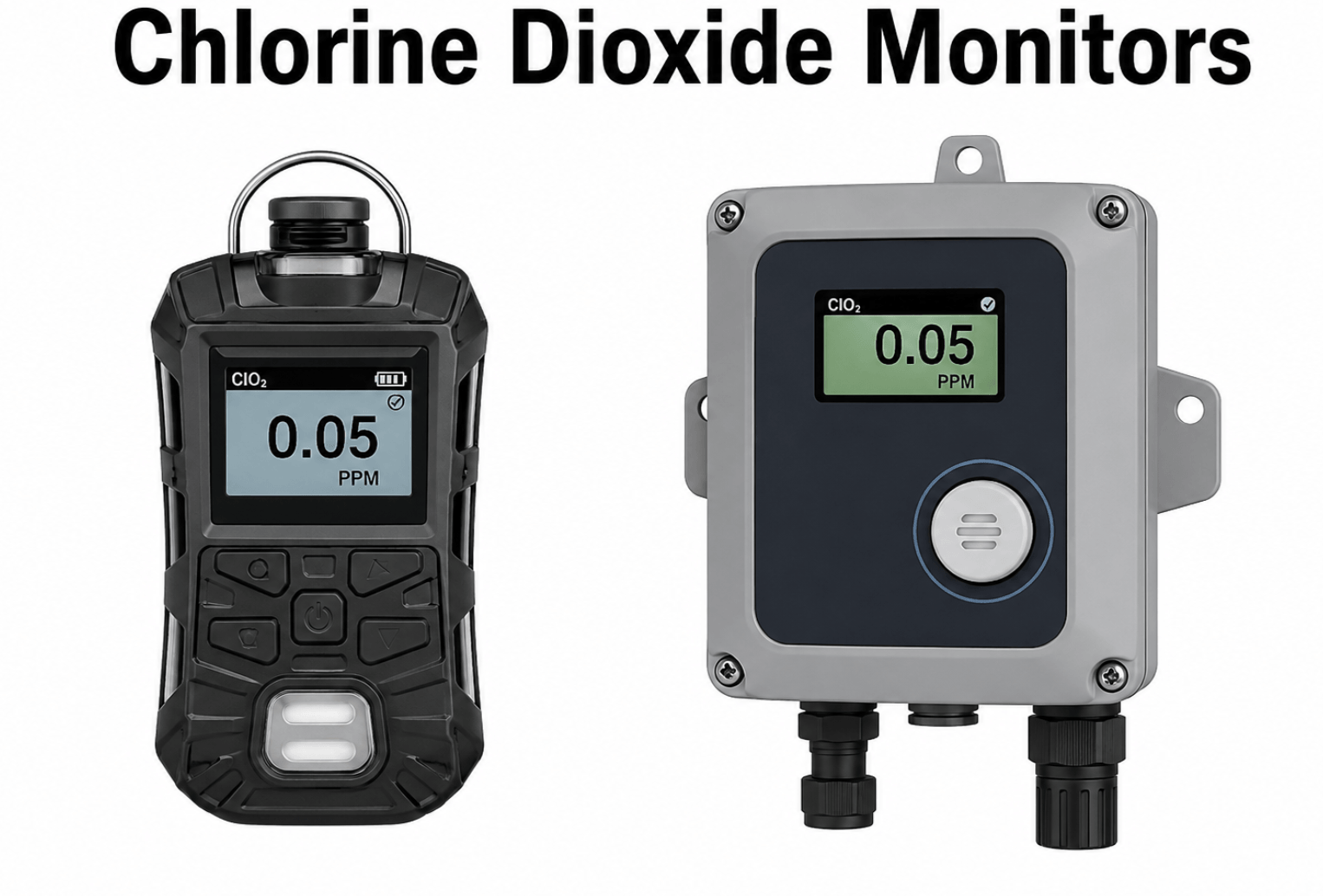
Fixed (continuous) detectors are mounted permanently near generators, storage, piping, and process areas.
They feed a controller with audible and visual alarms and can be integrated into ventilation, shutdown, or building automation systems. Use these for 24/7 area protection and fenceline monitoring.
Portable and personal detectors travel with the worker. Diffusion instruments protect a person in their breathing zone, while pumped instruments let you sample a confined space, a vessel, or a tank before entry so you’re not walking blind into an accumulated pocket of gas.
Many facilities run both. Fixed monitors for the installation, portables for maintenance, confined-space entry, and spot checks.
How to Choose the Right Chlorine Dioxide Detector
Work through these questions before you buy:
- Fixed, portable, or both? Map your permanent hazard zones versus your mobile tasks and confined-space entries.
- What’s the area classification? Hazardous (classified) locations require appropriately rated instruments.
- Single-gas or multi-gas? If workers also face other hazards (oxygen deficiency, combustibles, other toxics), a multi-gas platform with a ClO₂ channel may be smarter than a standalone unit.
- Diffusion or pump? Confined-space pre-entry testing needs a pump.
- Alarm and integration needs? Confirm the low/high alarm points, STEL and TWA tracking, and any control-system or datalogging integration you require.
- Calibration and lifecycle support? Electrochemical sensors drift and age. Factor in bump testing, calibration intervals, and sensor replacement from day one.
Calibration, Bump Testing, and Maintenance
A ClO₂ monitor is only as trustworthy as its last calibration. Build a maintenance routine around three habits.
Bump test frequently
Expose the sensor to a known gas concentration to confirm it responds and the alarms fire. Do this before each day’s use for portables, per your safety program.
Calibrate on a defined schedule
Follow the manufacturer’s interval after any event that could have stressed the sensor. Some vendors offer exchange or managed-calibration programs that swap instruments, so you’re never down.
Track sensor life
Electrochemical cells have a finite lifespan and lose sensitivity over time. Log readings and replace sensors before they fall out of spec.
Document everything. Calibration records and bump-test logs are part of demonstrating an effective, compliant gas-detection program.
Best Practices for a ClO₂ Safety Program
A monitor is one layer. Pair it with.
- Engineering controls, adequate ventilation, and containment around generators and process points.
- Proper PPE, chemical-resistant gloves, goggles or face shields, and protective clothing when handling ClO₂
- Alarm response procedures, clearly defined evacuation and shutdown steps tied to your low, high, and STEL alarms.
- Confined-space protocols. Always pre-test with a pumped instrument before entry.
- Training. Everyone in the area should understand what the alarms mean and exactly what to do when one sounds.
Frequently Asked Questions
What is the OSHA exposure limit for chlorine dioxide?
The OSHA permissible exposure limit (PEL) is 0.1 ppm as an 8-hour time-weighted average. The short-term exposure limit is 0.3 ppm over 15 minutes, and 5 ppm is considered Immediately Dangerous to Life or Health (IDLH).
Can I smell chlorine dioxide before it becomes dangerous?
No. The odor threshold isn’t a reliable warning of unsafe concentrations, which is why continuous instrument monitoring is essential.
What type of sensor do chlorine dioxide monitors use?
Almost all use electrochemical sensors, typically with a 0–1 or 0–2 ppm range and resolution fine enough to detect well below the 0.1 ppm PEL.
How often should a ClO₂ detector be calibrated?
Follow the manufacturer’s recommended interval and bump test regularly between calibrations. Electrochemical sensors drift over time and have a limited lifespan, so ongoing verification is non-negotiable.
The Bottom Line
Chlorine dioxide is enormously useful and genuinely dangerous. Its toxic threshold sits well below its odor threshold, and at higher concentrations it becomes an explosion risk, so you can’t manage it by feel.
A properly specified, calibrated chlorine dioxide monitor, backed by ventilation, PPE, clear alarm procedures, and disciplined maintenance, is what keeps a ClO₂ operation both productive and safe.
Match the instrument to your hazard zones and tasks, set your alarms against the 0.1 ppm and 0.3 ppm limits, and keep it calibrated, and you’ve got a monitoring program you can actually trust.