If you’ve ever pulled a portable multi-gas detector off the charging dock only to find it dead by the end of a 12-hour shift, there’s a good chance the culprit isn’t your battery.
It’s your LEL sensor. NDIR technology (non-dispersive infrared) has quietly become one of the most effective ways to extend portable detector battery life, in some cases stretching runtime from a single shift to several weeks between charges.
I work with gas detection systems every day as an industrial safety engineer, and the shift from catalytic bead to infrared LEL sensing is one of the most practical upgrades I recommend to plant safety managers.
In this article, I’ll explain exactly why NDIR sensors sip power while catalytic bead sensors gulp it, what real-world runtime numbers look like, and when the switch makes sense for your fleet.
The Battery Problem in Portable Gas Detection
Most portable multi-gas detectors monitor four channels: oxygen, carbon monoxide, hydrogen sulfide, and combustible gases (LEL). The first three use electrochemical cells, which are remarkably efficient.
They generate a small current from the chemical reaction with the target gas and draw almost nothing from the battery.
The combustible gas channel is different. For decades, the default sensing element has been the catalytic bead (pellistor), and it is by far the hungriest component in the instrument.
In a typical four-gas portable, the catalytic LEL sensor can account for well over half of total power consumption.
That’s why a detector rated for 12–14 hours of runtime with a catalytic bead can suddenly run for weeks when the LEL channel is swapped for an infrared sensor.
Understanding why requires a quick look at how each technology actually detects gas.
How Catalytic Bead Sensors Burn Through Power
A catalytic bead sensor works by literally burning the target gas. Inside the sensor are two small ceramic beads wound with platinum wire:
- The active bead is coated with a catalyst that oxidizes (combusts) flammable gas on its surface.
- The reference bead is inert and compensates for ambient temperature and humidity.
For combustion to occur on the active bead, it must be heated continuously to roughly 400–500°C.
That heating current never stops while the instrument is on, whether gas is present or not. Depending on the design, a pellistor pair draws somewhere in the range of 100–300 milliwatts, constantly, for the entire shift.
Think of it like leaving a tiny stove burner on inside your detector for 12 hours straight. It works, and it’s a proven technology, but it’s thermodynamically expensive.
Catalytic beads carry two other operational costs worth mentioning, because they compound the battery issue:
- They require oxygen to combust the gas, so they can under-read in inert or oxygen-deficient atmospheres, a real concern in confined space entry work.
- They can be poisoned by silicones, sulfur compounds, and lead, which degrades sensitivity silently until a bump test catches it.
How NDIR Technology Works And Why It’s So Efficient
NDIR technology takes a completely different approach: instead of burning the gas, it shines light through it.
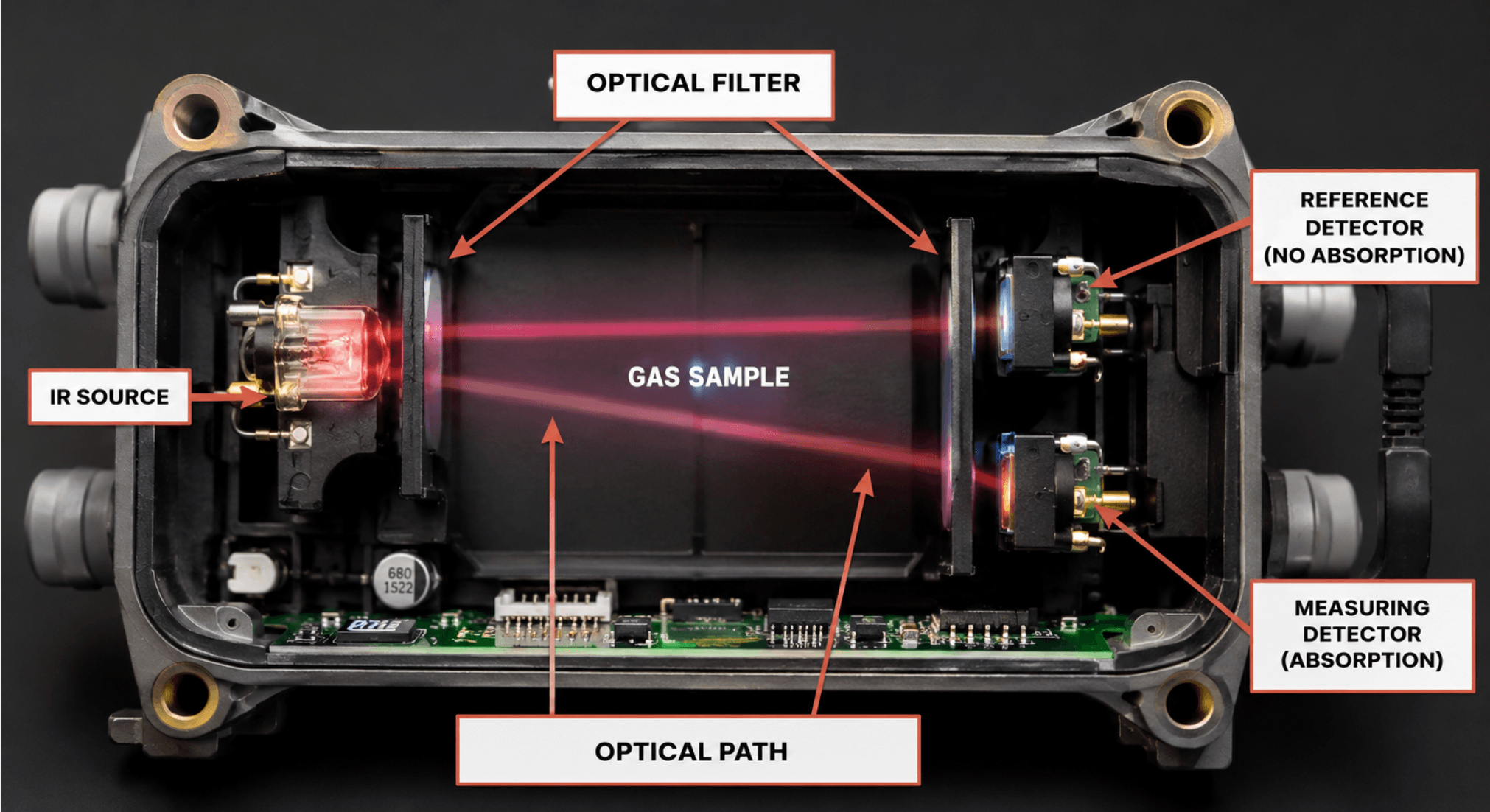
Hydrocarbon molecules absorb infrared light at specific wavelengths. Most combustible gases absorb strongly around 3.3 µm, where the carbon-hydrogen bond resonates. An NDIR sensor contains:
- An infrared source (a micro-lamp, MEMS emitter, or IR LED)
- An optical path or chamber where ambient gas diffuses in
- Two detectors: one at the active wavelength (3.3 µm for hydrocarbons) and one at a reference wavelength (typically ~3.9 µm) where nothing absorbs
When combustible gas enters the chamber, it absorbs some of the IR energy at the active wavelength.
The instrument compares the active and reference signals and calculates gas concentration from the difference, a principle known as the Beer–Lambert law.
Here’s the key to the power savings: the IR source doesn’t need to run continuously. It can be pulsed, flashed on for milliseconds, then switched off several times per second.
Between pulses, the sensor draws almost nothing. Modern designs using IR LEDs or MEMS emitters push efficiency even further, with average power draw an order of magnitude (or more) below a heated pellistor.
There’s no bead to keep at combustion temperature. No continuous heating current. Just brief, scheduled flashes of light.
Catalytic Bead vs NDIR: Power and Performance Compared
| Characteristic | Catalytic Bead (Pellistor) | NDIR Infrared |
|---|---|---|
| Detection principle | Combustion on heated catalyst | IR absorption at ~3.3 µm |
| Operating temperature | Bead heated to ~400–500°C continuously | Ambient, pulsed IR source |
| Typical power draw | High, continuous heating current | Low, pulsed source, minimal average draw |
| Impact on portable runtime | Often limits detector to ~1 shift per charge | Enables weeks between charges |
| Oxygen requirement | Yes (needs O₂ to combust gas) | No, works in inert atmospheres |
| Poisoning risk (silicones, H₂S, lead) | Yes | No |
| Fail-safe behavior | Can fail undetected (poisoned bead reads zero) | Optical failure is self-evident (fault flagged) |
| Detects hydrogen | Yes | No (H₂ has no C–H bond to absorb IR) |
| Typical sensor life | 2–5 years, less if poisoned | 5+ years |
| Sensor cost | Lower upfront | Higher upfront |
Real-World Battery Life: What to Expect
Numbers vary by manufacturer and configuration, but the pattern is consistent across the industry:
- A four-gas portable with a catalytic LEL sensor typically delivers 12–18 hours of continuous runtime, enough for one long shift, then back on the dock.
- The same instrument platform with an IR LEL sensor commonly delivers one to two months of runtime on a charge, because the dominant power load is gone.
That’s not a marginal improvement; it changes how a fleet operates. Charging docks become less of a bottleneck, workers stop fighting over the “good” units, and a detector left in a truck over a long weekend still turns on Monday morning.
The efficiency gain also enables entirely new form factors. Serviceable multi-year detectors with IR LEL channels, devices that run for years with minimal intervention, are only practical because NDIR removed the pellistor’s constant heating load from the power budget.
When NDIR Is the Right Choice (And When It Isn’t)
Based on my field experience, NDIR LEL sensors are the stronger choice when
- Battery runtime is a pain point: long shifts, remote sites, limited charging infrastructure
- You work in inert or low-oxygen atmospheres: nitrogen-purged vessels, confined spaces where catalytic beads under-read
- Sensor poisoning is a known problem: facilities with silicone lubricants, sulfur compounds, or leaded environments
- Total cost of ownership matters more than purchase price: longer sensor life and fewer failed bump tests offset the higher upfront cost
Catalytic bead sensors still earn their place when:
Hydrogen detection is required
This is the big one. Hydrogen has no carbon-hydrogen bond, so it’s invisible to standard 3.3 µm NDIR sensors.
If H₂ is in your hazard assessment, you need a catalytic bead, an electrochemical H₂ sensor, or another technology on that channel.
Budget
Budget constraints dominate, and the application is a well-ventilated, poison-free environment with reliable daily charging.
Broad
Broad, non-selective flammable response is desired; pellistors respond to nearly any combustible gas, while IR response varies by hydrocarbon.
Practical Tips for Switching Your Fleet to IR LEL
Audit your hazard assessment first
Confirm hydrogen and other non-hydrocarbon flammables (like carbon disulfide) aren’t in scope before dropping the catalytic bead.
Check calibration gas compatibility
IR sensors are typically calibrated on methane or propane, and cross-sensitivity factors differ from pellistors. Update your calibration procedures accordingly.
Don’t skip bump testing
Lower poisoning risk doesn’t mean zero maintenance — daily bump tests remain best practice regardless of sensor technology.
Recalculate your charging logistics
Fleets often over-provision docks for single-shift runtime. Moving to IR LEL may let you consolidate charging stations and spare units.
Pilot before you commit
Run a handful of IR-equipped units alongside your catalytic fleet for a quarter and compare downtime, failed bump tests, and battery complaints.
Frequently Asked Questions
Does NDIR technology really extend portable gas detector battery life?
Yes. The catalytic bead LEL sensor is typically the largest power consumer in a portable multi-gas detector because its bead must be heated continuously to around 400–500°C.
NDIR sensors replace that constant heating load with a pulsed infrared source, reducing average power draw dramatically, often extending runtime from a single shift to several weeks.
Can NDIR sensors detect hydrogen?
No. Standard NDIR sensors detect gases by their infrared absorption at the carbon-hydrogen bond wavelength (~3.3 µm).
Hydrogen contains no carbon and doesn’t absorb at this wavelength, so it’s invisible to hydrocarbon NDIR sensors. Sites with hydrogen hazards should retain catalytic beads or dedicated H₂ sensing on that channel.
Do NDIR sensors work in oxygen-deficient atmospheres?
Yes, and this is a major safety advantage. Catalytic bead sensors need oxygen to combust the target gas and can dangerously under-read in inert or oxygen-depleted environments.
NDIR sensors measure light absorption, which works identically with or without oxygen present, making them well suited to confined space and inerted-vessel work.
Are NDIR sensors immune to poisoning?
Effectively, yes. The silicones, sulfur compounds, and lead that permanently degrade catalytic beads have no effect on optical IR measurement.
NDIR sensors also tend to be fail-safe: if the optical path is blocked or the source fails, the instrument flags a fault rather than silently reading zero.
Why do NDIR sensors cost more than catalytic beads?
The optical components: IR source, filters, and dual detector cost more to manufacture than a pellistor pair.
However, longer sensor life (often 5+ years), immunity to poisoning, and reduced charging infrastructure usually deliver a lower total cost of ownership over the life of the instrument.
The Bottom Line
Portable detector battery life isn’t really a battery problem; it’s a sensor power problem. Catalytic bead LEL sensors spend the entire shift running a miniature heater at combustion temperature, while NDIR technology measures the same hazard with brief pulses of infrared light.
The result is runtime measured in weeks instead of hours, plus meaningful safety gains in inert atmospheres and poison-prone environments.
If hydrogen isn’t part of your hazard profile, moving your fleet’s LEL channel to infrared is one of the highest-impact, lowest-risk upgrades available in portable gas detection today.
1 thought on “Why NDIR Technology Can Extend Portable Detector Battery Life”