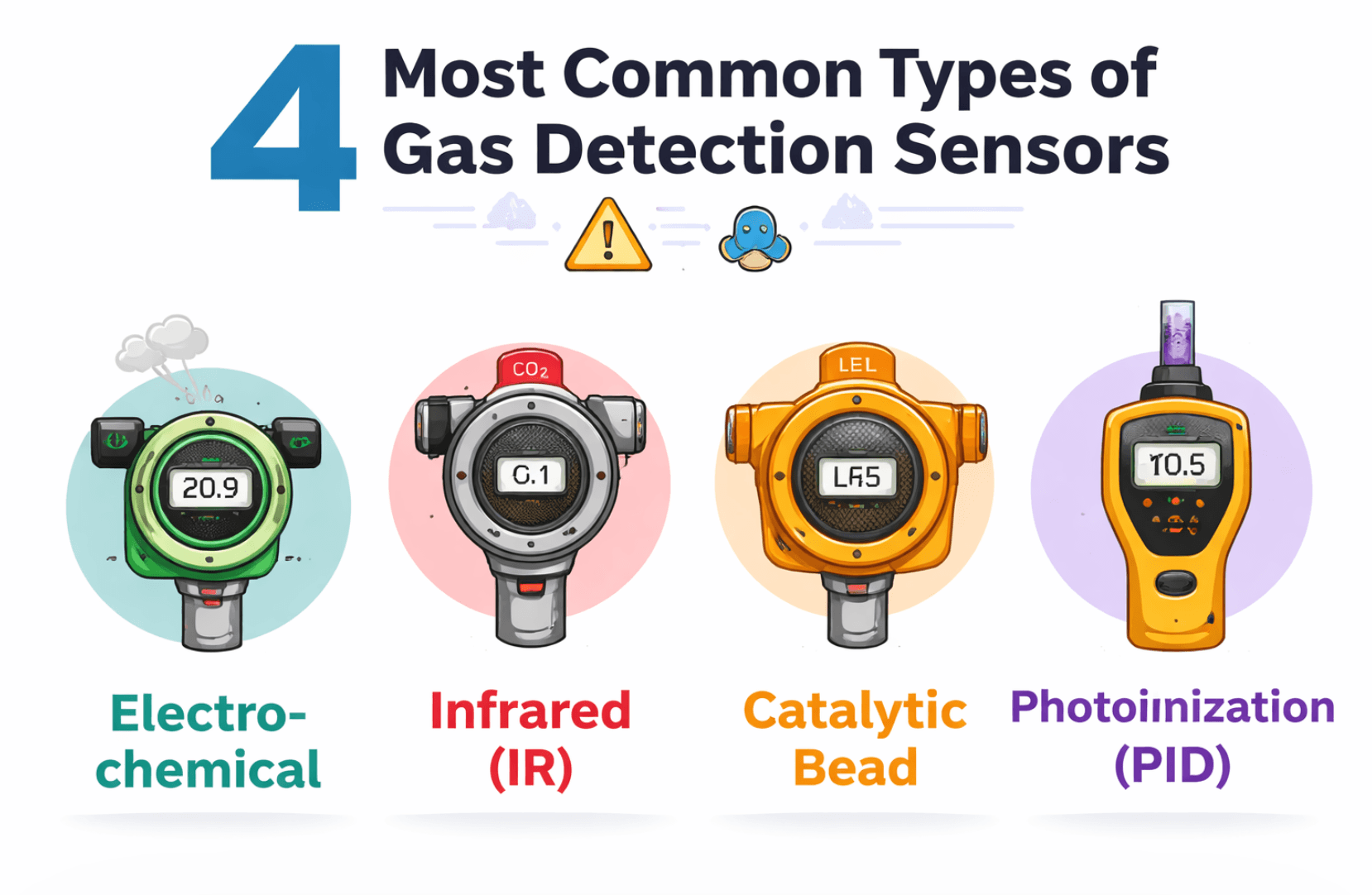
Gas leaks kill silently. Whether you’re protecting workers on an oil rig, monitoring air quality in a confined space, or ensuring safety in a laboratory, choosing the right gas detection sensor is one of the most critical decisions you’ll make. But with so many technologies on the market, it can be hard to know where to start.
In this guide, we break down the 4 most common types of gas detection sensors, how each one works, what gases they detect best, and the real-world situations where they excel or fall short.
Why Understanding Gas Sensor Types Matters
Not all gas detectors are created equal. A sensor that works flawlessly in a wastewater treatment plant may be completely unsuitable for a chemical manufacturing facility. Selecting the wrong sensor technology can result in:
- False negatives, a dangerous gas goes undetected.
- False positives, unnecessary evacuations, and costly downtime.
- Sensor degradation and premature failure due to environmental incompatibility.
- Regulatory non-compliance failing OSHA, ATEX, or other safety standards.
Understanding the underlying technology behind each sensor type empowers you to make smarter, safer choices.
Electrochemical Sensors
How They Work
Electrochemical sensors detect gases through chemical reactions. When a target gas comes into contact with the sensor’s electrolyte solution, it triggers an oxidation or reduction reaction at the electrodes.
This generates an electrical current proportional to the gas concentration. The higher the concentration, the stronger the current.
What gases do they detect?
Electrochemical sensors are best suited for toxic gases, including.
- Carbon monoxide (CO).
- Hydrogen sulfide (H₂S).
- Nitrogen dioxide (NO₂).
- Chlorine (Cl₂).
- Ammonia (NH₃).
- Oxygen (O₂) depletion monitoring.
Advantages
- High sensitivity and accuracy can detect gases in parts-per-million (ppm) or even parts-per-billion (ppb) concentrations.
- Low power consumption ideal for portable and battery-operated detectors.
- Relatively low cost, one of the most affordable sensor technologies available.
- Fast response time, typically responds within 30–60 seconds.
Limitations
- The finite lifespan of the electrolyte solution degrades over time, typically lasting 1–3 years.
- Cross-sensitivity: Some sensors may react to gases other than the target gas.
- Temperature and humidity sensitivity in extreme environments can affect accuracy.
- Not suitable for combustible gas detection at high concentrations.
Best Applications
Electrochemical sensors are the workhorses of personal gas monitors used in confined space entry, utilities, oil and gas, and emergency response.
If your primary concern is toxic gas exposure to workers, an electrochemical sensor is almost always your first choice.
Catalytic Bead Sensors (Pellistors)
How They Work
Catalytic bead sensors, also called pellistors, operate on the principle of catalytic combustion. The sensor contains two matched beads: one active bead coated with a catalyst (usually platinum or palladium), and one reference bead that is inert.
When combustible gas reaches the active bead, it oxidizes on the catalytic surface, generating heat.
This heat changes the electrical resistance of the bead, and the resulting imbalance between the two beads produces a measurable signal.
What gases do they detect?
Catalytic bead sensors are designed for flammable and combustible gases, including.
- Methane (CH₄), natural gas.
- Propane (C₃H₈).
- Hydrogen (H₂).
- Butane (C₄H₁₀).
- Ethanol.
- Most hydrocarbon vapors.
Results are typically expressed as a percentage of the Lower Explosive Limit (LEL), the minimum concentration at which a gas can ignite.
Advantages
- Broad-spectrum detection responds to virtually all combustible gases and vapors.
- Proven, reliable technology with decades of industry use.
- Robust and durable handles harsh industrial environments well.
- Cost-effective for LEL monitoring applications.
Limitations
- Requires oxygen to function and will not work in oxygen-deficient environments.
- Catalyst poisoning, exposure to silicones, lead compounds, or halogenated gases can permanently damage the sensor.
- Not suitable for very low concentrations, less sensitive than electrochemical or PID sensors.
- Consumes more power than some alternatives.
Best Applications
Catalytic bead sensors are the standard choice for detecting flammable gas leaks in industrial facilities, refineries, gas pipelines, and storage areas.
They are commonly found in fixed gas detection systems installed near potential leak sources.
Safety Tip
Never use a catalytic bead sensor as your sole line of defense in environments where catalyst-poisoning substances may be present.
Always verify sensor function with a known gas concentration bump test before each use.
Infrared (IR) Sensors
How They Work
Infrared sensors exploit the fact that many gases absorb infrared light at specific wavelengths. The sensor shines an IR light beam through a sample chamber.
A detector on the other side measures how much light reaches it. If a target gas is present, it absorbs some of the IR energy at its characteristic wavelength, reducing the light that reaches the detector. The degree of absorption corresponds to the gas concentration.
There are two main configurations.
- Non-Dispersive Infrared (NDIR): uses optical filters to target a specific wavelength; most common in commercial gas detectors.
- Point IR sensors: compact units for fixed installation.
- Open-path IR sensors: project a beam across a large area (up to 200 meters) to detect gas clouds
What gases do they detect?
Infrared sensors work well for gases that absorb IR radiation, such as:
- Carbon dioxide (CO₂).
- Methane (CH₄).
- Propane.
- Hydrocarbons (most).
- Refrigerant gases.
- Volatile organic compounds (VOCs).
Important
IR sensors cannot detect gases that do not absorb infrared light, including hydrogen (H₂), oxygen (O₂), chlorine (Cl₂), and noble gases.
Advantages
- No oxygen dependency, functions in inert or oxygen-depleted atmospheres.
- Immune to catalyst poisoning, highly resistant to contamination.
- Long operational life, no consumable electrolyte; many sensors last 5–10+ years.
- Excellent selectivity, less prone to cross-sensitivity than other sensor types.
- Suitable for high-concentration measurements.
Limitations
- Higher upfront cost, more expensive than electrochemical or catalytic bead sensors.
- Cannot detect all gases, limited to IR-absorbing molecules.
- Optical surfaces require maintenance; dust, condensation, or fogging on lenses can cause false readings.
- Larger form factor, not always suitable for compact, portable devices (though miniaturization is improving).
Best Applications
Infrared sensors shine (literally) in environments where long-term reliability is paramount and where catalyst poisoning is a risk.
They are widely used in HVAC systems for CO₂ monitoring, refrigeration leak detection, greenhouse gas monitoring, and oil and gas facilities.
Open-path IR detectors are especially valuable for perimeter monitoring of large outdoor sites.
Photoionization Detectors (PID Sensors)
How They Work
Photoionization detectors use ultraviolet (UV) light to ionize gas molecules. When high-energy UV photons strike a VOC molecule, they knock electrons loose, creating positively charged ions and free electrons.
This ionization produces a measurable electrical current. The stronger the current, the higher the gas concentration.
The key parameter is the ionization potential (IP) of the target gas measured in electron volts (eV). A PID sensor’s UV lamp must have a higher energy level than the IP of the gas to ionize it. Common lamp energies are 10.6 eV, 9.8 eV, and 11.7 eV.
What gases do they detect?
PID sensors are exceptionally sensitive to volatile organic compounds (VOCs) and many other substances, including.
- Benzene, toluene, xylene (BTX compounds).
- Isobutylene.
- Acetone and ketones.
- Ethylene oxide.
- Many industrial solvents and fuels.
They do not reliably detect methane, CO₂, CO, or most inorganic gases.
Advantages
- Extremely high sensitivity, can detect VOCs at parts-per-billion (ppb) levels.
- Fast response, one of the fastest sensor technologies available.
- Broad VOC detection responds to hundreds of different compounds.
- Non-destructive measurement, the gas is not consumed during detection.
- No oxygen dependency.
Limitations
- High humidity interference with water vapor can quench the ionization process, reducing sensitivity.
- UV lamp degradation lamps require periodic replacement (typically annually).
- Cannot differentiate between gases, a PID reads a combined response; it cannot identify which VOC is present without additional analysis.
- Higher cost than electrochemical or catalytic bead sensors.
- Not suitable for LEL monitoring of flammable gases.
Best Applications
PID sensors are the go-to technology for industrial hygiene surveys, hazmat response, soil and groundwater remediation, semiconductor manufacturing, and any application where detecting trace levels of VOCs is critical.
First responders frequently use handheld PID-based instruments to identify contamination at spill sites.
Quick Comparison: Which Gas Detection Sensor Is Right for You?
| ppm/ppb | Electrochemical | Catalytic Bead | Infrared (IR) | PID |
|---|---|---|---|---|
| Primary Target | Toxic gases | Combustible gases | CO₂, hydrocarbons | VOCs |
| Detection Range | ppm / ppb | % LEL | ppm – % | ppb – ppm |
| Oxygen Required? | Sometimes | Yes | No | No |
| Lifespan | 1–3 years | 2–5 years | 5–10+ years | 2–5 years |
| Catalyst Poisoning Risk | Low | High | None | Low |
| Relative Cost | Low | Low–Medium | Medium–High | Medium–High |
| Best Environment | Portable monitors | Industrial facilities | Long-term fixed installs | Hazmat / industrial hygiene |
Can You Combine Sensor Types?
Absolutely, and in many cases, you should. Multi-gas detectors often combine two, three, or even four different sensor technologies in a single unit. A typical 4-gas monitor used in confined space entry, for example, might include:
- An electrochemical sensor for O₂ and H₂S.
- A catalytic bead sensor for combustible gases (LEL).
- An electrochemical sensor for CO.
Adding a PID sensor to this combination gives you a powerful five-gas instrument capable of detecting both acute toxic hazards and low-level VOC exposures simultaneously.
The key is to match your sensor selection to your specific hazard assessment, not simply to buy the most sensors or the most expensive unit.
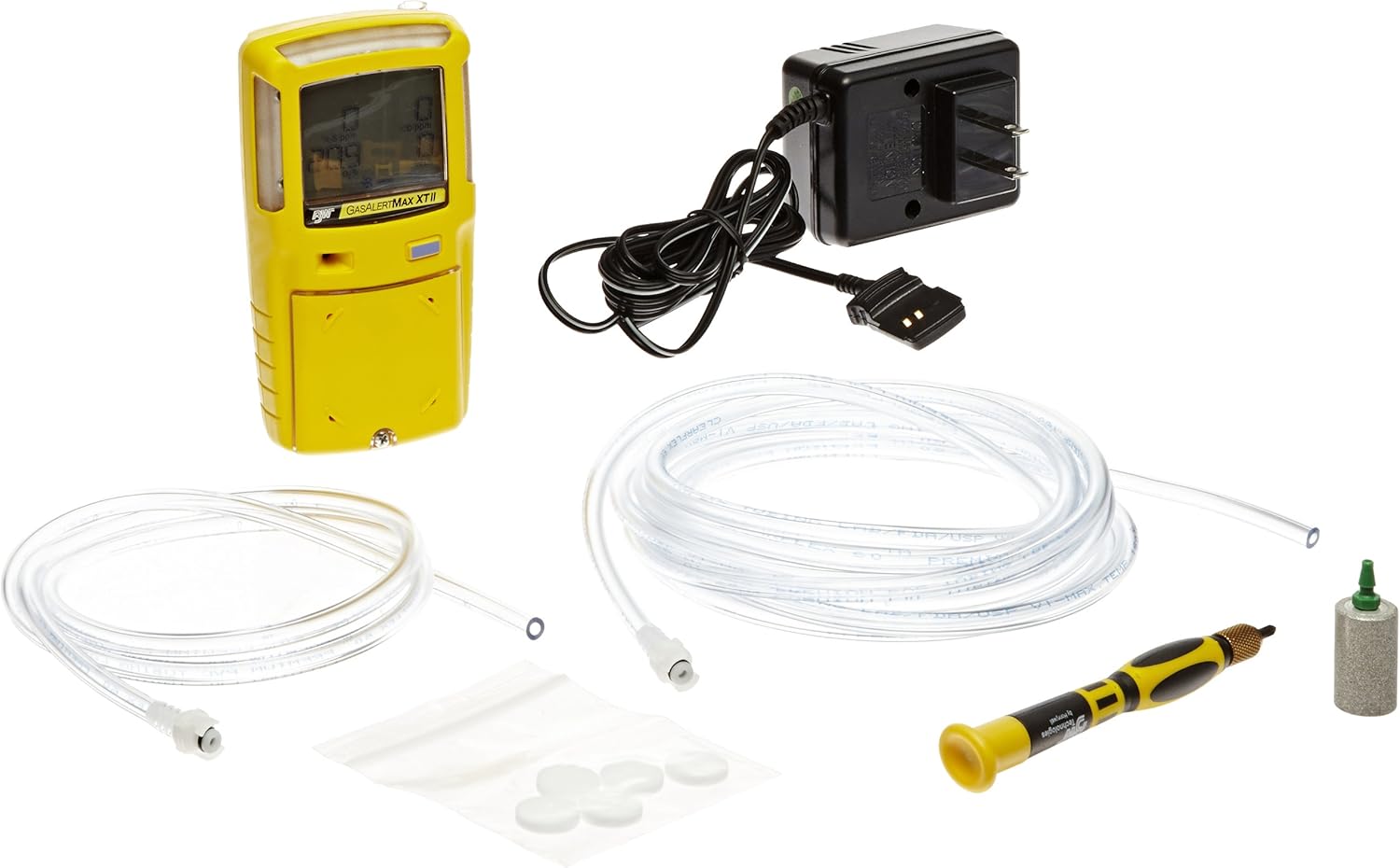
Maintenance: The Factor Most People Overlook
No matter which sensor technology you choose, sensors require regular maintenance to remain reliable:
Bump testing
Expose the sensor to a known gas concentration before each use to confirm it responds correctly.
Calibration
Adjust the sensor’s output against a certified reference gas on a scheduled basis (typically monthly or as required by the manufacturer).
Visual inspection
Check for physical damage, clogged filters, or contaminated optical surfaces.
Timely replacement
Never push a sensor beyond its rated service life.
A gas detector that isn’t properly maintained is potentially worse than no detector at all; it creates a false sense of security.
Final Thoughts
Understanding the four most common types of gas detection sensors, electrochemical, catalytic bead, infrared, and photoionization, is the foundation of any serious gas safety program. Each technology has distinct strengths, limitations, and ideal use cases.
The right sensor isn’t always the most expensive one. It’s the one that’s correctly matched to your specific gases of concern, environmental conditions, required sensitivity, and operational demands.
2 thoughts on “4 Most Common Types of Gas Detection Sensors”